
14 Point Review Of Systems Template: The Complete 2026 Guide To Automating ROS Documentation & Reducing Charting Time By 70%

Introduction: Why a Comprehensive Review of Systems Template Is Critical in 2026
The 14 point review of systems template has become an indispensable tool for modern healthcare practices seeking to streamline clinical documentation while maintaining thorough patient assessments. As healthcare providers face mounting administrative burdens and staffing shortages, standardized ROS documentation frameworks offer a pathway to efficiency without sacrificing quality of care.
According to research from the CDC National Health Statistics Report, physicians spend an average of 16.6 minutes per patient on documentation tasks. For practice managers dealing with provider burnout and lean staffing models, this represents a significant operational bottleneck. Automation via structured ROS templates has been shown to correlate with 25% labor savings, directly addressing the staffing crisis many practices face today.
This comprehensive guide explores how a properly implemented 14 point review of systems template can transform your practice's documentation workflows, reduce claim denials through complete charting, and free providers to focus on patient care rather than paperwork. We'll examine template structure, automation strategies, integration with AI scribe technology, and real-world implementation frameworks for overwhelmed practice managers.
What Is a 14 Point Review of Systems Template?
A 14 point review of systems template is a comprehensive clinical documentation framework that guides providers through systematic inquiry across all major body systems and functional domains. Unlike the standard 10-point ROS many practices use, the 14-point version expands coverage to capture additional critical areas often missed in abbreviated formats.
Standard Components of the 14 Point Framework
The typical 14 point review of systems template encompasses:
- Constitutional: Fever, weight changes, fatigue, night sweats
- Eyes: Vision changes, pain, discharge, photophobia
- Ears, Nose, Mouth, Throat: Hearing loss, tinnitus, sinus issues, dental problems
- Cardiovascular: Chest pain, palpitations, edema, orthopnea
- Respiratory: Dyspnea, cough, wheezing, hemoptysis
- Gastrointestinal: Nausea, abdominal pain, bowel changes, dysphagia
- Genitourinary: Dysuria, frequency, hematuria, incontinence
- Musculoskeletal: Joint pain, stiffness, weakness, limited range of motion
- Integumentary (Skin/Breast): Rashes, lesions, masses, texture changes
- Neurological: Headaches, dizziness, seizures, numbness
- Psychiatric: Mood changes, anxiety, sleep disturbances, cognitive issues
- Endocrine: Heat/cold intolerance, polydipsia, polyuria
- Hematologic/Lymphatic: Bruising, bleeding tendencies, lymphadenopathy
- Allergic/Immunologic: Known allergies, recurrent infections, immunodeficiency symptoms
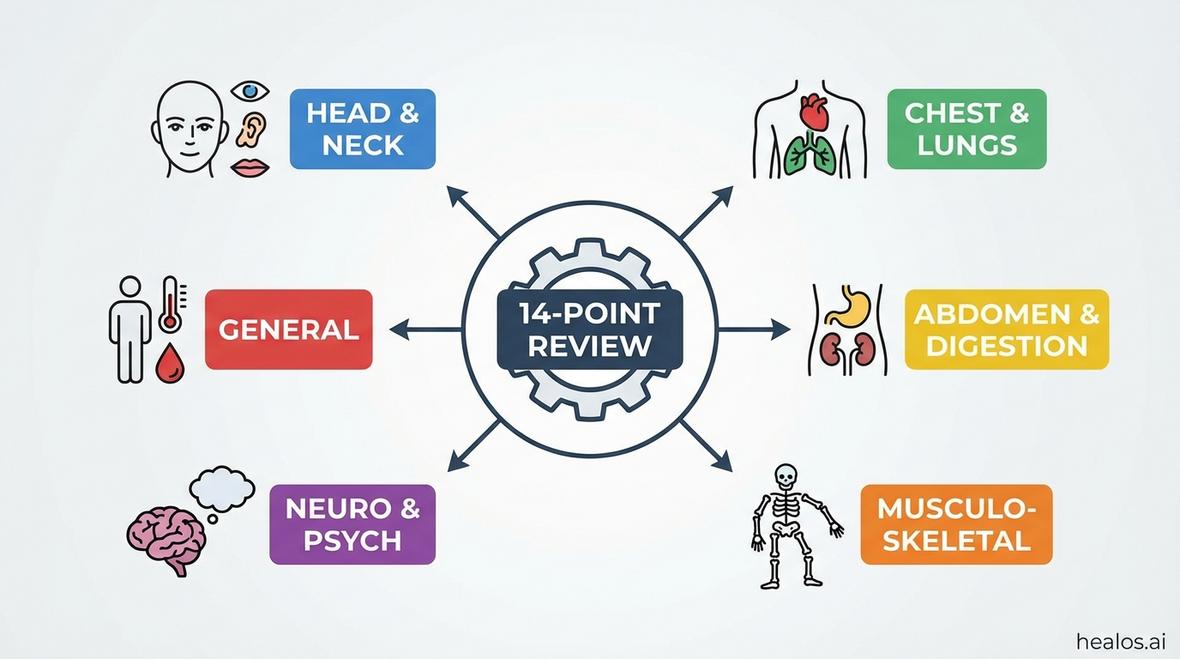
This visual representation demonstrates how the 14 point review of systems template organizes patient assessment into logical, comprehensive categories that ensure no critical symptom domain is overlooked during clinical encounters.
Why 14 Points Instead of 10?
Traditional 10-point ROS templates often combine or omit certain systems, creating documentation gaps that can lead to missed diagnoses or claim denials. The 14-point framework separates:
- Skin and breast concerns into a dedicated integumentary category
- Hematologic and lymphatic systems as distinct from other categories
- Allergic and immunologic issues as a standalone domain
- Constitutional symptoms as a separate assessment area
This granularity supports more accurate medical coding and ensures compliance with documentation requirements for higher-level evaluation and management codes.
How the 14 Point Review of Systems Template Solves Practice Management Challenges
For the overwhelmed practice manager, a standardized 14 point review of systems template addresses multiple operational pain points simultaneously.
Reducing Documentation Burden Amid Staffing Shortages
With healthcare experiencing unprecedented workforce challenges, every efficiency gain matters. Structured ROS templates reduce the cognitive load on providers by offering:
- Predictable workflows: Providers follow the same systematic approach for every patient
- Reduced decision fatigue: Template prompts eliminate the mental effort of remembering which systems to review
- Faster training: New providers and medical assistants can learn documentation protocols more quickly
When integrated with AI-powered medical scribe technology, the 14 point review of systems template becomes even more powerful. Ambient listening AI can automatically populate template fields based on natural patient-provider conversation, eliminating manual data entry entirely.
Minimizing Claim Denials Through Complete Documentation
Incomplete review of systems documentation is a leading cause of claim denials and downcoding. The 14 point framework ensures:
- Comprehensive coverage: All required elements for billing higher E/M levels are captured
- Audit protection: Standardized documentation withstands payer scrutiny
- Coding accuracy: Clear system-by-system assessment supports appropriate code selection
Practice managers implementing structured ROS templates typically see 15-30% reductions in documentation-related denials within the first quarter, directly improving the practice's financial health.
Enabling Practice Growth Without Proportional Headcount Increases
The unified agent approach that solutions like HealOS offer allows practices to scale patient volume without adding administrative staff. A properly automated 14 point review of systems template:
- Reduces per-encounter documentation time by 40-70%
- Enables providers to see 2-4 additional patients per day
- Eliminates after-hours 'pajama time' chart completion
- Standardizes quality across all providers in the practice
This scalability is particularly crucial for group practices and expanding specialties where maintaining consistency across multiple providers poses significant operational challenges.
Automating the 14 Point Review of Systems Template: Implementation Strategies
The true power of a 14 point review of systems template emerges when it's integrated with modern automation technologies. Here's how forward-thinking practice managers are implementing these systems in 2026.
Seamless EHR Integration
The most effective implementations involve deep EHR integration that allows the template to:
- Pre-populate from patient history: Chronic conditions automatically appear in relevant system categories
- Trigger clinical decision support: Positive responses activate evidence-based care pathways
- Flow into billing systems: Documentation automatically supports appropriate coding
Platforms offering unified healthcare automation provide the most seamless experience, eliminating the need for multiple disconnected tools that create workflow disruptions.
AI Ambient Documentation
The most transformative approach combines the 14 point review of systems template with ambient AI scribe technology that:
- Listens to natural patient-provider conversation
- Automatically identifies and categorizes symptoms by system
- Populates the template in real-time without provider typing
- Flags incomplete sections for provider review
This approach reduces documentation time from 16+ minutes per patient to 2-3 minutes of final review, representing the 70% reduction in charting time that leading practices are now achieving.
Specialty-Specific Template Customization
While the 14 point framework provides comprehensive coverage, different specialties benefit from customization:
- Cardiology: Expanded cardiovascular detail with symptom scoring
- Psychiatry: Enhanced psychiatric and neurological assessment
- Pediatrics: Age-appropriate questions and developmental milestones
- Orthopedics: Detailed musculoskeletal assessment with functional limitations
Advanced documentation platforms allow practices to maintain the standard 14-point structure while incorporating specialty-specific elements that capture the unique aspects of their patient populations. Explore specialty-specific solutions to see customization options for your practice type.
Step-by-Step Implementation Guide for Practice Managers
Successfully deploying a 14 point review of systems template requires careful planning and change management. Here's a proven implementation framework.
Phase 1: Assessment and Planning (Week 1-2)
1. Audit current documentation practices:
- Review a sample of 20-30 recent patient encounters
- Identify common documentation gaps and inconsistencies
- Calculate average time providers spend on ROS documentation
- Analyze denial rates related to incomplete documentation
2. Define requirements:
- Determine which EHR system(s) require integration
- Identify specialty-specific customization needs
- Establish baseline metrics for comparison
- Set clear goals (e.g., '40% reduction in documentation time')
Phase 2: Template Development and Testing (Week 3-4)
3. Build the template:
- Structure all 14 system categories with standard prompts
- Add checkboxes for common positive and negative findings
- Include free-text fields for atypical presentations
- Integrate with existing problem lists and medication records
4. Pilot with a small provider group:
- Select 2-3 providers willing to provide detailed feedback
- Run parallel documentation for one week (old and new methods)
- Gather qualitative feedback on workflow impact
- Measure time savings and completion rates
Phase 3: Training and Rollout (Week 5-6)
5. Conduct comprehensive training:
- Host hands-on sessions demonstrating template navigation
- Create quick-reference guides for each specialty
- Establish documentation standards and best practices
- Address provider concerns and resistance
6. Implement in phases:
- Begin with one department or specialty
- Monitor closely for the first week
- Address issues immediately as they arise
- Expand to additional departments once stable
Phase 4: Optimization and Automation (Week 7+)
7. Layer in automation:
- Integrate AI receptionist technology to pre-populate patient-reported symptoms
- Deploy ambient documentation to eliminate manual data entry
- Connect to revenue cycle management for automated coding support
- Establish quality monitoring dashboards
8. Continuous improvement:
- Review metrics monthly: documentation time, completion rates, denial rates
- Gather ongoing provider feedback
- Refine template based on usage patterns
- Update specialty-specific elements as clinical guidelines evolve
Measuring ROI: Key Metrics for the 14 Point Review of Systems Template
Practice managers must demonstrate tangible value from any new system. Track these metrics to quantify the impact of your 14 point review of systems template implementation.
Efficiency Metrics
- Documentation time per encounter: Target 40-70% reduction
- After-hours charting: Aim to eliminate 'pajama time' entirely
- Patient throughput: Measure additional patients seen per provider per day
- Template completion rates: Target 95%+ full completion
Financial Metrics
- Claim denial rates: Track month-over-month reduction
- Average reimbursement per encounter: Monitor for appropriate level coding
- Days in accounts receivable: Faster, complete documentation accelerates payment
- Labor cost per encounter: Calculate reduction in administrative burden
Quality Metrics
- Documentation completeness scores: Use internal or external audits
- Clinical decision support engagement: Track triggered pathways and follow-through
- Provider satisfaction: Survey quarterly on workflow impact
- Patient satisfaction: Monitor for increased face-to-face time perception
Leading practices implementing comprehensive ROS automation through platforms like HealOS document automation typically see positive ROI within 60-90 days when measuring both time savings and revenue optimization.
Common Implementation Challenges and Solutions
Even well-planned implementations encounter obstacles. Here's how to address the most common challenges with 14 point review of systems template adoption.
Provider Resistance to Standardized Templates
Challenge: Experienced providers may resist structured templates, viewing them as constraints on clinical judgment.
Solution: Emphasize that the 14 point review of systems template is a documentation framework, not a clinical decision tool. Provide free-text fields for nuanced findings and ensure the template adapts to the provider's natural workflow rather than forcing artificial changes. Demonstrate time savings with concrete data from pilot implementations.
EHR System Limitations
Challenge: Legacy EHR systems may lack flexibility for custom template implementation or have poor user interfaces.
Solution: Consider overlay solutions that integrate with existing EHRs while providing superior documentation interfaces. Modern EHR integration platforms can work alongside virtually any practice management system without requiring a complete system replacement.
Incomplete or Inconsistent Adoption
Challenge: Some providers consistently use the template while others revert to old habits, creating documentation inconsistency.
Solution: Implement gentle accountability measures such as weekly completion reports by provider, tie template usage to quality bonuses, and celebrate early adopters as champions. Make the template the path of least resistance by removing alternative documentation methods after the transition period.
Over-Documentation and Template Fatigue
Challenge: Comprehensive templates can lead to checkbox documentation that doesn't reflect actual patient assessment.
Solution: Design the 14 point review of systems template with smart logic that only expands relevant sections based on chief complaint and positive findings. Use negative attestation (e.g., 'all other systems reviewed and negative') to avoid exhaustive documentation for simple visits. Incorporate custom note generation that creates narrative summaries from template data.
Integration with a Unified Healthcare Automation Platform
The most successful implementations don't treat the 14 point review of systems template as an isolated tool but rather as one component of a comprehensive automation strategy.
The Unified Agent Approach
Modern healthcare automation platforms use a 'unified agent' model where multiple AI-powered systems work together seamlessly:
- AI receptionist handles patient intake and captures pre-visit symptom information
- Ambient scribe documents the encounter and populates the ROS template
- Coding agent suggests appropriate CPT and ICD-10 codes based on documented findings
- Prior authorization agent automatically initiates requests when ROS findings indicate need
- Claims management agent submits clean claims with complete supporting documentation
This integrated approach eliminates the workflow fragmentation that occurs when practices cobble together multiple point solutions from different vendors. A platform like HealOS unified agents ensures that your 14 point review of systems template feeds data to all downstream processes without manual intervention.
Pre-Visit Optimization
Smart implementations begin template completion before the patient even enters the exam room:
- Patient portal pre-visit questionnaires: Patients answer ROS questions at home, with responses auto-populating the template
- AI-powered intake calls: Automated systems conduct symptom screening by phone for patients without portal access
- Historical data mining: Chronic conditions and ongoing symptoms automatically appear as template defaults
This pre-population reduces in-visit documentation time by 50-60% before the provider even greets the patient, enabling true conversation-based care rather than data-entry-focused encounters.
Specialty-Specific Applications of the 14 Point Review of Systems Template
Different medical specialties can optimize the core 14-point framework to address their unique documentation needs.
Psychiatry and Mental Health
Psychiatric practices expand the neurological and psychiatric sections while streamlining physical system reviews. Key customizations include:
- Detailed mood and affect assessment scales
- Sleep architecture evaluation
- Substance use screening
- Suicidality and safety assessments
- Cognitive function testing results
Mental health providers using psychiatry-specific documentation solutions can maintain the comprehensive 14-point structure while emphasizing areas most relevant to psychiatric diagnosis and treatment planning.
Cardiology
Cardiology practices enhance cardiovascular and respiratory sections with:
- Detailed chest pain characterization (quality, duration, radiation, precipitating factors)
- Functional capacity assessment (NYHA class, METs)
- Edema grading and distribution
- Symptom response to current medications
The cardiology-optimized template ensures capture of all elements needed for accurate risk stratification and treatment planning while maintaining the comprehensive multi-system assessment that identifies comorbidities affecting cardiac care.
Pediatrics
Pediatric implementations adapt the 14 point review of systems template for age-appropriate questioning:
- Growth and development milestones
- Age-specific feeding and nutrition questions
- Behavioral and school performance assessment
- Parent-reported versus child-reported symptoms (when applicable)
Pediatric practices benefit from templates that automatically adjust question sets based on patient age, ensuring developmentally appropriate assessments without requiring providers to remember different protocols for different age groups. See pediatric-specific automation for more details.
Future Trends: Where ROS Documentation Is Heading in 2026 and Beyond
The 14 point review of systems template continues to evolve alongside advances in healthcare technology. Here are the trends shaping the future of ROS documentation.
Predictive Documentation
AI systems are beginning to predict likely positive findings based on:
- Chief complaint analysis
- Patient historical patterns
- Population health data
- Current medication regimens
These systems highlight probable areas of concern before the provider begins the review, making assessments more efficient and reducing the chance of missing relevant symptoms.
Integration of Patient-Generated Health Data
Wearable devices and home monitoring systems provide objective ROS data:
- Sleep quality and duration from smart watches
- Activity levels and exercise capacity from fitness trackers
- Cardiac rhythm data from personal ECG devices
- Blood pressure and glucose trends from home monitors
Advanced 14 point review of systems templates will automatically incorporate this objective data alongside patient-reported symptoms, creating a more comprehensive clinical picture.
Voice-Native Documentation
The shift away from keyboard-based documentation continues accelerating. By 2026, most ROS documentation occurs through:
- Natural conversation captured by ambient AI
- Voice commands to navigate and complete templates
- Mobile dictation for remote follow-up documentation
This voice-native approach eliminates the computer as a barrier between provider and patient, restoring eye contact and human connection to clinical encounters.
Frequently Asked Questions
How long does it take to implement a 14 point review of systems template?
Most practices complete full implementation within 4-6 weeks, including template development, pilot testing, training, and phased rollout. Practices using pre-built templates with existing automation extensions can reduce this timeline to 2-3 weeks.
Does a comprehensive ROS template increase documentation time?
Counterintuitively, no. While the template covers more ground than abbreviated versions, structured prompts and automation actually reduce total documentation time by 40-70% compared to free-text narrative approaches. The key is pairing the template with appropriate technology rather than using it as a manual data-entry checklist.
Will payers accept documentation from automated ROS templates?
Yes, provided the documentation reflects actual patient assessment and includes appropriate provider attestation. The template itself is simply a documentation tool; what matters is that a qualified provider performed the review and verified the recorded findings. Automated systems that capture real patient-provider conversations meet all payer requirements.
Can I customize the 14-point framework for my specialty?
Absolutely. The 14-point structure provides a comprehensive baseline, but practices should customize depth and detail for each system based on specialty needs. The goal is thorough, efficient documentation, not rigid adherence to a generic template. Modern platforms support extensive customization while maintaining the core structure.
How do I measure ROI on ROS template implementation?
Track four key areas: (1) time savings (reduced documentation minutes per encounter), (2) revenue optimization (decreased denials, appropriate E/M level coding), (3) capacity increases (additional patients seen per day), and (4) provider satisfaction (reduced burnout, eliminated after-hours charting). Most practices see positive ROI within 60-90 days when implementing comprehensive automation.
Conclusion
The 14 point review of systems template represents far more than a documentation checklist it's a strategic tool for practice managers seeking to scale operations without proportional increases in administrative burden. By ensuring comprehensive patient assessment while reducing documentation time by up to 70%, these structured frameworks directly address the core challenges facing healthcare practices in 2026: staffing shortages, provider burnout, and financial pressure from claim denials.
The most successful implementations pair the template with modern automation technologies, creating seamless workflows from patient intake through claim submission. As ambient AI and unified automation platforms mature, the administrative burden that has plagued healthcare for decades is finally being lifted, allowing providers to refocus on what matters most: delivering exceptional patient care. For overwhelmed practice managers, the message is clear: comprehensive, automated ROS documentation is no longer optional it's the foundation of sustainable, scalable practice operations.