
AI Agents Healthcare: The Complete 2026 Guide To Automating Practice Workflows And Reducing Provider Burnout

Introduction to AI Agents in Healthcare
Healthcare practices are drowning in administrative work. Providers spend 77% of their time on non-clinical tasks, leading to burnout, staffing shortages, and operational bottlenecks. The solution isn't hiring more staff it's deploying intelligent automation through AI agents healthcare systems that integrate seamlessly into existing workflows.
AI agents healthcare platforms represent a paradigm shift from isolated AI tools to unified, autonomous systems that handle everything from clinical documentation to claims processing. According to BCG's research on AI agents transforming healthcare, ambient AI scribes are already reducing physician documentation time significantly, while AI clinical assistants improve productivity and reduce diagnostic errors through instant data synthesis.
For overwhelmed practice managers facing staffing shortages and claim denials, AI agents healthcare technology offers a path to scale operations without proportional headcount increases. This comprehensive guide explores how modern healthcare automation delivers measurable ROI while addressing the specific challenges of administrative burden, financial health, and provider burnout.
What Are AI Agents in Healthcare?
AI agents healthcare systems are autonomous software programs designed to execute specific tasks within clinical and administrative workflows. Unlike traditional automation that follows rigid rules, these agents use machine learning, natural language processing, and contextual understanding to make decisions, adapt to variations, and complete complex multi-step processes.
Core Capabilities of Healthcare AI Agents
Modern AI agents healthcare platforms encompass four primary operational domains:
- Clinical Documentation: Ambient AI scribes capture patient encounters in real-time, generating structured SOAP notes, progress notes, and specialty-specific documentation without provider keyboard input
- Scheduling & Patient Support: Intelligent AI receptionist systems manage appointment booking, patient communications, intake workflows, and follow-up coordination
- Revenue Cycle Management: Automated claims processing, denial management, eligibility verification, and payment posting reduce days in A/R and improve collection rates
- Workflow Analytics: AI-powered insights identify bottlenecks, predict capacity issues, and recommend operational optimizations
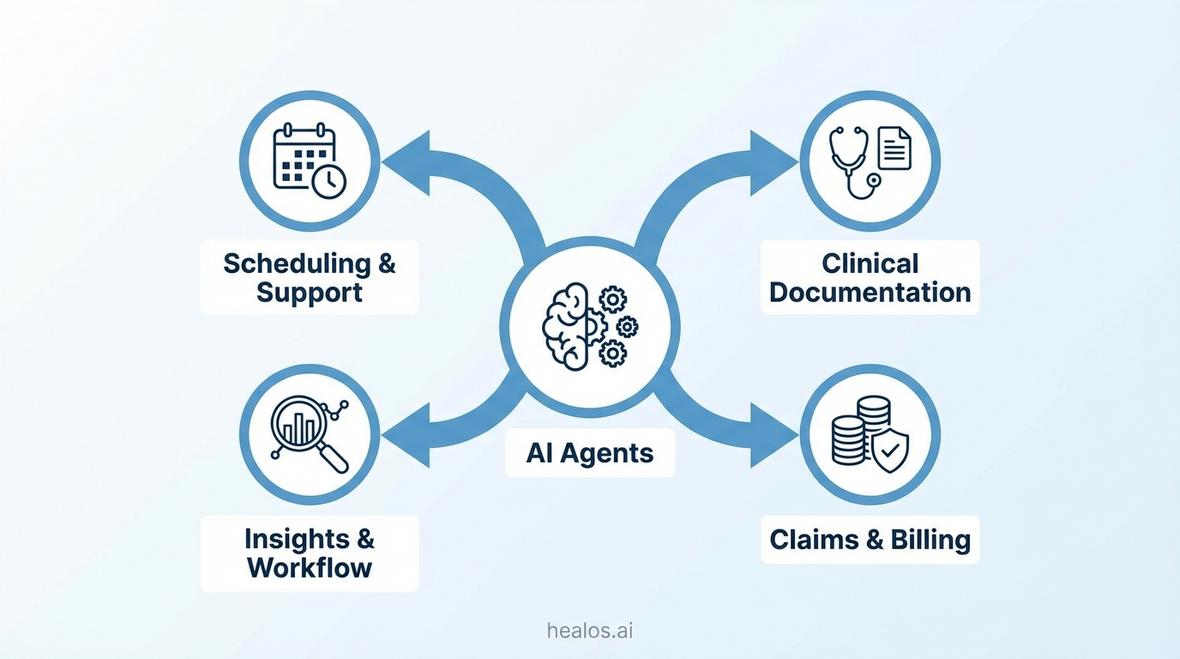
This integrated approach distinguishes next-generation healthcare automation from point solutions. Rather than deploying separate tools for documentation, billing, and patient engagement, unified AI agents healthcare platforms orchestrate all administrative functions through a single intelligent layer.
The Unified Agent Approach vs. Fragmented Tools
Traditional healthcare IT environments suffer from tool proliferation separate vendors for transcription, scheduling, billing, and analytics. Each system requires its own login, training, and integration effort. Data silos prevent cross-functional optimization.
The unified agent approach consolidates these functions into a coherent ecosystem where information flows seamlessly. A patient intake conversation captured by the AI intake agent automatically populates the EHR, triggers insurance verification, and informs the clinical documentation workflow all without manual data transfer.
Market Growth and Adoption Trends in 2026
Healthcare AI deployment has accelerated from experimental pilots to production-grade implementations. The data supporting this transformation is compelling.
Digital Health Market Expansion
According to Wolters Kluwer's 2026 Healthcare AI Trends analysis, the digital health technology market is estimated to grow to over $300 billion in 2026, driven primarily by AI-powered clinical decision support and ambient documentation tools. Healthcare organizations are prioritizing clinical solutions that deliver the greatest impact to care workflows rather than speculative AI experiments.
Explosive Growth in Billing Automation
The fastest-growing AI agents healthcare use case is automated billing. Research from Paubox shows AI billing automation increased from 36% adoption to 61% among US hospitals between 2023-2024. Nearly 70% of US hospitals now use predictive AI in some capacity, with health system-affiliated hospitals reaching 86% adoption.
Critically, hospitals using third-party or self-developed AI show 73% billing automation rates versus 58% for EHR-sourced AI suggesting that specialized AI agents healthcare platforms outperform native EHR modules.
From Pilots to Production: The Governance Imperative
Early AI adoption focused on proof-of-concept experiments. In 2026, deployment has shifted to integrated autonomous agents within core workflows under strict governance controls. Healthcare organizations now demand AI solutions with drift monitoring, bias detection, and clinical oversight capabilities built-in.
This maturation reflects a fundamental change: AI agents healthcare technology is no longer experimental it's infrastructure. Practices that delay adoption risk competitive disadvantage as automated competitors capture market share through superior operational efficiency.
Solving the Overwhelmed Practice Manager's Pain Points
Practice managers face three interconnected challenges: staffing shortages, provider burnout from excessive charting, and financial pressure from claim denials. AI agents healthcare systems address each directly.
Automating Administrative Workflows to Scale Without Headcount
Traditional scaling requires proportional staff increases. A practice seeing 20% more patients needs approximately 20% more administrative personnel for scheduling, documentation support, billing, and patient communications. This linear relationship breaks practice economics.
AI agents healthcare platforms break this constraint. A single AI scribe can document unlimited patient encounters simultaneously. An intelligent receptionist handles hundreds of appointment requests concurrently. Automated eligibility verification processes insurance checks in seconds rather than the 10-15 minutes required for manual verification.
For practice managers, this means revenue growth without corresponding overhead increases. The financial model shifts from variable cost per patient to fixed platform cost dramatically improving unit economics.
Eliminating Charting Burden and Provider Burnout
Provider burnout stems largely from documentation burden. Physicians spend 2-3 hours on EHR work for every clinical hour, often extending into evening 'pajama time.' This unsustainable workload drives clinician attrition and reduces patient access.
Ambient AI documentation captures patient conversations automatically, generating structured notes without provider typing. The physician focuses entirely on the patient while AI agents healthcare systems handle transcription, structuring, and EHR integration. According to clinical studies, this reduces documentation time by 75% and restores physician engagement.
Specialties with particularly complex documentation such as therapy, psychiatry, and oncology see the most dramatic improvements. Therapists generating SOAP or DAP notes for multiple daily sessions reclaim hours of administrative time previously spent on after-hours charting.
Improving Financial Health Through Denial Prevention
Claim denials represent significant revenue leakage. The average practice writes off 3-5% of revenue to denials, with primary causes including eligibility issues, authorization failures, and coding errors.
AI agents healthcare platforms prevent denials proactively. Real-time benefit verification confirms coverage before service delivery. Automated prior authorization workflows submit requests with complete clinical documentation, reducing rejection rates. AI-powered claim scrubbers identify coding errors before submission, catching issues that would otherwise generate denials weeks later.
The financial impact is substantial. Practices implementing comprehensive AI agents healthcare systems typically reduce denial rates by 40-60% within the first year, translating directly to bottom-line revenue improvement.
Seamless EHR Integration: The Technical Foundation
AI agents healthcare platforms deliver value only when integrated into existing clinical workflows. Standalone tools that require duplicate data entry or parallel workflows fail adoption tests.
Modern Integration Architecture
Leading platforms like HealOS connect to EHR systems through multiple pathways:
- HL7/FHIR APIs: Standards-based integration for bidirectional data exchange with major EHR platforms
- Direct EHR Embedding: Native modules that appear as integrated features within the EHR interface
- Smart Routing: Intelligent data flow that populates appropriate fields based on content type and clinical context
- Audit Trails: Complete documentation of AI-generated content for compliance and quality assurance
This integration depth ensures that AI-generated documentation, verified insurance information, and processed claims flow into the EHR automatically no copy-paste, no manual reconciliation.
Specialty-Specific Customization
Different specialties require different documentation structures, billing codes, and workflow patterns. A cardiology practice needs cardiovascular-specific templates and procedural documentation. Pediatric practices require growth charts, developmental milestones, and parent-inclusive documentation.
Advanced AI agents healthcare platforms offer specialty-specific configurations that understand domain terminology, preferred note structures, and specialty billing patterns. This customization ensures AI-generated outputs match clinician expectations without extensive post-editing.
Comprehensive Feature Breakdown: Beyond Documentation
While ambient documentation captures headlines, comprehensive AI agents healthcare platforms automate entire operational workflows.
Patient Engagement and Communication
Intelligent automation extends patient interactions beyond appointment scheduling:
- Appointment Reminders: AI-powered outreach reduces no-show rates by 30-40%
- Automated Follow-Up: Post-visit check-ins, medication adherence monitoring, and outcome tracking
- Voice AI: Natural language phone systems that handle routine inquiries without staff intervention
- Patient Education: Automated delivery of condition-specific information and care instructions
Revenue Cycle Intelligence
Financial operations benefit from AI agents healthcare automation across the entire revenue cycle:
- A/R Monitoring: Predictive algorithms identify at-risk accounts and recommend intervention timing
- Underpayment Detection: Automated contract validation ensures payers reimburse at contracted rates
- Denial Management: AI categorizes denial reasons and generates appeal letters automatically
- Collections Optimization: Behavioral analytics determine optimal patient payment outreach strategies
Operational Workflow Enhancement
Back-office functions equally benefit from intelligent automation:
- Fax Automation: AI extracts data from incoming faxes and routes information to appropriate workflows
- Referral Management: Automated processing of referral requests, specialist coordination, and status tracking
- Compliance Monitoring: Continuous audit of documentation completeness and regulatory adherence
Implementation ROI Analysis: Real Numbers
Understanding the financial return on AI agents healthcare investment requires examining specific cost savings and revenue improvements.
Direct Cost Reduction
Typical savings for a 5-provider primary care practice:
- Documentation Support: Eliminating 2 full-time scribes saves $84,000 annually
- Front Desk Efficiency: Reducing reception staff by 1 FTE saves $42,000 annually
- Billing Operations: Decreasing billing staff time by 30% saves approximately $25,000 annually
Total annual cost reduction: $151,000
Revenue Improvement
Beyond cost savings, AI agents healthcare systems drive top-line revenue growth:
- Increased Patient Volume: Faster documentation enables 15-20% more daily appointments, generating $200,000+ additional annual revenue for a typical practice
- Denial Reduction: Decreasing denials from 5% to 2% recovers approximately $90,000 annually for a $3M practice
- Faster Collections: Reducing days in A/R from 45 to 30 improves cash flow by $250,000+ (one-time) and reduces bad debt by $15,000 annually
Total First-Year ROI
For a typical small practice:
- Annual Platform Cost: $15,000-$25,000
- Cost Savings: $151,000
- Revenue Improvement: $305,000
- Net First-Year Benefit: $430,000+
This represents an ROI exceeding 1,700%—a transformative financial impact that enables reinvestment in clinical quality, provider compensation, or practice expansion.
Selection Criteria: Evaluating AI Agents Healthcare Vendors
Not all AI agents healthcare platforms deliver equivalent value. Practice managers should evaluate vendors across several critical dimensions.
Clinical Accuracy and Validation
Documentation quality directly impacts care continuity and compliance. Evaluate:
- Accuracy Rates: Look for platforms achieving 95%+ accuracy in specialty-specific documentation
- Clinical Validation: Verify that the platform has been tested in your specialty with real clinical data
- Customization Capability: Ensure templates and output formats match your documentation preferences
Integration Depth and Flexibility
Workflow disruption kills adoption. Assess:
- EHR Compatibility: Confirm native integration with your specific EHR platform
- Implementation Timeline: Best platforms deploy in days, not months
- Data Security: Verify HIPAA compliance, encryption standards, and audit capabilities
Unified Platform vs. Point Solutions
The 'unified agent' approach consolidates multiple functions into a single platform. This architecture offers:
- Single vendor relationship and consolidated support
- Consistent user experience across all functions
- Shared data model enabling cross-functional intelligence
- Simplified training and change management
Compare this against assembling separate best-of-breed tools for documentation, scheduling, billing, and analytics which requires managing multiple vendors, integrations, and potential compatibility issues.
Future Outlook: AI Agents Healthcare Evolution Beyond 2026
Current AI agents healthcare capabilities represent early stages of a longer transformation. Several emerging trends will reshape healthcare operations further.
Predictive Clinical Intelligence
Future AI agents will move beyond reactive documentation to predictive clinical support identifying patients at risk for deterioration, recommending preventive interventions, and flagging potential diagnostic oversights based on subtle pattern recognition across population health data.
Autonomous Care Coordination
AI agents will orchestrate complex multi-provider care pathways automatically scheduling specialist consultations, ordering appropriate tests, tracking referral completion, and ensuring care plan adherence without manual coordination effort.
Continuous Regulatory Adaptation
As healthcare regulations evolve, AI agents will update automatically to maintain compliance adjusting documentation requirements, billing code mappings, and authorization workflows in response to policy changes without requiring practice staff retraining.
Frequently Asked Questions
How accurate are AI agents healthcare systems for clinical documentation?
Leading platforms achieve 95-98% accuracy in specialty-specific documentation. However, all AI-generated clinical notes require physician review and approval before finalization, maintaining clinician oversight and final control over medical records.
Are AI agents healthcare platforms HIPAA compliant?
Reputable platforms maintain full HIPAA compliance through encryption, access controls, audit trails, and business associate agreements. Always verify specific security certifications during vendor evaluation.
How long does implementation take?
Best-in-class platforms deploy in under 24 hours for basic documentation features. Comprehensive implementations including billing automation and EHR integration typically complete within 2-4 weeks, depending on practice complexity.
What is the typical cost for small practices?
Pricing varies by feature set and practice size, but comprehensive AI agents healthcare platforms typically cost $200-$500 per provider monthly. Given the cost savings and revenue improvements detailed above, ROI is typically achieved within the first 2-3 months.
How much training is required?
Ambient documentation systems require minimal training most clinicians achieve proficiency within 2-3 patient encounters. Administrative staff using billing and scheduling automation typically require 1-2 hours of initial training plus ongoing support during the first month.
Conclusion
AI agents healthcare technology has evolved from experimental tools to mission-critical infrastructure for modern medical practices. For overwhelmed practice managers facing staffing shortages, provider burnout, and financial pressure, unified automation platforms offer a proven path to operational scalability without proportional cost increases. The evidence is clear: practices implementing comprehensive AI agents healthcare systems reduce administrative burden by 60-75%, improve revenue cycle performance by 40-60%, and enable providers to focus on clinical care rather than documentation. As healthcare continues its digital transformation, the question is no longer whether to adopt AI agents but how quickly practices can implement these systems to remain competitive in an increasingly automated industry.