
AI Charting For Doctors: The Complete 2026 Guide To Transforming Clinical Documentation

Introduction
Clinical documentation has long been one of the most time-consuming aspects of medical practice. Physicians spend an average of 2 hours on administrative tasks for every hour of direct patient care, according to research from the American Medical Association. This administrative burden contributes significantly to physician burnout, reduced patient satisfaction, and decreased practice efficiency. Enter AI charting for doctors—a revolutionary technology that is transforming how healthcare providers document patient encounters.
AI charting systems leverage artificial intelligence, natural language processing, and ambient listening technology to automatically generate clinical notes from patient-physician conversations. These systems can create comprehensive SOAP notes, progress notes, and other documentation formats in real-time, allowing doctors to focus on what matters most: patient care. In this comprehensive guide, we'll explore everything you need to know about AI charting for doctors in 2026, including how it works, its benefits, implementation strategies, and how to choose the right solution for your practice.
What Is AI Charting for Doctors?
AI charting for doctors refers to intelligent software systems that use artificial intelligence to automatically document patient encounters. Unlike traditional medical transcription or dictation software, modern AI charting solutions can understand the context of conversations, identify relevant clinical information, and structure it into standardized medical documentation formats.
How AI Charting Technology Works
The process of AI charting typically involves four key steps:
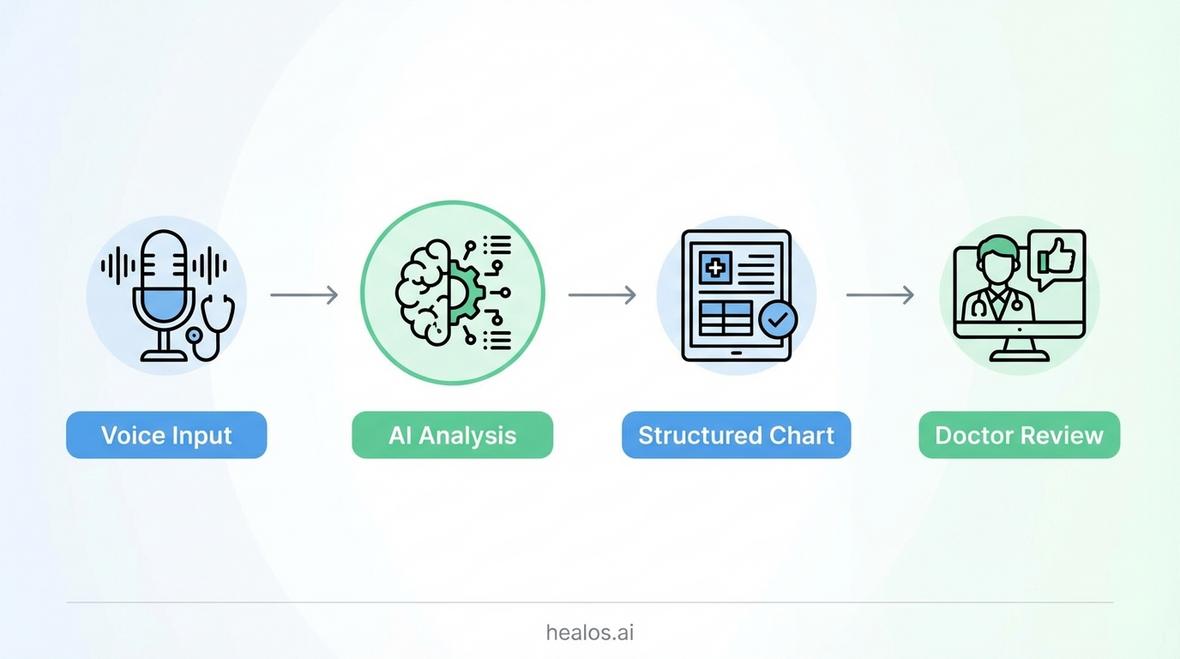
- Voice Input: The system captures the conversation between doctor and patient through ambient listening technology or direct voice input via microphone.
- AI Analysis: Advanced natural language processing algorithms analyze the conversation, identifying clinical information such as chief complaints, symptoms, examination findings, diagnoses, and treatment plans.
- Structured Chart Generation: The AI organizes the extracted information into a structured clinical note following standard formats like SOAP, DAP, or custom templates specific to your specialty.
- Doctor Review: The physician reviews the generated documentation, makes any necessary edits, and approves the final note for integration into the electronic health record (EHR).
This workflow dramatically reduces the time physicians spend on documentation while maintaining accuracy and compliance with medical documentation standards. AI scribe solutions have evolved to handle complex medical terminology across multiple specialties, from psychiatry to cardiology.
Types of AI Charting Systems
There are several categories of AI charting solutions available to healthcare providers:
- Ambient AI Scribes: These systems passively listen to patient encounters and generate documentation without requiring the physician to dictate directly to the system.
- Voice-Activated Dictation: Similar to traditional dictation but enhanced with AI that understands medical context and can structure notes automatically.
- Hybrid Systems: Combine ambient listening with direct dictation capabilities, offering flexibility based on the clinical setting.
- Specialty-Specific Solutions: Tailored to specific medical disciplines like psychiatry, cardiology, or pediatrics with templates and terminology unique to those fields.
The Transformative Benefits of AI Charting for Doctors
The adoption of AI charting for doctors delivers substantial benefits that extend beyond simple time savings. Research and real-world implementations have demonstrated measurable improvements across multiple dimensions of medical practice.
Dramatic Time Savings and Efficiency Gains
Time is the most valuable resource in healthcare, and AI charting delivers significant savings. According to data from healthcare technology implementations, physicians using AI charting solutions save an average of 2-3 hours per day on documentation tasks. For a typical physician seeing 20-25 patients daily, this translates to reducing documentation time from approximately 3-4 hours to under 1 hour.
These time savings manifest in several ways:
- Reduced After-Hours Work: Physicians spend significantly less time completing charts after clinic hours, a phenomenon known as 'pajama time.'
- Increased Patient Volume: Practices can see more patients without extending work hours, directly impacting revenue.
- Same-Day Chart Completion: Real-time documentation enables same-day chart closure, improving billing efficiency and cash flow.
The medical dictation capabilities of modern AI systems allow physicians to generate comprehensive notes in minutes rather than the 15-20 minutes typically required for manual documentation.
Combating Physician Burnout
Physician burnout has reached epidemic proportions, with administrative burden being a primary contributing factor. The American Medical Association reports that excessive documentation requirements are among the top causes of professional dissatisfaction. AI charting addresses this crisis by removing the most tedious aspect of medical practice.
Physicians using AI charting report:
- Improved work-life balance with fewer hours spent on documentation after clinic closes
- Greater job satisfaction from spending more time on direct patient care
- Reduced cognitive load during patient encounters
- Lower stress levels related to documentation backlogs
By enabling doctors to be more present during patient encounters rather than focused on typing into an EHR, AI charting restores the human element to medical practice that drew many physicians to the profession.
Enhanced Documentation Quality and Compliance
Counter to concerns about AI accuracy, well-designed AI charting systems actually improve documentation quality. These systems ensure that notes contain all required elements for proper coding and billing, reduce errors from fatigue or rushing, and maintain consistent documentation standards across the practice.
AI charting solutions achieve documentation accuracy rates of 95-98% according to validation studies, with the remaining items typically being minor stylistic preferences rather than clinical errors. The technology excels at capturing complete histories, thorough review of systems, and detailed examination findings that might be abbreviated in manual documentation.
Substantial Financial Returns
The financial case for AI charting is compelling. Practices implementing AI documentation solutions typically see return on investment within 3-6 months through multiple revenue channels:
- Increased Patient Volume: Time savings enable physicians to see 2-4 additional patients per day without extending hours.
- Improved Coding Accuracy: Complete documentation supports appropriate billing levels, often revealing that physicians have been under-coding.
- Faster Billing Cycles: Same-day chart completion accelerates billing and reduces days in accounts receivable.
- Reduced Scribe Costs: AI scribes cost a fraction of human medical scribes, which typically run $30,000-$50,000 annually per physician.
For a solo practitioner, the annual financial benefit of AI charting can exceed $50,000 when accounting for increased capacity and reduced staffing costs. The ROI comparison between traditional scribes and AI solutions demonstrates the substantial cost advantage.
Implementing AI Charting in Your Practice: A Step-by-Step Guide
Successfully implementing AI charting for doctors requires thoughtful planning and execution. Following these steps will ensure a smooth transition and maximize the benefits of the technology.
Step 1: Assess Your Practice Needs
Begin by conducting a thorough assessment of your current documentation workflow:
- Calculate how much time physicians currently spend on documentation
- Identify pain points in the existing process
- Determine which types of encounters take the longest to document
- Evaluate your current EHR system and integration requirements
- Consider specialty-specific needs and documentation formats
This assessment establishes baseline metrics that will allow you to measure the impact of AI charting after implementation.
Step 2: Research and Compare Solutions
The AI charting market has expanded rapidly, with numerous vendors offering various capabilities. Key factors to evaluate include:
- Accuracy: Look for solutions with validated accuracy rates above 95%
- Specialty Support: Ensure the system handles the terminology and documentation formats for your specialty
- EHR Integration: Seamless integration with your existing EHR is essential for workflow efficiency
- Customization: The ability to create custom templates and adjust output formats
- HIPAA Compliance: Robust security measures and business associate agreements
- Pricing Model: Understand whether pricing is per-provider, per-encounter, or flat-rate
- Support and Training: Availability of implementation support and ongoing technical assistance
Solutions like Healos AI offer comprehensive platforms that address multiple aspects of practice automation beyond just clinical documentation.
Step 3: Conduct a Pilot Program
Rather than implementing practice-wide immediately, start with a pilot program:
- Select 1-2 physicians to test the system initially
- Run the pilot for 4-6 weeks to allow time for adaptation
- Continue existing documentation methods as backup during the pilot
- Collect feedback from participating physicians weekly
- Measure time savings and documentation quality metrics
This approach minimizes risk and allows you to refine the implementation before broader rollout.
Step 4: Provide Comprehensive Training
Adequate training is critical to successful adoption. Effective training programs should include:
- System functionality and basic operation
- Best practices for speaking clearly and structuring conversations
- How to review and edit AI-generated notes efficiently
- Troubleshooting common issues
- Tips for optimizing documentation quality
Most AI charting vendors provide initial training, but plan for additional practice time as physicians become comfortable with the new workflow. The Healos Academy offers resources for optimizing AI documentation workflows.
Step 5: Monitor Performance and Optimize
After implementation, establish ongoing monitoring processes:
- Track documentation time per encounter
- Measure physician satisfaction through regular surveys
- Monitor documentation quality through chart audits
- Analyze financial metrics including patient volume and billing accuracy
- Collect patient feedback on care experience
Use this data to identify opportunities for further optimization and ensure the system continues to meet practice needs as workflows evolve.
AI Charting Across Medical Specialties
While AI charting delivers benefits across all medical disciplines, the technology has been adapted to meet the unique needs of various specialties.
Primary Care and Family Medicine
Primary care physicians face high patient volumes and diverse documentation requirements. AI charting helps family medicine practices handle the variety of conditions seen daily, from acute illnesses to chronic disease management. The technology excels at capturing comprehensive histories and generating thorough SOAP notes that support appropriate coding for complex visits.
Mental Health and Psychiatry
Mental health providers require detailed session notes that capture therapeutic interventions, patient progress, and treatment planning. AI scribes for psychiatry are designed to handle the nuanced language of therapy sessions while maintaining patient privacy. These systems can generate notes in formats like DAP, BIRP, or SOAP specifically tailored to behavioral health documentation requirements.
Specialty Practices
Specialists benefit from AI charting solutions customized to their discipline:
- Cardiology: Systems that capture detailed cardiovascular examinations, interpret diagnostic results, and document complex treatment plans for heart conditions.
- Orthopedics: AI charting that documents musculoskeletal examinations, range of motion assessments, and surgical planning with specialty-specific terminology.
- Pediatrics: Solutions designed for documenting well-child visits, growth parameters, developmental milestones, and parent counseling.
- Oncology: Systems capable of documenting complex cancer treatment protocols, staging information, and multidisciplinary care coordination.
The specialty-specific solutions offered by advanced AI platforms ensure that documentation meets the unique requirements of each medical discipline.
Security, Privacy, and Compliance Considerations
Healthcare providers rightfully have concerns about patient privacy and regulatory compliance when implementing AI charting systems. Understanding how modern AI solutions address these concerns is essential.
HIPAA Compliance
Reputable AI charting solutions are designed with HIPAA compliance as a fundamental requirement. This includes:
- End-to-end encryption of all patient data in transit and at rest
- Business Associate Agreements (BAAs) that formally establish HIPAA responsibilities
- Access controls and audit logging to track who accesses patient information
- Regular security audits and penetration testing
- Secure data centers with appropriate physical and technical safeguards
When evaluating AI charting solutions, verify that the vendor provides comprehensive documentation of their security measures and compliance certifications.
Data Privacy and AI Training
A common concern is whether patient data is used to train AI models. Leading AI charting vendors implement strict data governance policies:
- Patient data is never used to train AI models without explicit consent
- De-identification processes remove all protected health information before any data analysis
- Clear policies about data retention and deletion
- Options for on-premises deployment for practices with heightened security requirements
Understanding the vendor's data practices should be a priority during the selection process.
Liability and Responsibility
An important consideration is that AI charting systems are assistive tools, not replacements for physician judgment. The physician remains ultimately responsible for the accuracy and completeness of medical documentation. AI-generated notes should always be reviewed and approved by the provider before being finalized in the medical record.
This physician review step ensures clinical accuracy while still delivering substantial time savings compared to creating documentation from scratch.
The Future of AI Charting: Emerging Trends for 2026 and Beyond
The field of AI charting continues to evolve rapidly, with several emerging trends that will shape the future of clinical documentation.
Enhanced EHR Integration
Future AI charting systems will offer deeper integration with electronic health records, going beyond simple note creation to include:
- Automated order entry based on treatment discussions
- Real-time clinical decision support during patient encounters
- Automated coding and billing suggestions
- Predictive analytics for patient risk stratification
These advanced integrations will create a seamless documentation experience that requires minimal manual data entry.
Multimodal AI Capabilities
Next-generation AI charting will incorporate multiple data sources beyond voice:
- Analysis of medical images and diagnostic results
- Integration with remote monitoring devices and wearables
- Interpretation of lab results and automatic trending
- Incorporation of patient-reported outcomes and symptom tracking
This multimodal approach will create comprehensive documentation that synthesizes all available patient data automatically.
Specialized Workflow Automation
AI systems are expanding beyond documentation to automate adjacent workflows:
- Automated prior authorization request generation
- Intelligent referral letter creation
- Patient education material generation customized to the encounter
- Follow-up care coordination and scheduling
These capabilities transform AI from a documentation tool into a comprehensive practice automation platform. The AI agents available today demonstrate this broader automation potential.
Choosing the Right AI Charting Solution for Your Practice
With numerous AI charting solutions available, selecting the right one requires careful evaluation of your specific needs and priorities.
Key Selection Criteria
When comparing AI charting solutions, consider these essential factors:
- Documentation Quality: Request sample notes in your specialty to evaluate output quality
- Speed and Efficiency: How quickly does the system generate notes after an encounter?
- Customization Options: Can you create custom templates and modify output formats?
- EHR Compatibility: Does it integrate seamlessly with your existing EHR system?
- User Interface: Is the system intuitive and easy to use?
- Mobile Accessibility: Can you access and approve notes from mobile devices?
- Customer Support: What level of technical support and training is provided?
- Pricing Transparency: Are costs clear and predictable?
Cost Considerations
AI charting solutions typically use one of several pricing models:
- Per-Provider Monthly Fee: Fixed monthly cost per physician, typically ranging from $99 to $399
- Per-Encounter Pricing: Charges based on the number of patient encounters documented
- Tiered Plans: Different feature sets at various price points
- Enterprise Licensing: Custom pricing for larger organizations
Calculate the total cost of ownership including implementation, training, and ongoing support when comparing options. The cost analysis of AI scribe solutions demonstrates the long-term financial benefits despite initial investment.
Vendor Stability and Support
Consider the long-term viability of the vendor:
- How long has the company been operating?
- What is their customer retention rate?
- Do they have a track record of product innovation?
- What do existing customers say about their experience?
- Is there an active user community?
Choosing an established vendor with strong customer support ensures you'll have assistance when needed and that the product will continue to improve over time.
Overcoming Common Challenges with AI Charting
While AI charting delivers substantial benefits, practices may encounter challenges during implementation and adoption. Understanding these challenges and their solutions facilitates successful deployment.
Physician Resistance to Change
Some physicians are hesitant to adopt new technology, particularly if they've developed efficient manual documentation workflows. Address this resistance by:
- Demonstrating the time savings with concrete data from pilot programs
- Allowing voluntary adoption initially rather than mandating use
- Sharing testimonials from peer physicians who have successfully implemented AI charting
- Emphasizing that the technology augments rather than replaces clinical judgment
Most physician skepticism dissipates after experiencing the benefits firsthand during a trial period.
Initial Learning Curve
There is an adjustment period as physicians learn to work with AI charting systems effectively. Minimize this challenge by:
- Providing adequate training before go-live
- Establishing a support system for questions during the first few weeks
- Sharing best practices for optimizing documentation quality
- Setting realistic expectations that efficiency will improve after an initial adjustment period
Most physicians become proficient with AI charting systems within 2-3 weeks of regular use.
Technical Integration Challenges
Integrating AI charting with existing EHR systems can present technical challenges. Work closely with both your EHR vendor and the AI charting vendor to ensure smooth integration. Consider:
- Testing the integration thoroughly before full deployment
- Having IT support available during initial rollout
- Creating backup documentation processes for system downtime
- Establishing clear escalation paths for technical issues
Most modern AI charting solutions offer robust integration support to facilitate smooth implementation.
Frequently Asked Questions About AI Charting for Doctors
How accurate is AI charting compared to manual documentation?
Modern AI charting systems achieve accuracy rates of 95-98% for clinical content. The remaining items typically require minor edits for stylistic preferences rather than corrections of clinical errors. Many physicians find that AI-generated notes are more comprehensive than their manual documentation because the AI captures details that might be omitted when typing quickly.
Will AI charting work with my specialty?
Yes, AI charting solutions are available for virtually all medical specialties. Leading platforms offer specialty-specific templates and terminology for fields including primary care, psychiatry, cardiology, orthopedics, pediatrics, and many others. The key is selecting a solution that specifically supports your discipline's documentation requirements.
How long does it take to implement AI charting in a practice?
Implementation timelines vary based on practice size and complexity. For a small practice with 1-3 providers, the process typically takes 2-4 weeks from contract signing to full deployment. Larger practices may require 1-2 months for comprehensive rollout. Most physicians become proficient with the system within 2-3 weeks of regular use.
What happens if the AI makes an error in clinical documentation?
Physicians are required to review and approve all AI-generated notes before finalizing them in the medical record. This review step allows doctors to correct any errors, add additional information, or modify the documentation to match their preferences. The physician remains ultimately responsible for documentation accuracy.
Is AI charting HIPAA compliant?
Reputable AI charting solutions are designed to be fully HIPAA compliant, with features including end-to-end encryption, business associate agreements, access controls, and regular security audits. Always verify that any AI charting vendor you consider provides comprehensive documentation of their security measures and compliance certifications.
How much does AI charting cost?
Pricing varies by vendor and features, but typically ranges from $99 to $399 per provider per month for subscription-based models. Some vendors use per-encounter pricing instead. When evaluating cost, consider the return on investment through time savings, increased patient capacity, and reduced staffing expenses. Most practices achieve positive ROI within 3-6 months.
Can AI charting handle telemedicine encounters?
Yes, most modern AI charting solutions work seamlessly with telemedicine platforms. The AI can capture and document virtual patient encounters just as effectively as in-person visits. This capability has become increasingly important as telehealth has grown substantially in recent years.
Will AI charting replace medical scribes?
AI charting serves a similar function to human medical scribes but at a fraction of the cost and with greater consistency. Many practices are transitioning from human scribes to AI solutions, though some continue to use human scribes for complex cases or specialties where AI capabilities are still developing. The trend is clearly toward AI-based solutions due to cost and efficiency advantages.
Conclusion
AI charting for doctors represents a transformative advancement in healthcare technology that addresses one of the profession's most persistent challenges: the administrative burden of clinical documentation. By leveraging artificial intelligence to automate note creation, these solutions deliver substantial benefits including dramatic time savings, reduced physician burnout, improved documentation quality, and compelling financial returns.
As we progress through 2026, AI charting has evolved from an experimental technology to a proven solution adopted by thousands of practices across all specialties. The evidence is clear: physicians using AI charting spend significantly less time on documentation, report higher job satisfaction, and can focus more energy on direct patient care the aspect of medicine that drew them to the profession.
For practices considering AI charting implementation, the key is selecting a solution that aligns with your specific needs, provides robust support during implementation, and offers the flexibility to adapt as your practice evolves. With thoughtful planning and execution, AI charting for doctors can transform your documentation workflow and restore the joy of practicing medicine. Platforms like Healos AI demonstrate how comprehensive AI solutions can address not just documentation but multiple aspects of practice automation, creating a more efficient and satisfying healthcare delivery experience for both providers and patients.