
AI Clinical Documentation: Complete 2026 Guide To Automating Healthcare Records & Reducing Provider Burnout

The Administrative Crisis in Healthcare Documentation
Healthcare providers spend nearly 28% of their workday on documentation tasks, diverting attention from patient care and contributing to widespread burnout. For practice managers facing staffing shortages and escalating administrative costs, ai clinical documentation has emerged as a transformative solution. According to research on healthcare AI statistics, 57% of physicians identify administrative burden reduction through AI documentation as the biggest opportunity, prioritizing it over clinical decision support. This comprehensive guide explores how AI-powered documentation systems help overwhelmed practices automate workflows, reduce claim denials, and scale operations without increasing headcount.
What Is AI Clinical Documentation?
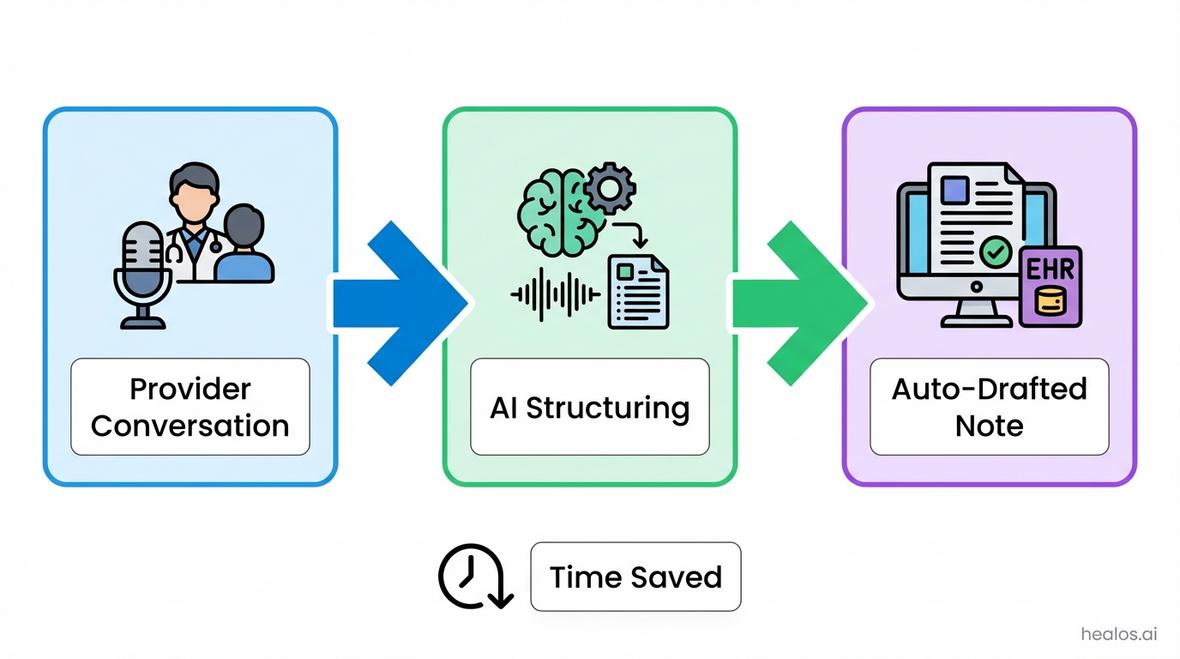
AI clinical documentation refers to intelligent software systems that automatically generate, structure, and manage clinical notes, medical records, and healthcare documentation using artificial intelligence technologies. These systems leverage natural language processing (NLP), speech recognition, and machine learning algorithms to convert provider-patient conversations into accurate, structured clinical notes.
Core Components of AI Documentation Systems
Modern AI clinical documentation platforms integrate multiple technologies working in concert. Ambient listening technology captures natural provider-patient conversations without requiring manual dictation. Advanced speech recognition engines transcribe dialogue in real-time with 98%+ accuracy rates. NLP algorithms then extract clinically relevant information, identifying symptoms, diagnoses, treatment plans, and medication details. Machine learning models continuously improve by learning from corrections and clinical patterns specific to each specialty and practice.
The HealOS AI Scribe exemplifies this unified approach, offering seamless EHR integration that automatically populates structured fields while maintaining narrative flow. Unlike fragmented solutions requiring multiple tools, this consolidated platform addresses the complete documentation lifecycle from capture through billing optimization.
Financial Impact on Practice Operations
For practice managers focused on financial health and operational efficiency, the return on investment from ai clinical documentation systems proves substantial. Traditional human medical scribes cost between $35,000 to $50,000 annually per provider, while AI solutions typically range from $99 to $399 monthly per provider representing potential savings exceeding $40,000 per provider yearly.
Reducing Claim Denials Through Documentation Quality
Incomplete or inaccurate clinical documentation remains a leading cause of insurance claim denials, directly impacting practice revenue. AI documentation systems ensure comprehensive capture of all billable services, accurate ICD-10 coding, and proper medical necessity justification. The HealOS Revenue Cycle Management suite integrates documentation quality checks with automated coding suggestions, reducing denial rates by ensuring clean claims from the outset.
According to industry analyses, practices implementing AI documentation report 15-30% reductions in claim denials within the first six months. This improvement stems from consistent documentation standards, automated coding verification, and comprehensive capture of encounter complexity that supports higher-level billing when clinically appropriate.
Addressing Staffing Shortages and Provider Burnout
The healthcare industry faces unprecedented staffing challenges, with 57% of physicians ranking administrative burden reduction as their top priority. Medical scribe positions remain chronically unfilled, forcing providers to absorb documentation workload that extends their workday by 2-3 hours beyond clinical sessions the phenomenon known as 'pajama time.'
Scaling Practice Operations Without Increasing Headcount
AI clinical documentation enables practices to see more patients without adding administrative staff. By automating note generation, these systems eliminate the scribe recruitment bottleneck while providing consistent documentation quality regardless of staffing fluctuations. Practice managers can redirect administrative personnel to revenue-generating activities like insurance benefit verification or patient engagement rather than documentation tasks.
The NVIDIA 2026 State of AI in Healthcare Report highlights how healthcare organizations achieve workflow efficiency gains through documentation automation, enabling regulatory readiness while optimizing resource allocation.
Combating Physician Burnout at the Source
Provider burnout correlates directly with administrative burden, particularly documentation workload. By reclaiming 1-2 hours daily previously spent on charting, physicians report improved work-life balance, increased professional satisfaction, and reduced emotional exhaustion. The comprehensive approach to eliminating pajama time demonstrates how strategic AI implementation transforms provider experience while maintaining clinical quality.
Seamless EHR Integration: The Unified Agent Approach
Many practice managers hesitate to implement new technology due to integration complexity and workflow disruption. The 'unified agent' approach distinguishes superior ai clinical documentation platforms from basic transcription tools. Rather than requiring providers to learn new systems or manually transfer information, these solutions work within existing EHR workflows.
How Seamless Integration Works
Advanced AI documentation platforms connect through standardized healthcare APIs (FHIR, HL7) or utilize secure browser extensions that interact directly with EHR interfaces. The HealOS integration framework supports all major EHR systems including Epic, Cerner, Athenahealth, eClinicalWorks, and dozens of specialty-specific platforms. This compatibility ensures documentation flows directly into appropriate EHR fields without manual copying or reformatting.
Implementation typically requires less than 24 hours, with providers experiencing minimal workflow disruption. The system learns EHR-specific templates, custom fields, and specialty-specific documentation requirements, adapting its output formatting accordingly.
Specialty-Specific AI Documentation Solutions
Different medical specialties have unique documentation requirements, terminology, and workflow patterns. Generic AI scribes often struggle with specialty-specific contexts, requiring extensive post-generation editing that negates efficiency gains.
Mental Health and Behavioral Health Documentation
Psychiatric and therapy practices require specialized documentation formats like SOAP, DAP, BIRP notes with attention to mental status examinations and treatment planning. The HealOS psychiatry solution understands therapeutic terminology, captures nuanced mental health assessments, and generates compliant progress notes matching payer requirements for different therapy modalities.
Surgical and Procedural Specialties
Orthopedics, cardiology, and surgical specialties need detailed procedural documentation, operative notes, and pre-/post-operative assessments. AI systems trained on surgical vocabulary accurately capture complex anatomical descriptions, instrument usage, and technique details. The cardiology-specific implementation recognizes cardiac terminology, imaging interpretations, and intervention procedures that general-purpose systems miss.
Multi-Provider Group Practices
Large group practices benefit from AI documentation's consistency across multiple providers while accommodating individual documentation styles. Centralized administrative oversight through unified dashboards enables practice managers to monitor documentation completion rates, identify bottlenecks, and ensure compliance standards across the entire provider team.
Implementation Roadmap for Practice Managers
Successfully deploying ai clinical documentation requires strategic planning beyond vendor selection. Practice managers should follow a structured implementation approach to maximize adoption and ROI.
Phase 1: Documentation Workflow Assessment
Begin by analyzing current documentation workflows, identifying bottlenecks, measuring time spent on charting, and quantifying related costs. Document provider pain points, specialty-specific requirements, and EHR limitations. This baseline establishes measurable improvement targets and builds internal stakeholder buy-in.
Phase 2: Pilot Program with Select Providers
Launch with 2-3 providers representing different specialties or documentation styles. This contained pilot reveals integration challenges, template customization needs, and training requirements before full-scale deployment. Collect quantitative metrics (time saved, notes completed) and qualitative feedback (user satisfaction, workflow impact) throughout the pilot period.
Phase 3: Staged Practice-Wide Rollout
Expand systematically rather than organization-wide simultaneously. This phased approach allows support resources to focus on each cohort, addresses specialty-specific customizations sequentially, and builds internal champions who mentor subsequent user groups. The comprehensive training methodology ensures providers achieve proficiency quickly.
Phase 4: Continuous Optimization and Expansion
After initial deployment, continuously refine templates based on provider feedback, expand to additional use cases like document automation for referrals and prior authorizations, and integrate complementary automation tools for intake, scheduling, and billing processes.
Measuring ROI: Key Performance Indicators for Practice Managers
Quantifying ai clinical documentation value requires tracking specific operational and financial metrics that align with practice management priorities.
Documentation Efficiency Metrics
Primary efficiency indicators include average time per note completion (target reduction: 50-70%), documentation completion within 24 hours of encounter (target: 95%+), and provider time reclaimed for patient care or administrative reduction. Track these metrics by provider, specialty, and encounter type to identify optimization opportunities.
Financial Performance Indicators
Monitor revenue impact through claim denial rates (target reduction: 15-30%), days in accounts receivable (target reduction: 10-20%), coding accuracy and appropriate E&M level capture, and net collections per provider. The comprehensive healthcare automation ROI calculator provides frameworks for measuring these financial outcomes.
Clinical Quality and Compliance Metrics
Documentation quality indicators include audit performance scores, clinical detail completeness for continuity of care, patient safety documentation (allergies, medications, problem lists), and regulatory compliance adherence. Superior AI systems improve these quality metrics while simultaneously increasing efficiency.
2026 Trends Shaping AI Clinical Documentation
The ai clinical documentation landscape continues evolving rapidly, with several emerging trends reshaping practice management strategies for forward-thinking healthcare organizations.
Ambient Clinical Intelligence Expansion
Next-generation systems move beyond simple transcription toward true clinical intelligence. These platforms not only capture conversations but analyze clinical reasoning, suggest differential diagnoses, flag potential drug interactions, and identify care gaps in real-time. The Wolters Kluwer analysis of 2026 healthcare AI trends emphasizes how generative AI transforms clinical documentation alongside decision support and patient engagement.
Unified Healthcare Automation Platforms
Rather than deploying separate point solutions for documentation, scheduling, billing, and patient communication, leading practices adopt unified platforms that orchestrate all administrative workflows. This consolidated approach reduces vendor management complexity, ensures data consistency across functions, and provides comprehensive analytics for practice optimization.
Predictive Analytics for Practice Management
Advanced AI documentation systems analyze historical patterns to predict appointment no-shows, identify patients at risk for non-compliance, forecast revenue cycles, and optimize scheduling templates. These predictive capabilities transform reactive practice management into proactive operational planning.
Security, Privacy, and Compliance Considerations
Practice managers must ensure ai clinical documentation systems meet stringent healthcare privacy and security requirements while maintaining operational efficiency.
HIPAA Compliance and Data Security
All AI documentation platforms must demonstrate full HIPAA compliance through business associate agreements, encrypted data transmission and storage, audit logging of all access and modifications, and secure authentication protocols. Evaluate vendors based on SOC 2 Type II certifications, penetration testing frequency, and incident response procedures.
Data Ownership and Model Training
Clarify whether your clinical data trains vendor AI models or remains exclusively within your practice environment. Optimal solutions offer private deployment options where AI models learn from your practice's documentation patterns without sharing Protected Health Information across customer databases.
Overcoming Common Implementation Challenges
Practice managers encounter predictable obstacles when deploying AI documentation systems. Proactive planning mitigates these challenges and accelerates successful adoption.
Provider Resistance and Change Management
Physician skepticism toward new technology stems from past negative experiences with EHR implementations and workflow disruptions. Address resistance through early provider involvement in vendor selection, transparent pilot programs demonstrating tangible time savings, and incremental adoption allowing gradual workflow adjustment rather than forced overnight transitions.
Template Customization and Specialty Adaptation
Generic AI output requires extensive editing when systems lack specialty-specific training. Invest initial effort in template customization, working with vendors to train models on your practice's preferred formats, terminology, and documentation styles. This upfront investment pays dividends through reduced long-term editing burden.
EHR Workflow Integration Complexity
Some EHR systems present integration challenges due to closed architectures or outdated API capabilities. Evaluate integration methods during vendor selection, prioritize vendors with proven track records in your specific EHR environment, and consider browser-based solutions when direct API integration proves problematic.
Frequently Asked Questions
How accurate is AI clinical documentation compared to human scribes?
Leading AI documentation platforms achieve 98%+ transcription accuracy rates with specialty-trained models. While human scribes offer contextual understanding advantages, they introduce variability based on individual skill levels, experience, and attention during sessions. AI systems provide consistent baseline quality with continuous improvement through machine learning, whereas human performance fluctuates based on fatigue, workload, and turnover.
Can AI documentation handle multiple providers in group practice settings?
Yes, advanced systems easily accommodate multiple providers within single practices. Each provider can maintain individualized templates, documentation preferences, and writing styles while the practice manager maintains centralized oversight through administrative dashboards. Systems track documentation by provider, enabling performance monitoring and workflow optimization across the entire practice.
What happens if the AI generates incorrect clinical information?
All AI documentation systems position generated notes as drafts requiring provider review and approval before finalization. Physicians maintain ultimate responsibility for clinical documentation accuracy and must review AI-generated content before signing. Quality systems highlight areas of uncertainty, flag potential inconsistencies, and learn from provider corrections to improve future accuracy.
How long does implementation typically take?
Initial technical integration often completes within 24-48 hours for cloud-based solutions with standard EHR connections. Provider training and workflow adjustment typically span 1-2 weeks for basic proficiency, with full optimization occurring over 30-60 days as templates refine and providers develop efficient review patterns. Phased rollouts for larger practices extend timelines but reduce implementation risk.
What ROI can practice managers realistically expect?
Most practices achieve positive ROI within 3-6 months through combined savings from eliminated scribe costs, increased provider productivity, reduced claim denials, and improved coding accuracy. Typical financial impact includes $30,000-$45,000 annual savings per provider on scribe costs alone, plus 10-20% revenue increases from seeing additional patients during reclaimed documentation time.
Conclusion
For overwhelmed practice managers navigating staffing shortages, provider burnout, and operational scaling challenges, ai clinical documentation represents a strategic solution addressing multiple pain points simultaneously. By automating administrative workflows through seamless EHR integration and unified agent approaches, practices reduce claim denials, eliminate documentation bottlenecks, and scale operations without increasing headcount. The financial case proves compelling with substantial ROI through combined cost savings and revenue optimization, while improved provider satisfaction and work-life balance deliver intangible benefits that strengthen practice culture and retention. As healthcare continues its digital transformation trajectory, early AI documentation adopters position themselves for competitive advantages in operational efficiency, financial performance, and clinical quality that will define successful practices throughout 2026 and beyond.