
AI Dictation Medical: The Complete 2026 Guide To Automating Clinical Documentation And Reducing Provider Burnout

Introduction
Medical documentation has long been a primary source of physician burnout, with clinicians spending nearly two hours on administrative tasks for every hour of direct patient care. Traditional ai dictation medical solutions have evolved significantly, transforming from basic voice-to-text tools into intelligent systems that understand clinical context, generate structured notes, and integrate seamlessly with EHR platforms. This comprehensive guide explores how modern AI dictation technology is revolutionizing healthcare documentation in 2026, enabling practice managers to scale operations without expanding headcount while simultaneously reducing provider burnout.
For overwhelmed practice managers facing staffing shortages and mounting administrative burdens, ai dictation medical systems represent a strategic solution that addresses both operational efficiency and financial health. By automating the documentation process, these systems reduce claim denials through improved accuracy, accelerate revenue cycles, and free providers to focus on patient care rather than keyboard entry.
Understanding AI Dictation Medical Technology
The term 'ai dictation medical' encompasses a range of technologies that use artificial intelligence to convert spoken clinical conversations into structured medical documentation. Unlike traditional medical transcription services that require human intermediaries, modern AI dictation systems employ natural language processing (NLP), machine learning algorithms, and ambient listening capabilities to capture, interpret, and format clinical encounters in real-time.
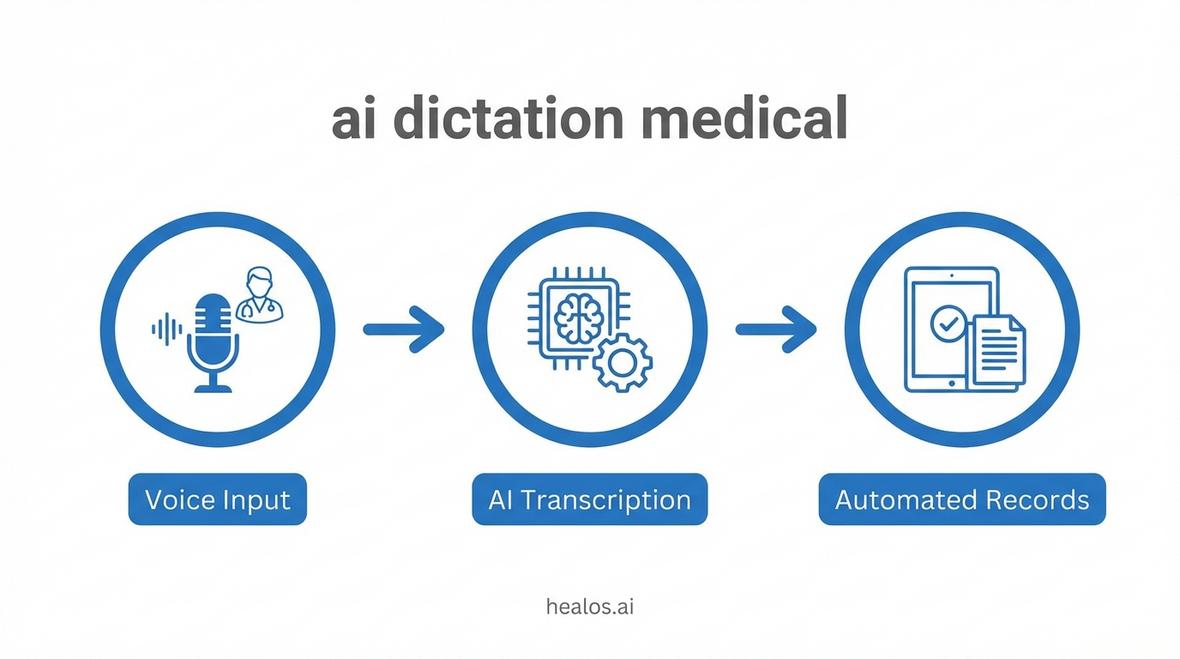
How AI Dictation Medical Works
Modern ai dictation medical platforms operate through three integrated phases. First, voice input capture occurs via microphone or ambient listening during patient encounters. Second, AI transcription engines process the audio using advanced speech recognition and clinical NLP models trained on millions of medical conversations. Third, automated record generation transforms the transcribed content into formatted clinical notes that match specialty-specific templates and documentation requirements.
These systems distinguish themselves from legacy voice recognition tools by understanding medical terminology, clinical context, and documentation standards. They can differentiate between subjective patient statements and objective clinical observations, properly structure SOAP notes, and even suggest appropriate billing codes based on documented procedures and diagnoses.
Ambient vs. Directed Dictation
The ai dictation medical landscape includes two primary approaches. Directed dictation requires providers to actively speak to the system, narrating their clinical findings in a structured format. Ambient AI dictation, by contrast, passively listens to natural patient-provider conversations and automatically generates documentation without requiring the clinician to change their communication style.
Ambient solutions offer superior workflow integration since providers simply have normal conversations with patients while the AI works in the background. This approach reduces cognitive load and preserves the patient-provider relationship that can be disrupted when clinicians focus on speaking to a recording device rather than engaging with the patient directly.
Benefits of AI Dictation Medical for Practice Managers
For practice managers navigating today's healthcare challenges, ai dictation medical systems deliver measurable improvements across multiple operational dimensions. The financial, staffing, and quality outcomes make these solutions increasingly essential for competitive practice management.
Addressing Staffing Shortages
The healthcare industry faces severe workforce shortages, with medical scribes and administrative staff particularly difficult to recruit and retain. Ambient AI reduces provider burnout via documentation automation, effectively functioning as a virtual scribe that never calls in sick, requires no benefits, and scales instantly as patient volume increases.
By implementing ai dictation medical technology, practice managers eliminate dependence on scarce human resources for documentation tasks. This allows existing staff to focus on higher-value activities like patient coordination, quality improvement initiatives, and revenue cycle management rather than note-taking and transcription.
Reducing Claim Denials Through Documentation Accuracy
Documentation quality directly impacts reimbursement rates and claim approval. Incomplete or inaccurate notes frequently result in claim denials, payment delays, and revenue leakage. Modern ai dictation medical systems significantly improve documentation completeness by capturing all relevant clinical details and ensuring notes meet payer requirements for medical necessity.
AI-powered documentation platforms can flag missing elements in real-time, prompt providers to address documentation gaps, and ensure appropriate specificity in diagnosis coding. This proactive approach to documentation quality translates into faster claim processing, fewer denials, and improved cash flow critical outcomes for practice financial health.
Operational Efficiency and Scalability
Practice managers constantly balance growth ambitions against operational constraints. Ai dictation medical solutions enable practices to increase patient volume without proportional increases in documentation staff or provider after-hours charting time. The automation of clinical documentation represents a true force multiplier for practice capacity.
Providers using advanced AI scribe technology complete notes 50-70% faster than manual charting methods, enabling them to see additional patients during clinic hours or reclaim personal time previously spent on 'pajama time' documentation. For practice managers, this efficiency translates into revenue growth without corresponding cost increases the ideal scenario for sustainable practice expansion.
Key Features of Modern AI Dictation Medical Systems
Not all ai dictation medical platforms deliver equal value. Practice managers evaluating solutions should prioritize systems with robust feature sets that address the full spectrum of documentation needs and workflow integration requirements.
Seamless EHR Integration
The most critical feature of any ai dictation medical system is its ability to integrate with your existing electronic health record platform. Solutions that require manual copy-paste workflows create friction and limit adoption. Leading platforms offer native integrations with major EHR systems like Epic, Cerner, Athenahealth, and eClinicalWorks, allowing documentation to flow directly into patient charts.
HealOS exemplifies this unified agent approach, providing seamless connectivity across diverse EHR environments without requiring expensive custom development or ongoing IT support. This integration capability ensures that ai dictation medical technology enhances rather than disrupts existing clinical workflows.
Specialty-Specific Documentation Templates
Medical specialties have distinct documentation requirements, terminology, and note structures. Generic ai dictation medical systems that apply one-size-fits-all templates produce notes requiring extensive editing. Advanced platforms offer specialty-specific templates for fields ranging from cardiology and orthopedics to psychiatry and pediatrics.
These customized templates ensure that generated notes include specialty-relevant sections, use appropriate terminology, and meet specialty-specific billing documentation requirements. Practice managers serving specialized care settings should prioritize ai dictation medical vendors with demonstrated expertise in their clinical domain.
Multi-Language Support and Translation
Increasingly diverse patient populations require multilingual documentation capabilities. Advanced ai dictation medical platforms support conversations in multiple languages and can generate notes in English regardless of the language spoken during the encounter. This capability expands access to care while ensuring standardized documentation for billing and legal purposes.
Some systems also provide medical translation services that convert completed notes into patient-preferred languages, supporting patient education and engagement across language barriers.
HIPAA Compliance and Security
Healthcare documentation involves highly sensitive patient information requiring strict security controls. Any ai dictation medical platform must demonstrate robust HIPAA compliance, including encrypted data transmission, secure cloud storage, access controls, and comprehensive audit trails.
Practice managers should verify that prospective vendors complete regular security audits, maintain appropriate business associate agreements, and implement data handling practices that meet or exceed regulatory requirements. Compromising on security to save costs creates unacceptable legal and reputational risks.
Implementation Considerations for Practice Managers
Successfully deploying ai dictation medical technology requires careful planning and change management. Practice managers who approach implementation strategically achieve faster adoption, higher satisfaction, and better return on investment.
Provider Training and Adoption Strategies
Technology adoption ultimately depends on provider buy-in. Clinicians skeptical of ai dictation medical systems may resist change or revert to familiar manual documentation methods. Effective implementation includes comprehensive training, ongoing support, and demonstrating quick wins that build confidence in the technology.
Start with enthusiastic early adopters who can serve as champions for broader adoption. Provide hands-on training sessions, readily accessible support resources, and regular feedback loops where providers can share experiences and request adjustments. Most importantly, quantify and communicate time savings and quality improvements to reinforce the value proposition.
Workflow Integration and Customization
Generic implementations of ai dictation medical technology often fail because they don't align with existing clinical workflows. Practice managers should work with vendors to customize the solution for their specific environment, including note templates, integration points with scheduling and billing systems, and workflow triggers.
Consider how the technology fits within existing processes: Will providers use it during patient encounters, immediately afterward, or at the end of the day? Does it integrate with your AI receptionist and front-office systems? How does it coordinate with your revenue cycle management processes? Answering these questions upfront prevents implementation friction.
Cost Analysis and ROI Calculation
Practice managers must justify ai dictation medical investments through clear financial analysis. Calculate the total cost of ownership including licensing fees, implementation costs, training time, and ongoing support. Compare this against current documentation costs including scribe salaries, transcription services, provider overtime for charting, and revenue lost to claim denials.
Most practices achieve positive ROI within 6-12 months through a combination of reduced staffing costs, increased provider productivity, improved billing accuracy, and enhanced provider satisfaction. Document baseline metrics before implementation to accurately measure improvement and validate the business case.
The HealOS Advantage for AI Dictation Medical
Among ai dictation medical platforms, HealOS distinguishes itself through its comprehensive, unified agent approach that extends beyond simple transcription to address the full spectrum of practice automation needs. For practice managers seeking a strategic solution rather than a point tool, this integrated approach delivers superior value.
Unified Agent Approach
Rather than forcing practices to cobble together disparate tools for different functions, HealOS provides a single platform that handles medical dictation, eligibility verification, prior authorization, referral management, and numerous other administrative workflows. This unified approach reduces vendor management complexity, ensures seamless data flow between functions, and provides practice managers with a single platform for comprehensive practice automation.
The ai dictation medical capabilities within HealOS integrate natively with other automation agents, so information captured during documentation automatically flows to billing, scheduling, and care coordination functions without manual intervention.
Comprehensive EHR Integration
HealOS offers the healthcare industry's most extensive EHR integration capabilities, connecting seamlessly with virtually any electronic health record system through a combination of native integrations, HL7 interfaces, and API connections. This flexibility ensures that practices aren't forced to change EHR platforms to access advanced ai dictation medical capabilities.
The platform's integration architecture supports bidirectional data flow, meaning information flows both into and out of the EHR. This enables HealOS to retrieve patient context before encounters, pre-populate templates with relevant historical information, and write completed notes directly back to the patient chart without provider intervention.
Specialty-Specific Optimization
HealOS provides optimized ai dictation medical workflows for diverse specialties including therapy, primary care, oncology, and many others. Each specialty implementation includes customized templates, terminology libraries, and documentation workflows designed by clinicians practicing in those fields.
This specialty-specific approach ensures that generated notes meet the unique requirements of each discipline without requiring extensive customization or ongoing template maintenance by practice staff.
Comparing AI Dictation Medical Solutions
The ai dictation medical market includes numerous vendors with varying capabilities, pricing models, and implementation approaches. Practice managers should evaluate alternatives systematically based on criteria aligned with their operational priorities.
Key Evaluation Criteria
When comparing ai dictation medical platforms, consider accuracy rates (target 95%+ for medical terminology), turnaround time (real-time vs. batch processing), EHR integration depth, specialty support, compliance certifications, pricing transparency, and vendor stability. Request demonstrations with your actual clinical scenarios rather than generic examples, and speak with current customers in similar practice settings.
Compare platforms directly using resources like the HealOS comparison pages that provide detailed feature-by-feature analysis of leading solutions. Understanding relative strengths and limitations helps identify the best fit for your specific requirements.
Pricing Models and Hidden Costs
AI dictation medical platforms employ various pricing models including per-provider monthly subscriptions, per-encounter fees, and tiered pricing based on practice size. Look beyond headline pricing to understand total cost of ownership including implementation fees, training costs, integration expenses, and ongoing support charges.
Some vendors advertise low base prices but charge significant additional fees for features like specialty templates, advanced integrations, or premium support. Ensure you understand the complete cost structure and what's included at each pricing tier before making commitments.
Future Trends in AI Dictation Medical Technology
The ai dictation medical field continues to evolve rapidly with emerging capabilities that will further transform clinical documentation in coming years. Practice managers should consider vendor roadmaps and innovation trajectories when selecting long-term partners.
Predictive and Proactive Documentation
Next-generation ai dictation medical systems will move beyond passive transcription to actively assist clinical decision-making. These platforms will suggest differential diagnoses based on symptoms discussed, recommend appropriate orders and interventions based on clinical guidelines, and flag potential medication interactions or contraindications mentioned during encounters.
This evolution transforms AI scribes from documentation tools into active clinical support systems that enhance care quality while simplifying documentation requirements.
Multimodal Data Integration
Future ai dictation medical platforms will incorporate data from multiple sources beyond voice, including vital sign monitors, diagnostic imaging, lab results, and wearable devices. This comprehensive data integration will enable automated generation of more complete clinical pictures with less provider effort.
Imagine a system that automatically incorporates ECG findings, laboratory results, and imaging reports into progress notes while the provider focuses entirely on patient interaction this represents the near-term future of healthcare documentation.
Overcoming Common Implementation Challenges
Despite clear benefits, ai dictation medical implementations sometimes encounter obstacles. Understanding common challenges and mitigation strategies improves success rates.
Addressing Provider Resistance
Some clinicians resist adopting ai dictation medical technology due to concerns about accuracy, workflow disruption, or skepticism about AI capabilities. Address resistance through transparent communication about how the technology works, involving skeptical providers in pilot programs, and demonstrating measurable time savings achieved by early adopters.
Allow providers to maintain some control over the process by offering hybrid approaches where they can review and edit AI-generated notes before finalizing. As confidence builds, most providers gradually reduce editing and trust the system more fully.
Managing Technical Integration Complexity
EHR integration represents the most common technical challenge in ai dictation medical implementations. Mitigate integration risks by selecting vendors with proven track records with your specific EHR platform, allocating adequate IT resources during implementation, and planning thorough testing before full deployment.
Work closely with your EHR vendor and the AI dictation platform provider to ensure appropriate data mapping, security configurations, and workflow integrations are properly implemented from the start.
Measuring Success and ROI
Quantifying the impact of ai dictation medical implementations validates investment decisions and identifies optimization opportunities. Practice managers should establish measurement frameworks before deployment and track key metrics consistently.
Key Performance Indicators
Monitor metrics including documentation time per encounter, chart closure rates (percentage of notes completed within 24 hours), provider satisfaction scores, claim denial rates, days in accounts receivable, and patient satisfaction ratings. Improvements across these dimensions demonstrate comprehensive value creation from ai dictation medical technology.
Establish baseline measurements before implementation and track metrics monthly to identify trends and correlate improvements with the technology deployment.
Qualitative Benefits
Beyond quantitative metrics, assess qualitative outcomes like provider work-life balance, staff morale, patient feedback about provider engagement during visits, and provider retention rates. These softer metrics often represent the most significant long-term value of ai dictation medical solutions but are frequently overlooked in traditional ROI analyses.
Frequently Asked Questions
How accurate is AI dictation medical technology?
Leading ai dictation medical platforms achieve 95-98% accuracy for medical terminology when properly implemented and trained on specialty-specific vocabulary. Accuracy continues improving as systems learn from usage patterns and expanded training data.
Does AI dictation medical work with my EHR?
Most major ai dictation medical platforms integrate with popular EHR systems including Epic, Cerner, Athenahealth, and eClinicalWorks. Platforms like HealOS offer particularly broad integration capabilities across diverse EHR environments through multiple connection methods.
How long does implementation take?
Typical ai dictation medical implementations require 2-6 weeks depending on practice size, EHR complexity, and customization requirements. Some cloud-based solutions with standard integrations can be operational within days for smaller practices.
What does AI dictation medical cost?
Pricing varies significantly across vendors, typically ranging from $100-$400 per provider per month depending on features, specialty requirements, and practice size. Compare total cost of ownership against current documentation expenses including scribe services, transcription costs, and provider overtime for charting.
Will AI replace medical scribes entirely?
While ai dictation medical technology automates many scribe functions, human scribes remain valuable for complex cases, training environments, and situations requiring nuanced clinical judgment. Most practices find that AI enables them to operate efficiently with fewer scribes rather than eliminating the role entirely.
How does AI dictation medical improve work-life balance?
By reducing or eliminating after-hours charting (so-called 'pajama time'), ai dictation medical systems help providers complete documentation during clinic hours, reclaim personal time, and reduce burnout associated with excessive administrative burdens.
Conclusion
AI dictation medical technology has matured into an essential tool for modern healthcare practices facing staffing challenges, documentation burdens, and financial pressures. For practice managers seeking to automate administrative workflows and scale operations without expanding headcount, these systems deliver measurable improvements in efficiency, accuracy, and provider satisfaction. Solutions like HealOS that offer seamless EHR integration, specialty-specific optimization, and unified agent approaches represent the future of practice automation. By thoughtfully implementing ai dictation medical technology with attention to workflow integration, provider training, and outcome measurement, practices can transform documentation from a burden into a competitive advantage while simultaneously improving financial health and reducing provider burnout.