
AI Doctors Note: How Healthcare Automation Reduces Documentation Time By 75% In 2026

Understanding AI Doctors Note Technology
The administrative burden of clinical documentation has reached crisis levels in modern healthcare. Physicians spend an average of 28 hours weekly on paperwork, often extending into evenings and weekends time that could be spent with patients or maintaining work-life balance. Enter the ai doctors note solution, a transformative technology that leverages artificial intelligence to automate medical documentation workflows and restore clinical efficiency.
An ai doctors note system uses advanced natural language processing and machine learning algorithms to capture patient encounters, generate clinical notes, and integrate seamlessly with existing Electronic Health Record (EHR) systems. According to research from the American Medical Association, practices implementing AI documentation tools report up to 75% reduction in charting time, translating to approximately 3-4 hours saved per provider daily.
For practice managers facing staffing shortages and provider burnout, the value proposition is clear: automation delivers both operational efficiency and financial health improvements without requiring additional headcount.
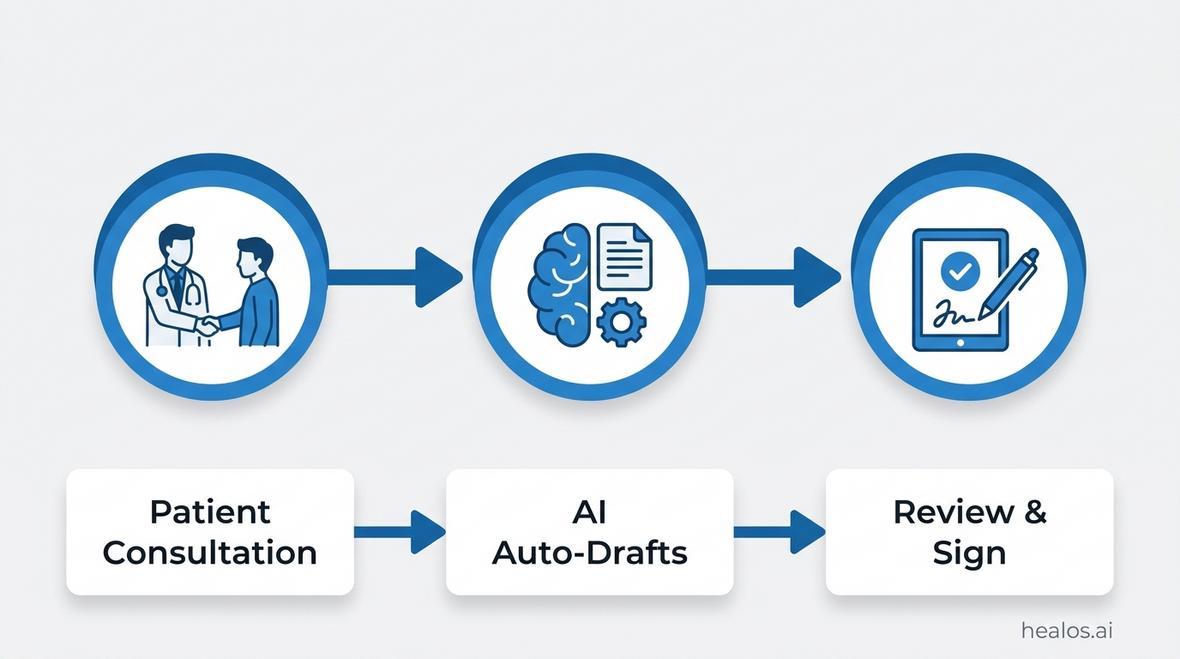
How AI Doctors Note Systems Work
Modern ai doctors note platforms operate through a streamlined three-step process that mirrors natural clinical workflows. First, during the patient consultation, the AI system listens and captures the conversation using ambient voice technology. Providers conduct their visits naturally without needing to type, click, or dictate into separate devices.
Second, the AI auto-drafts comprehensive clinical documentation by processing the captured audio through sophisticated algorithms trained on millions of medical encounters. These systems understand medical terminology, clinical context, and specialty-specific documentation requirements. The technology generates structured SOAP notes, progress notes, and specialty-specific templates in real-time.
Third, providers receive AI-generated drafts for review and electronic signature. This final human oversight step ensures accuracy while dramatically reducing the time spent on documentation. What previously took 15-20 minutes per patient now requires just 2-3 minutes of review time.
The AI scribe technology at the core of these systems integrates directly with existing EHR platforms, ensuring seamless data flow and eliminating duplicate entry. This integration capability is critical for practice managers seeking automation solutions that won't disrupt established workflows.
Ambient Listening Technology
Ambient listening represents the next evolution in medical documentation. Unlike traditional dictation software requiring specific voice commands, ambient AI systems process natural conversations between providers and patients. The technology distinguishes between multiple speakers, identifies clinically relevant information, and filters out non-medical dialogue.
This hands-free approach allows physicians to maintain eye contact and engage meaningfully with patients rather than staring at computer screens. Studies show that ambient listening technology improves patient satisfaction scores by 18-25% while simultaneously reducing documentation burden.
Natural Language Processing in Medical AI
The effectiveness of any ai doctors note system depends on sophisticated natural language processing (NLP) capabilities specifically trained on medical language. These algorithms must understand medical terminology, abbreviations, and the nuanced context of clinical conversations across dozens of specialties.
Advanced NLP engines recognize relationships between symptoms, diagnoses, medications, and treatment plans. They automatically extract billable procedures, suggest appropriate ICD-10 codes, and flag potential documentation gaps that could lead to claim denials. This intelligence transforms raw conversation into structured, compliant clinical documentation.
The Financial Impact: Claim Denials and Documentation Errors
Poor documentation quality directly impacts practice revenue through claim denials and payment delays. Claim denials cost practices $11M+ annually from documentation errors, with initial denial rates ranging from 15-20% for practices relying on manual documentation processes.
Each denied claim requires staff time to investigate, correct, and resubmit an administrative cycle that costs practices an average of $125,000 monthly in lost revenue and overhead expenses. For mid-sized practices with 10-15 providers, documentation-related revenue leakage can exceed $1.5 million annually.
AI doctors note systems address this financial hemorrhage by improving documentation accuracy to greater than 95%, ensuring that notes contain all required elements for first-pass claim approval. Automated coding suggestions reduce human error in procedure and diagnosis code selection, while real-time documentation checks flag missing information before encounters are closed.
The revenue cycle management benefits extend beyond claim acceptance rates. Comprehensive, accurate documentation supports higher-level billing codes when clinically appropriate, capturing additional revenue that manual documentation might miss. Practice managers report 12-18% revenue increases within six months of implementing AI documentation solutions.
Reducing Administrative Overhead
The staffing implications of AI documentation are equally compelling. Traditional documentation workflows require substantial support staff: medical scribes, transcriptionists, and billing specialists who review notes for completeness. These positions represent significant recurring costs typically $35,000-$45,000 annually per full-time equivalent.
An ai doctors note platform can replace or significantly reduce the need for these positions while delivering superior consistency and speed. For practices facing recruiting challenges in tight labor markets, AI automation offers scalability without the complexities of hiring, training, and managing additional headcount.
Addressing Provider Burnout and Pajama Time
Provider burnout has reached epidemic proportions, with documentation burden cited as a primary contributing factor. The concept of 'pajama time'—hours spent on charting after clinic hours has become normalized in healthcare, with physicians routinely completing notes at home during evenings and weekends.
This unsustainable pattern contributes to high turnover rates, reduced patient satisfaction, and declining quality of care. According to the National Academy of Medicine, burnout-related physician turnover costs the healthcare system approximately $4.6 billion annually, with individual replacement costs exceeding $500,000 per physician when factoring in recruiting, onboarding, and productivity loss.
AI doctors note technology directly addresses burnout by eliminating after-hours documentation work. Providers complete their documentation during or immediately following patient encounters, enabling them to leave work on time and maintain healthier boundaries between professional and personal life.
The impact on provider satisfaction is measurable and immediate. Practices implementing AI documentation report 30-40% improvements in provider satisfaction scores within three months. Reduced burnout translates to better patient care, lower turnover, and improved practice culture.
Specialty-Specific Documentation Benefits
Different medical specialties face unique documentation challenges. Psychiatrists and therapists must capture detailed session notes while maintaining therapeutic rapport. Cardiologists require comprehensive documentation of complex cardiac histories and diagnostic interpretations. Pediatricians need age-appropriate documentation that captures developmental milestones and parental concerns.
Modern ai doctors note platforms offer specialty-specific templates and documentation workflows optimized for these diverse needs. A psychiatry-focused AI scribe understands mental health terminology and generates notes in DAP, SOAP, or narrative formats. A cardiology solution automatically incorporates EKG interpretations and catheterization findings.
This specialization ensures that AI-generated notes meet specialty board requirements and regulatory standards while capturing the clinical nuances that matter most to each discipline.
EHR Integration and the Unified Agent Approach
For practice managers evaluating AI solutions, EHR integration capabilities represent a critical decision factor. Fragmented systems that require providers to toggle between multiple platforms undermine efficiency gains and create new frustrations. The unified agent approach addresses this challenge by creating a single AI-powered system that handles documentation, coding, billing, and administrative workflows within the existing EHR environment.
HealOS exemplifies this unified approach by offering seamless integration with major EHR platforms including Epic, Cerner, athenahealth, and dozens of others. Providers work within their familiar EHR interface while AI agents operate in the background, capturing conversations, generating notes, and populating appropriate fields automatically.
This integration extends beyond documentation to encompass the entire practice workflow. Automated insurance verification, prior authorization processing, and referral management all operate through the same unified platform, eliminating the need for separate point solutions and reducing vendor management complexity.
Implementation and Deployment Timeline
Practice managers rightfully worry about implementation timelines and disruption to clinical operations. Traditional EHR implementations can take 6-12 months and require significant workflow adjustments. Modern ai doctors note solutions deploy far more rapidly, with many practices achieving full implementation within 2-4 weeks.
The deployment process typically includes: initial EHR integration and testing (1 week), provider training and workflow optimization (1 week), and gradual rollout with ongoing support (1-2 weeks). Because AI documentation tools work within existing EHR systems rather than replacing them, the learning curve is minimal and provider adoption is high.
Compliance, Security, and HIPAA Considerations
Healthcare data security and regulatory compliance are non-negotiable requirements for any technology handling patient information. Practice managers must ensure that ai doctors note solutions meet stringent HIPAA requirements, including encryption of data in transit and at rest, comprehensive audit trails, and Business Associate Agreements.
Leading AI documentation platforms undergo regular third-party security audits and maintain SOC 2 Type II certification. Voice data is processed using end-to-end encryption, and AI models are trained using de-identified datasets that protect patient privacy. Access controls ensure that only authorized users can view or edit clinical documentation.
Beyond HIPAA compliance, practices must consider state-specific requirements for medical documentation, specialty board guidelines, and payer-specific documentation standards. Sophisticated AI systems incorporate these varying requirements into their documentation logic, ensuring that generated notes meet all applicable regulatory standards.
ROI Calculator and Cost-Benefit Analysis
The financial case for ai doctors note implementation becomes clear when practice managers calculate the total cost of manual documentation processes. Consider a mid-sized practice with 10 providers:
- Current Documentation Costs: 10 providers × 3 hours daily documentation × $150/hour opportunity cost = $4,500 daily or $1.17M annually
- Scribe Costs: 10 medical scribes × $40,000 annual salary = $400,000
- Claim Denial Costs: 15% denial rate × $2M monthly collections × $125K rework costs = $375,000 annually
- Total Annual Cost: Approximately $1.95M
After implementing AI documentation:
- Reduced Documentation Time: 75% reduction = $877,500 saved in provider time
- Reduced Scribe Needs: 50% reduction = $200,000 saved
- Improved Claim Acceptance: Denial rate drops to 5% = $250,000 saved
- Total Annual Savings: Approximately $1.33M
- AI Platform Cost: $150-300 per provider monthly = $18,000-36,000 annually
- Net ROI: $1.29M or 3,600% return on investment
These calculations demonstrate why forward-thinking practice managers view AI documentation not as an expense but as a strategic investment that pays for itself within weeks while delivering ongoing operational and financial benefits.
Choosing the Right AI Doctors Note Platform
Not all ai doctors note solutions deliver equivalent results. Practice managers should evaluate platforms based on several critical criteria:
Accuracy and Clinical Quality
Documentation accuracy rates should exceed 95%, with specialty-specific terminology and clinical context properly captured. Request sample notes and have providers evaluate clinical appropriateness before committing to a platform.
EHR Integration Capabilities
Seamless integration with your existing EHR is essential. Verify that the AI platform supports bi-directional data flow, automated field population, and native EHR interface rather than requiring separate windows or applications.
Customization and Flexibility
Practices have unique documentation preferences, templates, and workflows. The best AI documentation platforms allow extensive customization to match your specific needs rather than forcing standardized templates.
Comprehensive Automation Capabilities
Look beyond basic transcription to platforms offering comprehensive practice automation including AI receptionist capabilities, automated insurance verification, and denial management. The unified agent approach delivers greater value than fragmented point solutions.
Support and Training Resources
Implementation success depends on robust training and ongoing support. Evaluate vendor responsiveness, training resources, and customer success programs before making final decisions.
The Future of AI in Medical Documentation
The evolution of ai doctors note technology continues to accelerate. Emerging capabilities include predictive analytics that identify patients at risk for adverse events based on documentation patterns, automated quality measure reporting, and AI-powered clinical decision support integrated directly into documentation workflows.
Machine learning models continue to improve through exposure to millions of patient encounters, becoming more accurate and nuanced over time. Future systems will likely incorporate multimodal inputs including lab results, imaging, and wearable device data to generate increasingly comprehensive clinical pictures.
For practice managers, the strategic imperative is clear: AI documentation represents not a future possibility but a current necessity for practices seeking to thrive amid staffing shortages, financial pressures, and provider burnout. Early adopters gain competitive advantages through improved efficiency, provider satisfaction, and financial performance.
Implementation Best Practices
Successful ai doctors note implementation requires thoughtful change management and provider engagement. Best practices include:
- Start with Champions: Identify tech-savvy providers willing to pilot the system and provide feedback before full rollout
- Customize Templates: Work with vendors to configure specialty-specific templates and workflows before launch
- Provide Comprehensive Training: Ensure all providers receive hands-on training and have access to ongoing support resources
- Measure and Communicate Results: Track time savings, documentation quality improvements, and provider satisfaction metrics to demonstrate value
- Iterate and Optimize: Gather regular feedback and work with vendors to continuously refine the system
Practices following these best practices typically achieve provider adoption rates exceeding 90% within 30 days and realize full ROI within 3-6 months.
Frequently Asked Questions
How accurate are AI-generated doctors notes?
Leading ai doctors note platforms achieve accuracy rates exceeding 95% for clinical content, medical terminology, and documentation completeness. Advanced natural language processing trained on millions of medical encounters enables these systems to understand complex clinical conversations and generate high-quality documentation. However, human review remains essential to ensure accuracy and clinical appropriateness for each individual patient encounter.
Will AI documentation work with my existing EHR system?
Most modern AI documentation platforms integrate with major EHR systems including Epic, Cerner, athenahealth, eClinicalWorks, and dozens of others. The integration typically works through standard APIs and HL7 interfaces, enabling seamless data flow without requiring EHR replacement. Practices should verify specific integration capabilities with vendors during the evaluation process.
How long does implementation take?
Implementation timelines for ai doctors note solutions typically range from 2-4 weeks for full deployment. This includes initial EHR integration and testing (1 week), provider training (1 week), and gradual rollout with support (1-2 weeks). The rapid deployment contrasts sharply with traditional EHR implementations that can take 6-12 months, making AI documentation a low-risk addition to existing systems.
What about patient privacy and HIPAA compliance?
Reputable AI documentation platforms maintain strict HIPAA compliance through end-to-end encryption, comprehensive audit trails, and Business Associate Agreements. Voice data is encrypted during transmission and storage, and AI models are trained on de-identified datasets. Practices should verify that vendors maintain SOC 2 Type II certification and undergo regular third-party security audits.
Can AI handle specialty-specific documentation requirements?
Yes, advanced ai doctors note platforms offer specialty-specific templates and workflows for psychiatry, cardiology, pediatrics, orthopedics, and other specialties. These customized approaches ensure that documentation meets specialty board requirements and captures the clinical nuances most relevant to each discipline. The AI understands specialty-specific terminology and generates notes in appropriate formats (SOAP, DAP, narrative, etc.).
What happens if the AI makes a mistake?
All AI-generated documentation requires human review and approval before finalization. Providers review AI-drafted notes, make necessary corrections, and electronically sign completed documentation. This oversight ensures clinical accuracy while still delivering substantial time savings compared to manual documentation. Most platforms learn from corrections over time, continuously improving accuracy.
How much does AI documentation cost?
Pricing for ai doctors note platforms typically ranges from $150-300 per provider monthly, depending on feature sets and practice size. This cost is substantially lower than employing medical scribes ($35,000-45,000 annually per FTE) while delivering superior consistency and availability. Most practices achieve positive ROI within 3-6 months through time savings, reduced staffing needs, and improved claim acceptance rates.
Conclusion
The administrative burden of clinical documentation has reached unsustainable levels, driving provider burnout, staffing challenges, and financial pressures for healthcare practices. AI doctors note technology offers a proven solution that reduces documentation time by up to 75%, improves claim acceptance rates, and enables practices to scale without increasing headcount. For practice managers seeking to improve financial health and operational efficiency, AI documentation represents not a future possibility but a current strategic imperative. The unified agent approach, exemplified by platforms like HealOS, delivers seamless EHR integration and comprehensive practice automation that transforms both provider experience and practice performance. Early adopters gain competitive advantages through improved efficiency, provider satisfaction, and financial outcomes that position their practices for long-term success.