
AI Healthcare Assistant: The Complete 2026 Guide To Automating Practice Workflows

Understanding AI Healthcare Assistants in 2026
An ai healthcare assistant represents a transformative technological solution designed to automate administrative and clinical workflows in medical practices. As healthcare organizations face mounting pressures from staffing shortages, provider burnout, and escalating operational costs, AI-powered platforms have emerged as essential tools for practice managers seeking to scale operations without proportional increases in headcount.
According to research from NVIDIA, AI usage in healthcare jumped to 56% in 2026, up 13 percentage points year-over-year, with 78% of digital healthcare respondents actively using AI. This rapid adoption reflects the technology's proven ability to address critical operational pain points while improving financial outcomes and care quality.
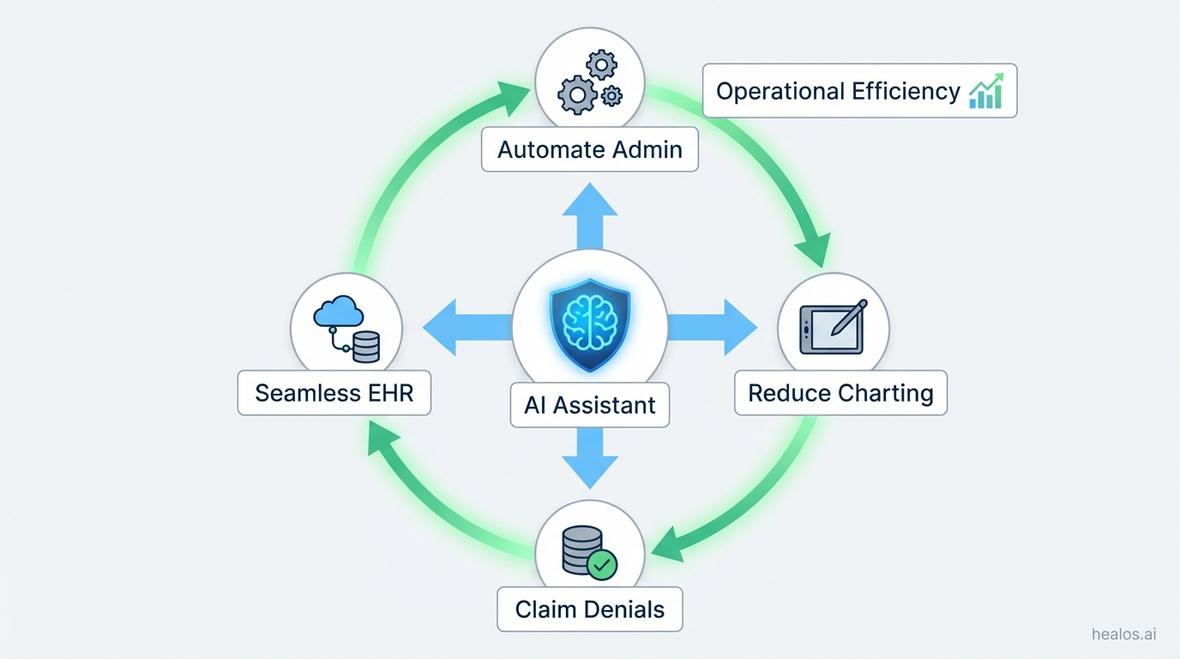
For overwhelmed practice managers, an ai healthcare assistant serves as a unified solution that integrates seamlessly with existing Electronic Health Record (EHR) systems to automate documentation, reduce claim denials, streamline revenue cycle management, and alleviate the charting burden that contributes to provider burnout. The digital health technology market is estimated to grow to over $300 billion by 2026, largely powered by AI-driven clinical decision support and ambient documentation tools that enhance care workflows.
Core Capabilities of Modern AI Healthcare Assistants
Today's ai healthcare assistant platforms deliver comprehensive automation across multiple operational domains. Understanding these capabilities helps practice managers identify which workflows can be optimized immediately for maximum impact.
Seamless EHR Integration
The foundation of any effective ai healthcare assistant lies in its ability to integrate with existing EHR systems without disrupting established workflows. Modern solutions like HealOS connect with major platforms including Epic, Cerner, Athenahealth, and dozens of other systems to ensure data flows bidirectionally without manual intervention.
This integration enables the AI to pull patient information, pre-populate fields, and write completed notes directly into the medical record eliminating the need for providers to toggle between multiple applications or manually transfer information. For practice managers, this means zero workflow disruption during implementation and faster staff adoption.
Automated Administrative Workflows
Administrative tasks consume an estimated 77% of healthcare workers' time, according to industry research. An ai healthcare assistant dramatically reduces this burden by automating repetitive processes including:
- Patient intake and registration: Automated collection and verification of patient demographics, insurance information, and medical history
- Appointment scheduling and reminders: AI-powered receptionist capabilities that handle booking, rescheduling, and confirmation calls
- Insurance verification: Real-time eligibility verification and benefit checking before appointments
- Prior authorization management: Automated submission and tracking of prior authorization requests
- Referral coordination: Streamlined referral management from intake through specialist appointment confirmation
These automations directly address the staffing shortage challenge by enabling smaller teams to handle larger patient volumes without sacrificing quality or increasing overtime costs.
Clinical Documentation Automation
Provider burnout stems largely from excessive charting requirements that extend the workday well beyond patient contact hours. An ai healthcare assistant equipped with AI scribe capabilities transforms documentation by listening to patient encounters and automatically generating comprehensive clinical notes.
These ambient listening systems capture the natural conversation between provider and patient, then structure the information into properly formatted SOAP notes, progress notes, or specialty-specific templates all while the encounter is happening. Providers simply review and sign off, reducing documentation time by up to 75% compared to manual charting.
For practice managers, this translates to providers seeing more patients per day, reduced 'pajama time' spent charting at home, and significantly lower burnout rates that improve retention and reduce costly turnover.
Revenue Cycle Management Optimization
Financial health represents a top priority for practice managers, and an ai healthcare assistant delivers measurable improvements through intelligent revenue cycle management automation. According to Bessemer Venture Partners research, providers using AI for revenue cycle management capture more revenue through better coding and fewer claim denials.
Key RCM capabilities include:
- Automated coding: AI reviews clinical documentation and suggests appropriate CPT and ICD-10 codes, reducing undercoding that leaves money on the table
- Claims scrubbing: Pre-submission validation identifies errors that would result in denials, improving first-pass acceptance rates
- Denial management: Automated tracking, root cause analysis, and appeals processing for rejected claims
- Payment posting: Intelligent reconciliation of payments against expected reimbursements with automatic posting to patient accounts
- Accounts receivable monitoring: Proactive identification of aging claims requiring follow-up action
These automations directly impact the practice's bottom line by accelerating cash flow, reducing days in accounts receivable, and maximizing reimbursement for services rendered.
Implementation Considerations for Practice Managers
Successfully deploying an ai healthcare assistant requires thoughtful planning around several key factors that determine return on investment and staff adoption rates.
Unified Agent Approach vs. Point Solutions
Practice managers face a critical architectural decision: implement multiple specialized point solutions or adopt a unified platform that handles diverse workflows through a single interface. The unified agent approach offered by comprehensive platforms delivers significant advantages in terms of reduced training burden, simplified vendor management, and seamless data flow across functions.
When evaluating solutions, consider how many separate logins staff will need, whether data transfers automatically between functions, and the total cost of ownership across all necessary capabilities. A fragmented technology stack often costs more in hidden integration expenses and staff frustration than a slightly higher-priced unified solution.
Staff Training and Change Management
Even the most capable ai healthcare assistant fails if staff resist adoption or use it incorrectly. Successful implementation requires a structured change management approach that includes:
- Executive sponsorship: Visible support from practice leadership reinforcing the importance of the transition
- Workflow analysis: Documenting current processes before implementation to identify optimization opportunities
- Phased rollout: Starting with a pilot group before full deployment allows refinement based on real-world feedback
- Comprehensive training: Role-specific instruction that goes beyond basic features to teach optimal usage patterns
- Ongoing support: Accessible technical assistance during the critical first 90 days when questions and frustrations peak
According to a new study, about 39% of time in healthcare roles is expected to be impacted by AI via automation or augmentation, positioned to assist rather than replace workers. Communicating this augmentation message helps reduce resistance from staff concerned about job security.
Security, Compliance, and HIPAA Considerations
Healthcare data demands the highest security standards, and any ai healthcare assistant must meet stringent HIPAA compliance requirements. Practice managers should verify that potential vendors provide:
- Business Associate Agreements (BAAs): Formal contracts establishing HIPAA responsibilities
- Data encryption: Both in transit and at rest using industry-standard protocols
- Access controls: Role-based permissions limiting data exposure to authorized users only
- Audit logging: Comprehensive tracking of all system access and data modifications
- Regular security assessments: Ongoing vulnerability testing and penetration testing to identify risks
- Compliance certifications: SOC 2, HITRUST, or similar third-party validations of security practices
Failure to properly vet security capabilities can expose the practice to devastating breaches that damage patient trust, trigger regulatory penalties, and generate costly remediation expenses.
Measuring ROI and Performance Metrics
Practice managers need concrete data to justify technology investments and track performance improvements. An effective ai healthcare assistant implementation should deliver measurable results across several key performance indicators.
Financial Metrics
Track these financial outcomes to quantify the business impact:
- Revenue per provider: Increased patient volume from reduced documentation time should drive higher monthly collections
- Days in accounts receivable: Faster, cleaner claims submission accelerates payment cycles
- First-pass claim acceptance rate: Fewer denials mean less rework and faster reimbursement
- Net collection rate: The percentage of expected reimbursement actually collected should improve with better coding and denial management
- Cost per encounter: Administrative automation reduces the labor expense associated with each patient visit
According to Rock Health research, AI startups captured 54% of digital health funding in 2025, up from 37% in 2024, signaling strong investor confidence in these technologies' ability to deliver measurable value.
Operational Efficiency Metrics
Operational improvements provide additional validation of the ai healthcare assistant's impact:
- Time to complete documentation: Minutes saved per patient encounter multiplied across thousands of visits
- Prior authorization turnaround time: Days from submission to approval should decrease with automation
- Phone call handling capacity: Number of patient calls managed by AI vs. requiring human intervention
- Claims processed per FTE: Billing staff productivity should increase substantially with automated workflows
- Patient wait times: More efficient workflows enable better schedule adherence and reduced waiting
Quality and Satisfaction Metrics
Don't overlook the human factors that determine long-term success:
- Provider burnout scores: Regular surveys using validated instruments like the Maslach Burnout Inventory
- Staff turnover rate: Reduced burnout and improved workflows should decrease costly staff departures
- Patient satisfaction scores: More face-to-face time and less provider distraction improve patient experience
- Documentation quality: Completeness and accuracy of clinical notes should improve with AI assistance
- Staff adoption rate: Percentage of eligible staff actively using the system indicates acceptance
Selecting the Right AI Healthcare Assistant
With numerous vendors competing for market share, practice managers need a systematic evaluation framework to identify the optimal ai healthcare assistant for their specific needs.
Evaluation Criteria Checklist
Use these criteria to compare competing solutions:
| Category | Key Questions |
|---|---|
| EHR Compatibility | Does it integrate with our current EHR? How deep is the integration? |
| Functionality Breadth | Does it handle all our priority workflows or require multiple vendors? |
| Ease of Use | Can staff learn it quickly? Is the interface intuitive? |
| Accuracy | What are documented accuracy rates for transcription and coding? |
| Security | Does it meet all HIPAA requirements with proper certifications? |
| Support | What training and ongoing technical support is provided? |
| Pricing | Is pricing transparent? Are there hidden fees or usage limits? |
| Scalability | Can it grow with the practice as patient volume increases? |
Why HealOS Stands Out
For practice managers prioritizing seamless integration and comprehensive automation, HealOS delivers a unified ai healthcare assistant platform that addresses every workflow discussed in this guide. The system's strength lies in its 'unified agent' architecture that eliminates the complexity of managing multiple point solutions while ensuring data flows seamlessly across functions.
Key differentiators include native integration with 50+ EHR systems, industry-leading accuracy rates exceeding 98% for clinical documentation, and purpose-built automation for both administrative and clinical workflows. The platform's modular design allows practices to start with high-priority use cases and expand over time, making it accessible to practices of all sizes.
Future Trends in AI Healthcare Assistants
The ai healthcare assistant landscape continues evolving rapidly, with several emerging capabilities poised to deliver additional value in the coming years.
Predictive Analytics and Proactive Interventions
Next-generation systems will leverage machine learning to predict issues before they occur identifying patients at risk of no-shows, flagging claims likely to be denied before submission, and recommending optimal appointment scheduling patterns based on historical data. This shift from reactive to proactive management represents a fundamental change in how practices operate.
Expanded Clinical Decision Support
As AI models train on larger datasets, ai healthcare assistants will provide increasingly sophisticated clinical decision support suggesting evidence-based treatment protocols, identifying potential drug interactions, and alerting providers to guideline-recommended preventive services. This transforms the AI from an administrative tool into a clinical partner that enhances care quality.
Patient-Facing Automation
Future iterations will expand patient self-service capabilities through intelligent chatbots that handle routine questions, symptom checkers that triage concerns appropriately, and personalized health coaching that improves adherence to treatment plans. These patient-facing features reduce staff workload while improving engagement and outcomes.
Frequently Asked Questions
How long does it take to implement an ai healthcare assistant?
Implementation timelines vary based on practice size and system complexity, but most deployments complete within 30-90 days. This includes technical integration, staff training, and workflow optimization. Some basic features like AI medical scribing can be operational within days for immediate impact.
Will AI replace my staff members?
No. An ai healthcare assistant is designed to augment human capabilities, not replace personnel. It handles repetitive, time-consuming tasks so staff can focus on higher-value activities requiring human judgment, empathy, and complex problem-solving. Most practices redeploy staff to patient-facing roles rather than reducing headcount.
What if the AI makes a mistake in clinical documentation?
All AI-generated clinical documentation requires provider review and approval before finalizing. The ai healthcare assistant serves as a highly accurate first draft that providers can edit as needed. This maintains the provider's ultimate responsibility for clinical accuracy while dramatically reducing the time required to create comprehensive notes.
How much does an ai healthcare assistant cost?
Pricing models vary significantly by vendor and functionality. Most charge either per-provider monthly subscriptions (typically $100-$500 per provider) or per-encounter fees (usually $1-$5 per note). Comprehensive platforms like HealOS offer tiered pricing that scales with practice size and feature requirements. The investment typically delivers positive ROI within 3-6 months through increased revenue and reduced labor costs.
Is my patient data secure with an ai healthcare assistant?
Reputable ai healthcare assistant vendors implement enterprise-grade security including encryption, access controls, and regular audits. Always verify that any vendor provides a Business Associate Agreement (BAA) and maintains relevant certifications like SOC 2 or HITRUST before sharing patient data.
Conclusion
For overwhelmed practice managers facing staffing shortages, provider burnout, and financial pressures, an ai healthcare assistant represents not just an incremental improvement but a fundamental transformation in how practices operate. By automating administrative workflows, reducing documentation burden, and optimizing revenue cycle management, these platforms enable practices to scale without proportional increases in headcount while improving both staff satisfaction and financial performance. The key to success lies in selecting a comprehensive, unified solution that integrates seamlessly with existing EHR systems and supports the full spectrum of operational needs. As AI adoption accelerates across healthcare, practices that implement these technologies strategically will gain significant competitive advantages in efficiency, financial health, and provider retention.