
AI Healthcare Automation Platform: Complete 2026 Guide To Reducing Staffing Burdens & Claim Denials

Why Practice Managers Are Turning to AI Healthcare Automation Platforms in 2026
Practice managers across the United States face an unprecedented crisis: WHO projects a shortfall of nearly 11 million health workers by 2030, while administrative burdens continue to escalate. For the overwhelmed practice manager, every hour lost to billing corrections, prior authorization paperwork, and manual charting represents not just operational inefficiency but a direct threat to the practice's financial viability and provider well-being.
An AI healthcare automation platform represents more than a technological upgrade it's a strategic solution to the staffing crisis that's crippling healthcare practices nationwide. These platforms leverage unified AI agents to handle everything from clinical documentation to revenue cycle management, allowing practices to scale operations without proportional increases in headcount.
The stakes have never been higher. According to Healthcare IT News, 20% of healthcare workers spend over 20 hours monthly correcting billing mistakes, time that could be redirected toward patient care and practice growth. Meanwhile, provider burnout from excessive charting continues to drive physicians out of practice entirely.
This comprehensive guide explores how AI healthcare automation platforms are transforming practice management in 2026, with specific focus on reducing claim denials, automating administrative workflows, and addressing the twin crises of staffing shortages and provider burnout.
What Defines an AI Healthcare Automation Platform
An AI healthcare automation platform is a comprehensive technology solution that deploys intelligent agents to automate multiple administrative and clinical workflows within healthcare practices. Unlike point solutions that address single tasks, these platforms offer integrated automation across revenue cycle management, clinical documentation, patient communication, and administrative processing.
The Unified Agent Advantage
The distinguishing feature of advanced AI healthcare automation platforms is the 'unified agent' architecture. Rather than deploying separate AI tools for each task, a unified agent learns your practice's specific workflows, EHR structure, and documentation preferences, then applies this knowledge across all automation functions.
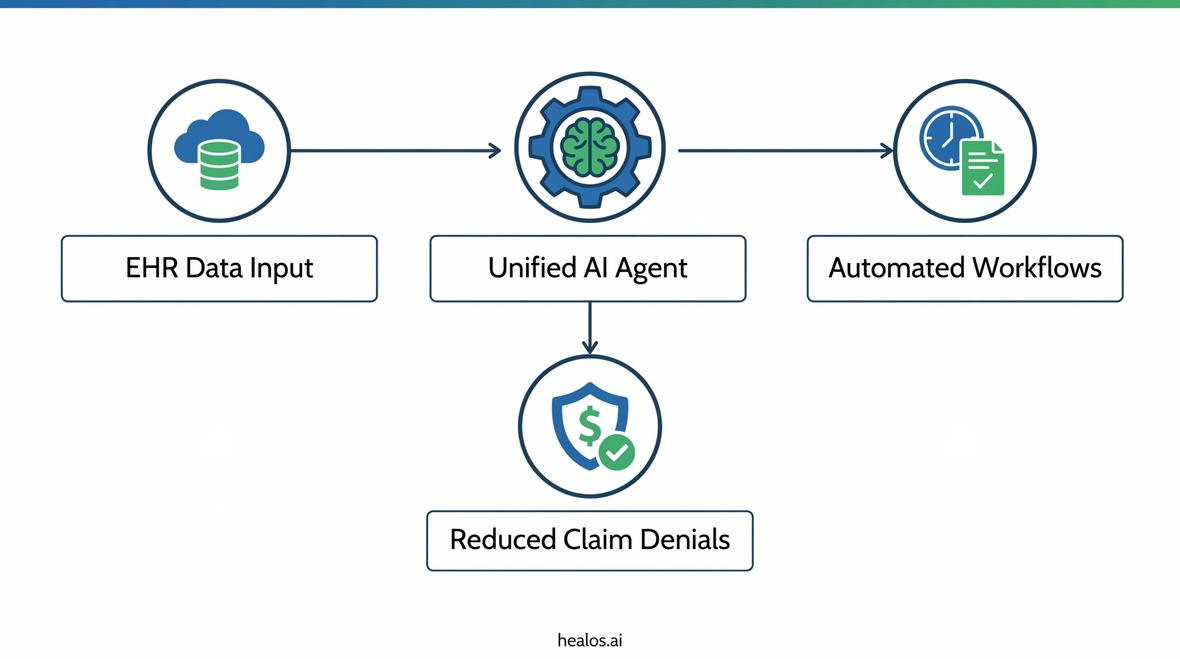
This unified approach delivers several critical advantages for practice managers:
- Seamless EHR Integration: Single integration point eliminates the need for multiple vendor relationships and technical implementations
- Consistent Documentation: The AI maintains your practice's voice and style across all automated outputs
- Cross-Functional Intelligence: Insights from billing inform documentation; clinical notes enhance prior authorization success
- Reduced Training Burden: Staff learns one system rather than juggling multiple automation tools
Core Capabilities of Modern Platforms
Leading AI healthcare automation platforms in 2026 typically encompass these functional areas:
Clinical Documentation Automation:AI scribes capture patient encounters in real-time, generating structured notes that integrate directly into your EHR without provider review or editing in many cases.
Revenue Cycle Management: Automated claims processing, denial management, payment posting, and accounts receivable monitoring reduce the billing staff burden by up to 70%.
Patient Communication:AI receptionists handle appointment scheduling, insurance verification, patient intake, and follow-up calls without human intervention.
Prior Authorization: Automated prior authorization preparation and submission reduces approval timelines from weeks to days.
Administrative Processing: Document extraction, fax automation, referral management, and other clerical tasks execute automatically in the background.
Solving the Healthcare Staffing Crisis with Automation
The healthcare staffing shortage isn't a future threat it's the current reality for practice managers struggling to maintain operations with skeleton crews. An AI healthcare automation platform directly addresses this challenge by fundamentally changing the staffing equation.
Scaling Without Proportional Headcount Increases
Traditional practice growth followed a predictable pattern: adding providers meant hiring proportional administrative staff for billing, scheduling, documentation support, and patient communication. A practice adding two physicians might need to hire three to four administrative employees to maintain service levels.
AI healthcare automation platforms break this pattern entirely. By automating the workflows that previously required human staff, practices can expand provider capacity while maintaining or even reducing administrative headcount. The digital health technology market estimated to grow to over $300 billion in 2026 reflects this fundamental shift in how healthcare practices operate.
Redeploying Staff to Higher-Value Activities
Rather than replacing staff, strategic practice managers use AI healthcare automation platforms to redeploy their teams from repetitive data entry to patient-facing activities that improve satisfaction and outcomes. Front desk staff transition from answering phones to care coordination; billing specialists shift from payment posting to complex denial resolution that requires human judgment.
This redeployment strategy addresses both the staffing shortage and employee satisfaction. Staff who previously spent hours on mundane tasks report higher job satisfaction when their roles evolve to more meaningful work.
Reducing Claim Denials: The Financial Impact
For practice managers focused on financial health, claim denials represent the silent profit killer. Every denied claim requires staff time to investigate, correct, and resubmit and many denials are never successfully resolved, becoming permanent revenue losses.
Root Causes AI Automation Addresses
The majority of claim denials stem from preventable errors that AI healthcare automation platforms eliminate systematically:
Eligibility Verification Failures: Automated real-time eligibility checks before appointments ensure coverage is valid and benefits are understood before services are rendered.
Coding Accuracy: AI-powered medical coding analyzes clinical documentation and assigns appropriate codes with higher accuracy than manual coding, reducing denials for incorrect or unsupported codes.
Prior Authorization Compliance: Automated systems track which services require authorization and initiate the process proactively, preventing denials for services rendered without proper approval.
Timely Filing: AI monitors claim submission deadlines by payer and automatically submits claims well before filing limits expire.
Documentation Support: Claims denied for insufficient documentation trigger automated processes to append necessary notes, reducing the manual burden on providers and billing staff.
Quantifying the Financial Impact
The financial benefits of reduced claim denials compound across multiple dimensions. Direct revenue capture improves as first-pass acceptance rates increase from industry averages of 75-80% to 90-95% with comprehensive automation. Staff time previously dedicated to denial management becomes available for other revenue-generating activities. Cash flow accelerates as clean claims process faster through payer systems.
For a mid-sized practice processing 1,000 claims monthly with an average reimbursement of $150, reducing denials from 20% to 5% represents $270,000 in annual revenue recovery funds that would otherwise require writing off or extensive appeals processes to collect.
Addressing Provider Burnout Through Documentation Automation
Provider burnout has reached epidemic levels, with excessive charting identified as a primary contributor. Physicians report spending two hours on documentation and administrative tasks for every hour of direct patient care a ratio that's professionally unsustainable and personally devastating.
The Charting Burden
Traditional EHR documentation requires providers to type or dictate detailed notes during or after patient encounters, then review and sign these notes before they're finalized. For a provider seeing 20 patients daily, this documentation burden can add three to four hours beyond scheduled clinical time, forcing physicians to complete charting at home during 'pajama time.'
This burden doesn't just affect provider well-being it directly impacts practice capacity. Providers who spend evenings and weekends catching up on documentation can't sustainably see more patients, limiting practice growth regardless of patient demand.
How AI Documentation Automation Solves This
Modern AI healthcare automation platforms deploy ambient listening technology that captures the natural clinical conversation between provider and patient, automatically generating comprehensive clinical notes without provider typing or dictation. According to research from industry experts, AI agents execute multi-step tasks like drafting notes and preparing prior auth materials under appropriate human oversight.
The workflow transformation is dramatic: providers conduct normal patient conversations, the AI captures and structures the encounter, and complete notes appear in the EHR within minutes often before the patient leaves the exam room. Provider review typically requires 30-60 seconds rather than 5-10 minutes of manual documentation.
For practices implementing comprehensive medical scribe automation, documentation time per patient typically decreases by 70-85%, directly translating to reduced burnout and increased capacity.
Seamless EHR Integration: The Make-or-Break Factor
The promise of automation fails entirely if the AI healthcare automation platform can't integrate smoothly with your existing EHR system. Practice managers consistently identify EHR integration as the most critical implementation consideration and the area where many platforms fall short.
Understanding Integration Challenges
Healthcare practices use dozens of different EHR systems, each with unique data structures, API capabilities, and workflow requirements. Point solutions often support only major EHR platforms, leaving practices using specialized or regional systems without automation options.
Even when technical integration is possible, workflow integration presents additional challenges. An AI tool that requires providers to leave their normal EHR workflow to access automation features adds friction rather than reducing it, undermining adoption and benefits realization.
The Unified Integration Approach
Leading AI healthcare automation platforms approach EHR integration as a core competency rather than an afterthought. These platforms invest in building and maintaining integrations with hundreds of EHR systems, including specialized platforms serving niche specialties.
The integration architecture focuses on three key principles: data flows bidirectionally between the AI platform and EHR without manual export/import; automation executes within the provider's existing workflow rather than requiring separate logins or interfaces; and the AI learns and adapts to your specific EHR configuration and template structure.
For practice managers evaluating platforms, requesting references from practices using your specific EHR system provides the most reliable validation of integration quality. Additionally, reviewing the platform's EHR integration documentation reveals the breadth and depth of their integration capabilities.
Implementation Roadmap for Practice Managers
Successfully deploying an AI healthcare automation platform requires strategic planning and phased implementation. Practice managers who approach automation as an operational transformation rather than a technology installation achieve significantly better outcomes.
Phase One: Assessment and Planning
Begin by documenting your current workflows and identifying the highest-impact automation opportunities. For most practices, these fall into three categories: clinical documentation consuming provider time, revenue cycle processes with high error rates or denial rates, and patient communication creating staffing bottlenecks.
Quantify the baseline metrics you'll use to measure success: hours per day providers spend on documentation, claim denial rates by denial reason, time from service to claim submission, and patient wait times for appointment scheduling or phone call responses.
Phase Two: Pilot Implementation
Rather than attempting practice-wide implementation immediately, select a pilot group typically one or two providers and associated administrative staff for initial deployment. This contained scope allows you to identify and resolve integration issues, refine workflows, and build internal champions before broader rollout.
The pilot phase should run long enough to move beyond the learning curve (typically 4-6 weeks) and capture meaningful data on outcomes. Document both quantitative improvements (documentation time reduced, denial rates improved) and qualitative feedback from providers and staff.
Phase Three: Scaled Deployment
With pilot success validated, expand deployment across the practice in waves. Group providers with similar specialties or workflows together to maximize the efficiency of training and support. Continue measuring outcomes against baseline metrics to quantify ROI and identify areas requiring additional optimization.
Plan for ongoing optimization rather than treating implementation as a one-time project. As your team becomes more proficient with the AI healthcare automation platform, you'll identify additional workflows that can be automated and ways to refine existing automations for better outcomes.
Selecting the Right AI Healthcare Automation Platform
The AI healthcare automation market has exploded in 2026, with dozens of vendors offering platforms with overlapping feature sets. Practice managers need a framework for evaluation that cuts through marketing claims to identify the platform that best fits their specific needs.
Key Evaluation Criteria
Breadth of Automation: Does the platform automate the full spectrum of administrative workflows, or does it require integrating multiple point solutions? Comprehensive platforms reduce vendor management burden and integration complexity.
EHR Integration Quality: How well does the platform integrate with your specific EHR? Request demonstrations using your EHR system and speak with reference customers using the same platform.
Customization Capabilities: Can the platform adapt to your specific workflows, documentation templates, and practice preferences, or does it force you to conform to its standard approach?
Implementation Support: What level of support does the vendor provide during implementation? Look for dedicated implementation teams, comprehensive training programs, and ongoing optimization support.
Pricing Structure: Does the pricing model align with your practice economics? Per-provider pricing works well for smaller practices, while per-transaction or subscription models may suit larger organizations better.
Why HealOS Leads for Practice Managers
For practice managers specifically focused on scaling without increasing headcount while reducing claim denials, HealOS delivers distinct advantages through its unified agent architecture and comprehensive automation coverage.
The platform's seamless EHR integration supports over 100 different EHR systems with deep, bidirectional data flows that work within your existing provider workflows. Rather than requiring providers to access a separate application, HealOS automation executes transparently within the EHR interface they already use daily.
The unified agent approach means a single AI learns your practice's specific documentation style, billing patterns, and operational workflows, then applies this intelligence across clinical documentation, revenue cycle management, patient communication, and administrative processing. This consistency delivers better outcomes than deploying separate point solutions that don't share context or learning.
Calculating ROI: The Practice Manager's Perspective
For practice managers operating under budget constraints, demonstrating clear return on investment justifies the automation investment and secures stakeholder buy-in. The ROI calculation for an AI healthcare automation platform encompasses both direct cost savings and revenue improvements.
Direct Cost Savings
The most immediate savings come from reduced administrative staffing needs. A practice that would need to hire two additional billing specialists and one front desk coordinator to support adding two providers can instead deploy automation to handle the incremental workload. At average healthcare administrative salaries of $45,000-$55,000 including benefits, this represents $135,000-$165,000 in avoided annual costs.
Additionally, practices reduce outsourcing costs for medical transcription, after-hours answering services, and specialized billing support. These services typically cost $2,000-$5,000 monthly for mid-sized practices, representing another $24,000-$60,000 in annual savings.
Revenue Improvements
The revenue side of the ROI equation often exceeds cost savings. Reduced claim denials directly increase collections as noted earlier, a practice processing 1,000 monthly claims can recover $270,000 annually by reducing denials from 20% to 5%.
Faster claim submission accelerates cash flow. Claims submitted within 24 hours of service rather than 7-10 days process through payer systems faster, improving days in accounts receivable by 15-20 days. For a practice with $2 million in annual collections, this acceleration represents approximately $80,000-$110,000 in improved working capital.
Finally, provider capacity improvements directly enable revenue growth. When documentation automation saves each provider 90 minutes daily, that time becomes available for additional patient appointments. A provider who previously maxed out at 18 patients daily can now comfortably see 20-22, representing 10-20% capacity increases without additional provider hiring.
Future Trends: AI Healthcare Automation in 2026 and Beyond
The AI healthcare automation landscape continues evolving rapidly. Understanding emerging trends helps practice managers make platform selections that remain valuable as technology advances.
Agentic Automation Evolution
The next generation of AI healthcare automation platforms moves beyond executing predefined workflows to deploying autonomous agents that make contextual decisions and handle exceptions without human intervention. According to BCG research, AI agents transforming clinical workflow automation and operational efficiency represents the frontier of healthcare innovation.
These agentic systems will handle complex scenarios like appeals for denied claims by analyzing the denial reason, reviewing clinical documentation for supporting evidence, researching payer policies, and generating appeal letters with appropriate medical justification all without human involvement except final approval.
Predictive and Preventive Capabilities
Current AI healthcare automation platforms are largely reactive, responding to documentation needs, claim submissions, and patient communications as they occur. Future platforms will shift toward predictive and preventive automation.
For claim denial prevention, AI will analyze historical patterns to identify claims at high denial risk before submission, flagging them for additional documentation or coding review. For patient communication, AI will predict which patients are at risk of no-shows or non-compliance and proactively initiate outreach to prevent these outcomes.
Frequently Asked Questions
How much does an AI healthcare automation platform cost?
Pricing varies significantly by platform and practice size. Most platforms offer per-provider monthly subscription pricing ranging from $99-$399 per provider for comprehensive automation, or per-transaction pricing for specific functions like claims processing. Enterprise pricing for larger practices or health systems is typically customized based on volume and feature requirements.
What's the typical implementation timeline?
For pilot implementation with one to two providers, expect four to six weeks from contract signing to go-live. Practice-wide deployment typically takes three to six months depending on practice size and complexity. EHR integration setup usually completes within the first two weeks.
How much staff training is required?
Modern AI healthcare automation platforms are designed for minimal training requirements. Providers typically need one to two hours of initial training, with proficiency developing over the first two to three weeks of use. Administrative staff require similar training timelines. Leading platforms provide comprehensive training resources, including live sessions, video tutorials, and documentation.
What accuracy rates should I expect?
For clinical documentation, leading AI platforms achieve 95-98% accuracy in note generation, with the remaining 2-5% requiring minor provider edits. For claims processing and coding, accuracy rates of 98-99% are standard. These rates typically improve over time as the AI learns your specific practice patterns.
How is patient data security handled?
All reputable AI healthcare automation platforms are fully HIPAA-compliant with comprehensive business associate agreements. Look for platforms with SOC 2 Type II certification, end-to-end encryption, and robust access controls. Patient data should never be used for AI training without explicit de-identification and consent.
Conclusion
For the overwhelmed practice manager facing staffing shortages, rising claim denials, and provider burnout, an AI healthcare automation platform represents the most viable path to sustainable practice growth in 2026. By automating administrative workflows through seamless EHR integration and unified agent architecture, these platforms enable practices to scale without proportional headcount increases while simultaneously improving financial performance through reduced denials and accelerated collections. The successful practice managers of 2026 aren't those who've mastered doing more with less they're those who've strategically deployed automation to fundamentally transform how their practices operate. With comprehensive platforms now mature and proven across thousands of practices, the question isn't whether to automate, but how quickly you can implement to capture the competitive advantage before your market peers do.