
AI Healthcare Company: The Complete 2026 Guide To Automation, ROI, And Scaling Your Practice

Understanding AI Healthcare Companies in 2026
An AI healthcare company is fundamentally reshaping how medical practices operate by delivering intelligent automation across clinical documentation, revenue cycle management, patient communication, and administrative workflows. In 2026, these companies are no longer experimental they are strategic partners enabling practices to scale without proportional increases in headcount or overhead.
According to research from AI usage in digital healthcare at 78%, adoption has surged from 70% the prior year, driven by measurable improvements in data analytics, predictive tools, and administrative efficiency. For the overwhelmed practice manager facing staffing shortages and provider burnout, partnering with the right AI healthcare company is now a business imperative.
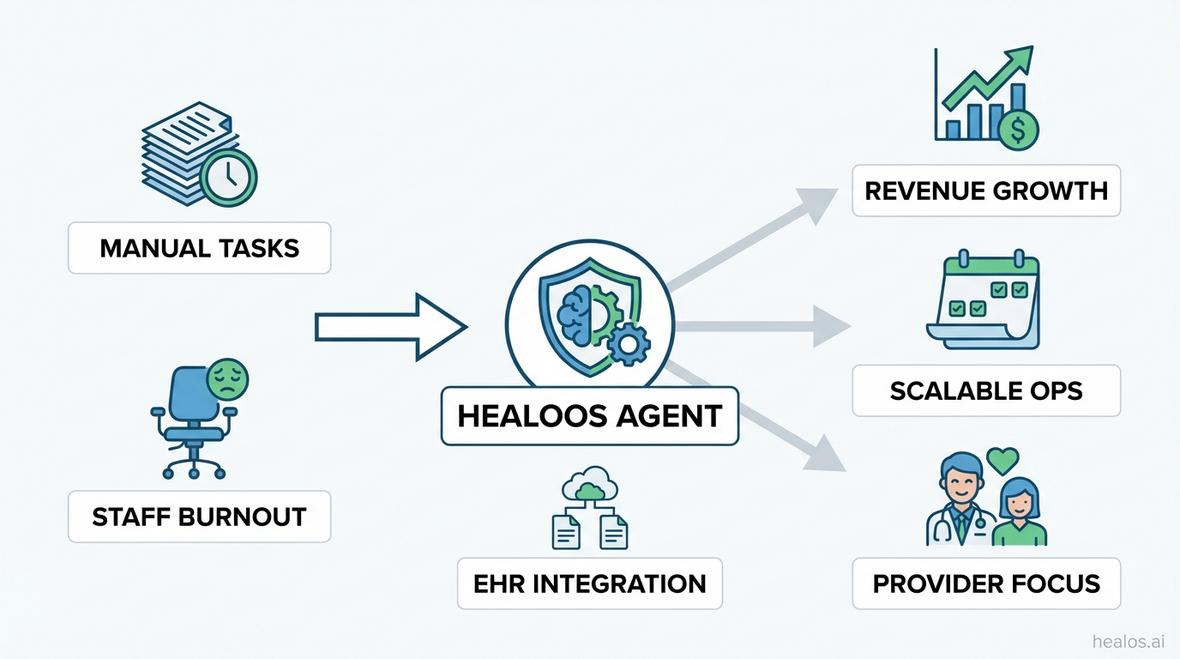
The modern ai healthcare company delivers value through unified agent-based architectures that integrate seamlessly with existing EHR systems, automate repetitive tasks, and provide real-time insights into financial and operational performance. This guide explores how AI healthcare companies work, what to look for when evaluating vendors, and how solutions like HealOS are setting new standards for practice automation.
Why Practice Managers Turn to AI Healthcare Companies
Practice managers face a common set of pressures in 2026: rising labor costs, declining reimbursement rates, claim denials, provider burnout from excessive charting, and the operational strain of managing growth without adding full-time equivalents. An AI healthcare company addresses these pain points by automating the most time-consuming and error-prone workflows.
57% US physicians cite reducing administrative burden as AI benefit, with charting, prior authorizations, and claim follow-ups leading the list of tasks that drain provider time and morale. For practice managers, this translates into tangible ROI: fewer denials, faster cash flow, reduced overtime, and the ability to see more patients with the same team.
Key motivations for adopting an AI healthcare company solution include:
- Financial health: Reducing claim denials, accelerating payment cycles, and improving coding accuracy to capture every billable service.
- Operational efficiency: Automating intake, scheduling, referral management, and documentation to free staff for higher-value tasks.
- Provider satisfaction: Cutting after-hours charting ('pajama time') and reducing burnout by offloading documentation to AI scribes.
- Scalability: Growing patient volume and revenue without linear increases in administrative or clinical headcount.
These outcomes are not theoretical. Practices leveraging comprehensive AI platforms report documentation time reductions of 75%, claim denial rate drops of 30%, and staff productivity gains equivalent to adding multiple full-time employees without the associated payroll burden.
Core Capabilities of Leading AI Healthcare Companies
Not all AI healthcare companies are created equal. The most effective platforms deliver a unified suite of intelligent agents that work together across the full practice lifecycle from patient intake and clinical documentation to billing, collections, and compliance monitoring.
Clinical Documentation Automation
The flagship capability of any leading ai healthcare company is AI scribe technology that converts ambient conversation during patient encounters into structured clinical notes. This eliminates the need for providers to type or dictate, reducing documentation time by up to 80% and enabling real-time EHR updates.
Top AI healthcare companies offer:
- Ambient listening: Capture natural conversation without requiring providers to interact with devices during exams.
- Custom templates: Generate notes in SOAP, DAP, or specialty-specific formats aligned to practice workflows.
- Multi-language support: Enable seamless documentation for diverse patient populations.
- EHR integration: Push finalized notes directly into Epic, Cerner, Athena, or other systems with a single click.
Solutions like HealOS medical scribe achieve over 98% accuracy, meeting or exceeding human scribe performance while operating at a fraction of the cost.
Revenue Cycle Management (RCM)
AI healthcare companies are transforming RCM by automating claim scrubbing, denial management, payment posting, and accounts receivable follow-up. Over 80% executives see AI delivering significant value across operations, particularly in workflows that directly impact cash flow and margins.
Key RCM automation features include:
- Eligibility verification: Automated insurance checks before appointments to prevent denials.
- Prior authorization: AI agents that submit, track, and follow up on authorization requests.
- Claims processing: Real-time scrubbing for coding errors, missing documentation, and payer-specific requirements.
- Denial management: Root cause analysis, automated appeals, and predictive modeling to reduce future denials.
- Payment posting: Reconcile EOBs and ERAs with patient accounts and flag underpayments.
Practices using HealOS RCM report 30% reductions in days in accounts receivable and claim denial rates below 5%, compared to industry averages of 8-12%.
Patient Communication and Scheduling
Front-office automation is critical for practice scalability. AI healthcare companies deploy virtual receptionists that handle inbound calls, appointment scheduling, reminders, and patient intake 24/7, without adding headcount.
AI receptionist capabilities include:
- Voice AI: Natural language call handling for appointment booking, triage, and common inquiries.
- Intake automation: Digital forms, insurance capture, and demographic updates completed before the visit.
- Appointment reminders: SMS, email, and voice reminders that reduce no-show rates by 40%.
- Follow-up calls: Post-visit check-ins, medication adherence support, and patient satisfaction surveys.
This automation ensures no call goes unanswered, no appointment slot remains unfilled, and staff can focus on in-person patient needs rather than phone triage.
Referral and Document Management
Referral coordination and document processing are notoriously manual and error-prone. Leading AI healthcare companies automate:
- Referral intake: Capture, route, and track specialist referrals with automated status updates.
- Fax automation: Convert incoming faxes into structured data and route to appropriate workflows.
- EOB extraction: Parse Explanation of Benefits documents and reconcile with payments.
Solutions like HealOS referral management reduce referral leakage, ensure timely specialist follow-up, and improve care coordination all without additional administrative burden.
Evaluating AI Healthcare Companies: Key Selection Criteria
Choosing the right AI healthcare company requires a structured evaluation of technology, integration, cost, and support. Practice managers should prioritize vendors that deliver seamless EHR connectivity, proven accuracy, transparent pricing, and a unified agent approach that consolidates multiple workflows into a single platform.
EHR Integration and Interoperability
An AI healthcare company solution is only as valuable as its ability to work within your existing tech stack. Look for vendors offering:
- Native integrations: Pre-built connectors for major EHRs (Epic, Cerner, Athena, eClinicalWorks, Tebra, etc.).
- API flexibility: Open APIs for custom integrations with practice management, billing, and patient engagement systems.
- Bidirectional data sync: Real-time updates flowing between the AI platform and EHR without manual data entry.
HealOS integrations support over 30 EHR systems and offer custom integration services for niche or legacy platforms, ensuring a smooth deployment regardless of your current technology environment.
Accuracy, Compliance, and Security
Clinical and financial workflows demand precision. Evaluate AI healthcare companies based on:
- Documentation accuracy: Target 98%+ for note generation, coding suggestions, and data extraction.
- HIPAA compliance: End-to-end encryption, secure data handling, BAA agreements, and SOC 2 certification.
- Audit trails: Comprehensive logging of all AI actions, approvals, and edits for compliance and quality assurance.
Top AI healthcare companies publish third-party audits, accuracy benchmarks, and customer case studies to substantiate their claims.
Cost and ROI Transparency
Pricing models for AI healthcare companies vary widely from per-provider subscriptions to usage-based fees. Prioritize vendors that offer:
- Transparent pricing: Clear per-user or per-transaction costs with no hidden fees.
- ROI calculators: Tools to estimate time savings, cost reductions, and revenue gains based on your practice size and workflows.
- Flexible contracts: Monthly or annual options with the ability to scale up or down as needs change.
Practices should expect payback periods of 3-6 months when replacing manual processes or human scribes with AI automation.
Unified Agent Architecture
The most advanced AI healthcare companies deliver a 'unified agent' approach multiple specialized AI agents working together under a single platform, sharing context and data to eliminate silos and redundant workflows.
For example, HealOS agents cover clinical documentation, RCM, patient communication, referral management, and compliance all coordinated to ensure seamless handoffs and complete visibility across the practice lifecycle. This architecture reduces training burden, simplifies vendor management, and maximizes ROI by enabling end-to-end automation.
Market Trends and Adoption Data
The AI healthcare company sector is experiencing explosive growth. Global health tech M&A reached 400 deals in 2025, up from 350 in 2024, driven by AI's demonstrated impact on revenue growth and margin improvement for both payers and providers.
Digital health market to exceed $300B in 2026 driven by AI, with ambient documentation and clinical decision support tools leading adoption. This growth reflects both pent-up demand for automation and increasing confidence in AI accuracy, security, and regulatory compliance.
Key adoption drivers include:
- Labor shortages: Difficulty hiring and retaining administrative and clinical staff is pushing practices toward automation.
- Value-based care: Shift from fee-for-service to outcomes-based reimbursement requires better data, care coordination, and efficiency.
- Regulatory complexity: Rising compliance burdens for prior authorizations, quality reporting, and documentation are overwhelming manual processes.
Practices that adopt comprehensive AI platforms early gain competitive advantages in patient acquisition, provider retention, and financial performance.
Real-World Use Cases and Outcomes
AI healthcare companies deliver measurable results across diverse specialties and practice sizes. Here are representative use cases:
Multi-Specialty Group Practice
A 12-provider group practice (primary care, cardiology, orthopedics) implemented AI scribe, RCM automation, and virtual receptionist services. Results after six months:
- Documentation time: Reduced from 2 hours per provider per day to under 30 minutes.
- Claim denial rate: Dropped from 9% to 4%.
- No-show rate: Fell by 35% due to automated reminders.
- Patient volume: Increased by 18% without adding clinical staff.
Solo Behavioral Health Provider
A solo psychiatrist using HealOS for psychiatry automated session notes, prior authorizations, and billing follow-ups. Outcomes:
- Time savings: 10+ hours per week reclaimed from charting and administrative tasks.
- Revenue growth: 22% increase in billable sessions due to improved scheduling efficiency.
- Burnout reduction: Provider reported significantly improved work-life balance and job satisfaction.
Pediatric Clinic
A five-provider pediatric clinic deployed HealOS for pediatrics to automate intake, vaccine administration documentation, and well-visit notes. Results:
- Check-in time: Reduced by 60% with digital intake and insurance verification.
- Coding accuracy: Improved by 25%, capturing previously missed billable services.
- Parent satisfaction: Increased due to faster visits and reduced wait times.
Implementation and Change Management
Successful deployment of an AI healthcare company solution requires thoughtful change management. Best practices include:
- Executive sponsorship: Practice leadership must champion adoption and communicate benefits to all staff.
- Phased rollout: Start with a pilot group (e.g., one provider or workflow) before full-scale deployment.
- Comprehensive training: Hands-on sessions, quick-start guides, and ongoing support ensure staff confidence and competence.
- Feedback loops: Regular check-ins to identify issues, refine workflows, and celebrate wins.
Leading AI healthcare companies provide dedicated implementation managers, customized training, and 24/7 technical support to ensure smooth onboarding and rapid time-to-value.
Future Directions for AI Healthcare Companies
The AI healthcare company landscape will continue to evolve rapidly through 2026 and beyond. Emerging trends include:
- Agentic AI: Autonomous agents that not only automate tasks but also make proactive recommendations and take action without human prompting.
- Predictive analytics: AI models that forecast patient no-shows, claim denials, and clinical deterioration to enable preventive interventions.
- Interoperability standards: Wider adoption of FHIR and HL7 standards to enable seamless data exchange across platforms and providers.
- Specialty-specific tuning: AI models trained on specialty-specific data (e.g., oncology, cardiology) for higher accuracy and relevance.
Practice managers should partner with AI healthcare companies that demonstrate ongoing innovation, transparent roadmaps, and commitment to customer success.
Frequently Asked Questions
What is an AI healthcare company?
An AI healthcare company develops and deploys artificial intelligence solutions to automate clinical, administrative, and financial workflows in healthcare settings. These companies offer products such as AI scribes, revenue cycle management automation, virtual receptionists, and patient engagement tools.
How much does AI healthcare automation cost?
Pricing varies by vendor and scope. AI scribe solutions typically range from $99 to $300 per provider per month, while comprehensive platforms with RCM and front-office automation may cost $500 to $1,500+ per provider per month. ROI typically exceeds cost within 3-6 months due to time savings, increased patient volume, and reduced denials.
Is AI documentation HIPAA compliant?
Reputable AI healthcare companies are fully HIPAA compliant, offering end-to-end encryption, secure data storage, BAA agreements, and regular third-party audits. Always verify compliance credentials before contracting with any vendor.
How long does implementation take?
Deployment timelines range from 1-4 weeks depending on EHR complexity, scope of automation, and practice readiness. Many AI healthcare companies offer rapid onboarding with initial training completed in under 24 hours.
Can AI replace human staff?
AI healthcare companies augment not replace human teams. Automation handles repetitive, time-consuming tasks, freeing staff to focus on patient care, complex problem-solving, and relationship-building. Practices typically reallocate rather than eliminate roles, improving job satisfaction and productivity.
Conclusion
For the overwhelmed practice manager, partnering with the right AI healthcare company is no longer optional it is a strategic imperative to scale operations, improve financial health, and reduce provider burnout. The data is clear: AI adoption in healthcare reached 78% in 2026, with measurable gains in documentation efficiency, claim accuracy, and patient satisfaction. Leading platforms like HealOS deliver unified agent architectures, seamless EHR integration, and proven ROI, enabling practices to automate administrative workflows without sacrificing quality or compliance. By evaluating vendors on integration capabilities, accuracy, cost transparency, and unified automation, practice managers can confidently deploy AI solutions that transform operations and position their practices for long-term success.