
AI Medical Charting In 2026: The Complete Guide To Automated Clinical Documentation

Introduction to AI Medical Charting
Healthcare providers today face an overwhelming documentation burden that consumes nearly 50% of their workday. AI medical charting has emerged as a transformative solution, leveraging artificial intelligence to automate clinical note-taking, reduce administrative workload, and restore meaningful patient interaction time. This comprehensive guide explores how AI medical charting is revolutionizing healthcare documentation in 2026, delivering measurable improvements in efficiency, accuracy, and provider satisfaction.
With physician burnout reaching crisis levels and administrative tasks increasingly dominating clinical workflows, AI scribe technology represents more than just a convenience it's becoming essential infrastructure for sustainable medical practice. According to the OpenAI Jan 2026 Healthcare AI Report, physician AI adoption for documentation jumped from 38% in 2023 to 66% in 2024, demonstrating the rapid acceleration of this technology across medical practices.
What Is AI Medical Charting?
AI medical charting refers to the use of artificial intelligence technologies including natural language processing, speech recognition, and machine learning to automatically generate clinical documentation from patient encounters. Unlike traditional medical transcription, AI charting systems actively listen to conversations, identify relevant clinical information, and structure it into comprehensive medical notes that align with specialty-specific templates and regulatory requirements.
Modern AI medical charting platforms employ ambient listening technology that captures the natural dialogue between providers and patients without requiring structured dictation. These systems intelligently extract chief complaints, history of present illness, review of systems, physical examination findings, assessments, and treatment plans, then automatically format this information into SOAP notes, progress notes, or other documentation formats.
Key Components of AI Medical Charting Systems
- Ambient Voice Capture: Continuous listening technology that records patient-provider conversations without manual activation
- Clinical Natural Language Processing: Advanced AI that understands medical terminology, context, and clinical reasoning patterns
- Template Customization: Specialty-specific documentation formats that match individual provider preferences and regulatory requirements
- EHR Integration: Seamless connection to electronic health record systems for automatic note insertion and workflow continuity
- Quality Assurance Algorithms: AI-powered verification systems that ensure documentation accuracy and completeness
How AI Medical Charting Works: The Technology Behind Automation
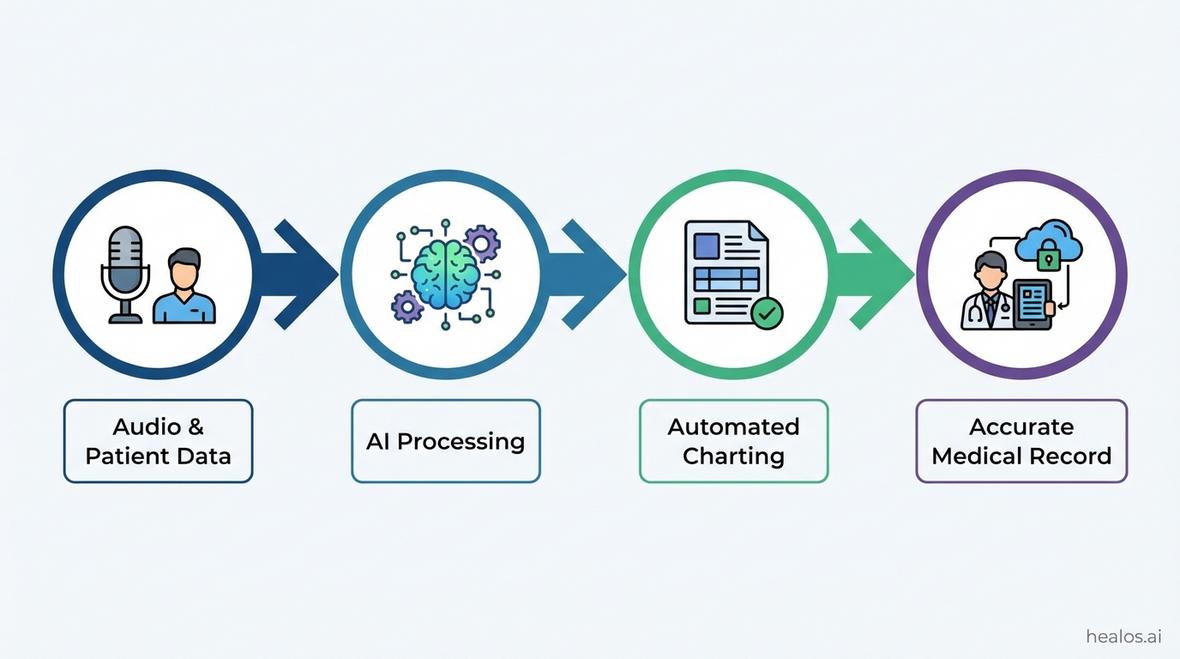
Understanding the technical foundation of AI medical charting helps providers make informed implementation decisions. The process typically follows a multi-stage workflow that transforms spoken conversation into structured clinical documentation.
Voice Capture and Transcription
The process begins with ambient listening technology that captures the complete patient encounter through a smartphone, tablet, or computer microphone. Advanced speech recognition algorithms convert spoken words into text with medical-vocabulary accuracy rates exceeding 98%, as demonstrated in the Stanford Review of 500+ Medical AI Studies.
Clinical Information Extraction
Natural language processing engines analyze the transcribed conversation to identify clinically significant information. The AI distinguishes between relevant medical history, current symptoms, examination findings, and incidental conversation. Machine learning models trained on millions of clinical encounters recognize patterns specific to different medical specialties, from cardiology to psychiatry.
Structured Note Generation
The extracted information is then organized into the appropriate documentation format. Whether generating a comprehensive H&P, a focused progress note, or specialty-specific documentation like custom clinical notes, the AI applies formatting rules, inserts section headers, and ensures all required elements are present according to billing and compliance standards.
EHR Integration and Workflow Integration
The final step involves transferring the completed note into the provider's electronic health record system. Modern AI medical charting platforms offer direct EHR integrations that eliminate copy-paste workflows, automatically populate discrete data fields, and maintain audit trails for compliance documentation.
Transformative Benefits of AI Medical Charting
The adoption of AI medical charting delivers measurable improvements across multiple dimensions of healthcare delivery, from provider wellness to financial performance.
Dramatic Time Savings and Efficiency Gains
The most immediate benefit providers experience is substantial time recovery. Traditional documentation consumes 2-3 hours of a physician's day, often extending into evening 'pajama time.' AI medical charting reduces documentation time by 60-75%, freeing providers to see additional patients or reclaim personal time. Research from the Wolters Kluwer 2026 AI Trends report indicates that ambient documentation tools deliver ROI through reduced administrative costs in a digital health market exceeding $300 billion.
Reduced Physician Burnout
Administrative burden is the leading contributor to physician burnout, with documentation specifically cited as the most frustrating aspect of modern practice. By eliminating after-hours charting and restoring focus to patient care, AI medical charting directly addresses this crisis. Providers using AI documentation report higher job satisfaction, improved work-life balance, and reduced intention to leave clinical practice.
Enhanced Documentation Accuracy and Compliance
Human documentation often suffers from inconsistency, incompleteness, and errors introduced by fatigue or time pressure. AI systems maintain consistent quality standards, ensure all required elements are captured, and apply the latest coding and billing guidelines. This consistency improves compliance with regulatory requirements and reduces claim denials related to documentation deficiencies.
Financial Return on Investment
While AI medical charting requires upfront investment, the financial returns typically manifest within months. Cost savings come from multiple sources: eliminated or reduced medical scribe expenses (averaging $40,000-$50,000 annually per full-time scribe), increased patient throughput from recovered time, improved coding accuracy leading to appropriate reimbursement, and reduced claim denials.
Implementation Considerations for AI Medical Charting
Successful deployment of AI medical charting requires thoughtful planning across technical, workflow, and human factors.
Choosing the Right Platform
Not all AI medical charting solutions offer equivalent capabilities. Key evaluation criteria include specialty-specific training data, EHR compatibility, customization options, compliance certifications, and vendor support quality. Platforms like HealOS AI offer comprehensive solutions spanning multiple specialties with deep integration capabilities.
Workflow Integration Strategies
The most effective implementations integrate AI charting seamlessly into existing clinical workflows rather than requiring providers to adopt entirely new processes. This might involve using existing examination room technology, maintaining familiar note review processes, and preserving established quality assurance checkpoints.
Staff Training and Adoption
Technology adoption succeeds when staff understand both the 'how' and the 'why.' Comprehensive training programs should cover technical operation, troubleshooting common issues, and optimization strategies. Equally important is communicating the benefits both for providers and for patient care quality to build genuine enthusiasm rather than reluctant compliance.
Privacy and Security Compliance
Healthcare data carries stringent privacy and security requirements under HIPAA and related regulations. AI medical charting platforms must implement appropriate safeguards including data encryption, access controls, audit logging, and business associate agreements. Providers should verify vendor compliance certifications and understand data handling practices before deployment.
AI Medical Charting Across Medical Specialties
Different medical specialties have unique documentation requirements, and effective AI medical charting systems adapt to these variations.
Primary Care Applications
Primary care encounters span diverse presenting complaints and require comprehensive documentation of multiple body systems. AI charting for primary care excels at capturing wide-ranging conversations, organizing information into clear assessments and plans, and ensuring preventive care elements are documented for quality measure reporting.
Mental Health and Behavioral Health
Psychiatric and therapy encounters demand special attention to patient narrative, mental status examination, and treatment planning. Specialized AI solutions for psychiatry capture nuanced clinical observations while maintaining appropriate boundaries around sensitive information and supporting various note formats from SOAP to DAP to narrative summaries.
Surgical and Procedural Specialties
Surgical specialties like orthopedics require detailed procedure notes, operative reports, and pre/post-operative documentation. AI medical charting systems designed for these specialties capture procedural details, complications, findings, and post-operative instructions with the precision these high-stakes environments demand.
Pediatrics
Pediatric AI charting accommodates the unique aspects of documenting child healthcare, including developmental milestones, growth parameters, parent-reported history, and child-specific examination findings. These systems adjust language and structure to reflect pediatric-specific documentation standards.
The Future of AI Medical Charting: Emerging Trends
As we progress through 2026, AI medical charting continues to evolve with several emerging capabilities reshaping clinical documentation.
Predictive Clinical Intelligence
Next-generation systems move beyond passive documentation to active clinical decision support. By analyzing patterns in patient data, these AI platforms can suggest differential diagnoses, flag potential medication interactions, or identify patients who may benefit from specific interventions all integrated naturally into the documentation workflow. According to the NVIDIA 2026 AI Healthcare Trends Report, predictive and data analytics are core to AI in healthcare, supporting diverse workloads including clinical documentation automation for practices facing staffing shortages.
Multilingual Documentation Capabilities
Language barriers create documentation challenges in diverse patient populations. Advanced AI medical charting platforms now offer real-time translation capabilities, allowing providers to conduct encounters in patients' preferred languages while generating English documentation for the medical record, or vice versa.
Quality Measure and Registry Reporting Automation
Manual extraction of quality measures from documentation creates significant administrative burden. Emerging AI charting systems automatically identify documented care elements that satisfy quality reporting requirements, populating registry submissions and generating reports without additional provider effort.
Patient-Facing Documentation
Progressive AI platforms generate dual outputs: traditional clinical documentation for the medical record and patient-friendly summaries that explain diagnoses, treatment plans, and next steps in accessible language. This supports patient engagement and shared decision-making while reducing the need for separate after-visit summary creation.
Overcoming Common Implementation Challenges
While the benefits of AI medical charting are substantial, organizations should anticipate and plan for common implementation challenges.
Initial Accuracy Verification
Early in implementation, providers naturally question AI accuracy. Establishing systematic review processes allows verification while the AI learns provider-specific preferences and terminology. Most platforms demonstrate rapid improvement through machine learning, with accuracy often exceeding manual documentation within weeks of deployment.
Managing Workflow Disruption
Any new technology creates temporary workflow disruption. Minimizing this requires phased rollouts, champion providers who model successful use, and accessible technical support during the transition period. Starting with lower-acuity encounters allows providers to build confidence before applying AI charting to complex cases.
Integration and Technical Issues
EHR integration challenges occasionally emerge, particularly with legacy systems or highly customized implementations. Working with vendors who offer robust technical support and proven integration experience across multiple EHR platforms substantially reduces these obstacles.
ROI and Financial Analysis of AI Medical Charting
Understanding the financial impact of AI medical charting helps organizations justify investment and measure success.
Cost Components
AI medical charting costs typically include per-provider subscription fees (ranging from $99-$400 monthly depending on features and specialty), implementation support, training, and ongoing technical support. These costs are substantially lower than human medical scribe alternatives, which average $35,000-$50,000 annually per full-time equivalent.
Revenue Enhancement Opportunities
Recovered time enables providers to see additional patients even one additional patient daily generates substantial annual revenue. Improved coding accuracy ensures appropriate reimbursement for services rendered. Better documentation quality reduces claim denials and appeals, improving collection rates.
Cost Reduction Benefits
Beyond scribe cost elimination, AI medical charting reduces transcription expenses, minimizes compliance risk through consistent documentation, and decreases provider overtime related to chart completion. Administrative staff time previously spent on documentation support can be redirected to higher-value activities like revenue cycle management or patient engagement.
Selecting an AI Medical Charting Vendor
The AI medical charting market includes numerous vendors with varying capabilities, specializations, and business models. Effective vendor selection considers multiple factors beyond initial cost.
Vendor Evaluation Criteria
Specialty expertise: Does the vendor understand your specialty's unique documentation requirements? EHR compatibility: What integration depth does the platform offer with your specific EHR system? Customization flexibility: Can templates be tailored to match your documentation preferences? Compliance credentials: What certifications and security measures protect patient data? Support quality: What training, technical support, and ongoing optimization assistance does the vendor provide?
Comparing Leading Platforms
Organizations should evaluate multiple platforms through structured demonstrations and pilot programs. Requesting references from similar practices, reviewing published case studies, and conducting hands-on testing with actual patient encounters provides the most reliable assessment of real-world performance. Comparison resources like HealOS platform comparisons can help providers understand relative strengths across different solutions.
Frequently Asked Questions About AI Medical Charting
How accurate is AI medical charting compared to human documentation?
Modern AI medical charting platforms achieve accuracy rates of 95-98% for clinical content extraction, often exceeding human documentation which may suffer from fatigue, time pressure, or inconsistent detail. The highest accuracy is achieved when AI-generated notes undergo brief provider review and refinement.
Is AI medical charting HIPAA compliant?
Reputable AI medical charting vendors implement comprehensive HIPAA compliance measures including data encryption, access controls, audit logging, and business associate agreements. Providers should verify compliance certifications and understand data handling practices before selecting a platform.
How much time does AI medical charting save?
Time savings vary by specialty and documentation complexity, but most providers report 60-75% reduction in documentation time. For physicians spending 2-3 hours daily on charting, this translates to 1.5-2 hours recovered per day potentially 7.5-10 hours weekly.
What does AI medical charting cost?
Subscription costs range from approximately $99-$400 per provider monthly depending on specialty, features, and volume. This represents substantial savings compared to human medical scribes costing $35,000-$50,000 annually, with additional ROI from increased patient capacity and improved coding accuracy.
Can AI medical charting work for my specialty?
AI medical charting platforms now support virtually all medical specialties, with leading vendors offering specialty-specific training data and templates for fields ranging from therapy to oncology. Specialty-specific platforms provide better initial accuracy and require less customization than general-purpose solutions.
How long does implementation take?
Implementation timelines vary from same-day activation for cloud-based platforms with simple EHR interfaces to several weeks for complex enterprise deployments with deep EHR integration. Most practices achieve full deployment within 2-4 weeks including staff training and workflow optimization.
Conclusion
AI medical charting has evolved from experimental technology to essential infrastructure for modern healthcare delivery. By automating the documentation burden that consumes hours of provider time daily, AI charting restores focus to patient care, reduces burnout, and improves practice financial performance. The rapid adoption demonstrated by the jump from 38% to 66% physician AI use for documentation between 2023 and 2024 reflects the tangible value providers experience. As we progress through 2026, AI medical charting continues advancing with enhanced accuracy, expanded specialty support, and deeper integration with clinical workflows. For healthcare organizations seeking sustainable solutions to documentation burden, AI medical charting represents not just an efficiency tool, but a fundamental reimagining of how clinical information is captured, structured, and utilized to support better patient outcomes.