
AI Medical Documentation: The Complete 2026 Guide To Automated Clinical Notes

Introduction to AI Medical Documentation
AI medical documentation has fundamentally transformed how healthcare providers capture, structure, and manage clinical information. As healthcare systems face mounting pressure from administrative burdens and physician burnout, artificial intelligence offers a solution that addresses both efficiency and accuracy in medical record-keeping. The technology leverages natural language processing, machine learning, and ambient listening capabilities to automatically generate clinical notes from patient-provider interactions.
According to Wolters Kluwer, the digital health technology market grows to over $300 billion in 2026, driven by AI ambient documentation tools for workflow automation and cost savings. This massive growth reflects the urgent need for solutions that can reduce the 28 hours per week physicians currently spend on documentation tasks.
The shift toward automated documentation isn't simply about technology adoption it represents a fundamental reimagining of clinical workflows. Healthcare providers now have access to tools that can capture comprehensive patient encounters in real-time, structure information according to specialty-specific templates, and integrate seamlessly with existing electronic health record systems.
How AI Medical Documentation Works
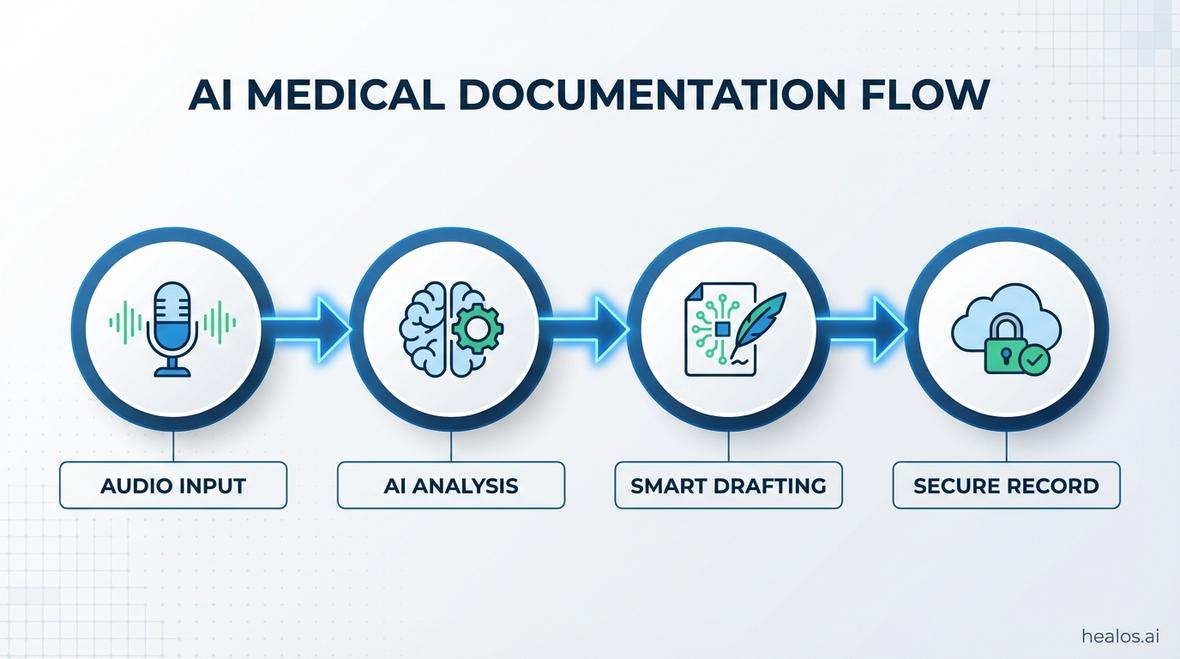
Modern AI medical scribe solutions operate through a sophisticated four-stage process that transforms raw clinical conversations into structured medical records. Understanding this workflow helps healthcare organizations appreciate both the technology's capabilities and its practical implementation.
Audio Input and Capture
The documentation process begins with audio capture during patient encounters. Healthcare providers can record conversations through various methods dedicated microphones, smartphone applications, or integrated telehealth platforms. The system continuously listens for clinically relevant information while filtering background noise and non-medical conversation.
Advanced solutions like medical scribe software support both in-person and virtual consultations, providing flexibility across different care delivery models. The audio capture phase requires no specific commands or formatting from clinicians, allowing natural conversation flow between provider and patient.
AI Analysis and Processing
Once captured, the audio undergoes sophisticated analysis through natural language processing algorithms. Research from NVIDIA indicates that natural language processing in clinical documentation reaches 40% adoption, supporting efficiency gains and scalability without increasing headcount. The AI identifies medical terminology, symptom descriptions, treatment plans, and other structured elements within the conversation.
Machine learning models trained on millions of clinical encounters recognize context, disambiguate medical terms, and categorize information according to documentation standards like SOAP notes, DAP notes, or specialty-specific formats. The system understands clinical reasoning patterns and can distinguish between current complaints, medical history, examination findings, and treatment recommendations.
Smart Drafting and Structuring
The analyzed information transforms into structured clinical notes through intelligent drafting algorithms. The system organizes content into appropriate sections, applies medical coding when applicable, and formats documentation according to regulatory requirements and specialty best practices.
Healthcare providers using custom note templates benefit from documentation that aligns precisely with their workflow preferences and specialty requirements. The drafting phase incorporates clinical decision support, flagging potential documentation gaps or inconsistencies that could affect billing accuracy or compliance.
Secure Record Storage
Completed documentation flows directly into secure, HIPAA-compliant storage systems. The final notes integrate with electronic health records through standardized interfaces like HL7 FHIR, ensuring seamless data exchange across healthcare systems. Cloud-based storage with encryption protects sensitive patient information while enabling authorized access from any location.
Financial Impact and Cost Savings
The economic case for AI medical documentation extends beyond simple efficiency gains. Healthcare organizations implementing these solutions report substantial cost reductions across multiple operational areas.
Healthcare AI could generate $300-900 billion in annual hospital cost savings by 2050 through document automation, reducing administrative costs and claim denials. This projection encompasses direct labor savings, improved billing accuracy, and reduced compliance-related penalties.
Direct Labor Cost Reduction
Traditional medical scribes cost healthcare practices between $35,000 and $50,000 annually per full-time equivalent. AI solutions typically cost $99 to $299 per provider monthly representing savings exceeding $40,000 per provider annually. These economics make advanced documentation technology accessible even to small independent practices.
The cost analysis demonstrates that practices can recover their investment within the first quarter of implementation while building toward long-term operational efficiency.
Revenue Cycle Improvements
Accurate, comprehensive documentation directly impacts billing accuracy and claim acceptance rates. Practices report 15-25% reductions in claim denials after implementing AI documentation systems, as automated notes consistently capture billable services and include appropriate medical necessity justification.
Integration with revenue cycle management systems ensures documentation supports optimal reimbursement while maintaining compliance with payer requirements and regulatory standards.
AI Documentation Across Medical Specialties
Different medical specialties have unique documentation requirements, terminology, and workflow patterns. Modern AI solutions adapt to these variations through specialty-specific configurations and templates.
Mental Health and Psychiatry
Mental health providers face particularly burdensome documentation requirements, with session notes, treatment plans, and risk assessments consuming significant time. Psychiatry-focused AI scribes understand therapeutic terminology, capture nuanced clinical observations, and structure notes according to formats like DAP, BIRP, or GIRP.
Behavioral health documentation must balance clinical detail with privacy sensitivity. AI systems designed for this specialty incorporate appropriate safeguards while generating comprehensive notes that support continuity of care and regulatory compliance.
Primary Care and Family Medicine
Primary care physicians manage diverse patient populations with wide-ranging conditions. Their documentation needs span preventive care, chronic disease management, acute illness treatment, and care coordination. AI solutions for primary care recognize this variety and structure notes appropriately for different encounter types.
The technology supports individual providers in capturing comprehensive assessments efficiently, enabling them to see more patients without sacrificing documentation quality or spending additional hours on after-hours charting.
Specialty and Procedural Medicine
Specialties like cardiology, orthopedics, and oncology require detailed procedural documentation and highly technical terminology. AI systems trained in these domains understand specialty-specific language and structure notes according to relevant guidelines.
Procedural specialties benefit from templates that capture technique details, equipment specifications, and outcomes in standardized formats that satisfy both clinical and billing requirements.
Implementation and EHR Integration
Successful AI documentation deployment requires careful planning around technical integration, workflow adaptation, and staff training. Organizations that approach implementation systematically achieve faster adoption and better outcomes.
Electronic Health Record Compatibility
Modern AI documentation platforms support integration with major EHR systems through multiple pathways direct API connections, HL7 interfaces, and manual copy-paste workflows when direct integration isn't available. The integration capabilities determine how smoothly generated notes flow into existing clinical systems.
Practices should evaluate integration options during vendor selection, prioritizing solutions that offer native connectivity with their specific EHR platform. Seamless integration eliminates double documentation and ensures real-time availability of clinical information.
Training and Change Management
Technology adoption succeeds when clinicians understand both the capabilities and limitations of AI documentation tools. Comprehensive training programs should cover basic operation, optimization techniques, quality review processes, and troubleshooting common issues.
Organizations that designate internal champions and provide ongoing support achieve higher adoption rates and better long-term satisfaction with their AI documentation investments.
Accuracy, Quality, and Compliance
Clinical documentation serves legal, regulatory, and patient care purposes. AI-generated notes must meet the same standards as human-created documentation while offering potential advantages in consistency and completeness.
Accuracy and Quality Assurance
Leading AI documentation platforms achieve 95-98% accuracy rates in capturing clinical information from patient encounters. However, accuracy extends beyond simple transcription quality documentation requires appropriate structure, medical terminology usage, and clinical reasoning representation.
Practices should implement review processes during initial deployment, gradually reducing oversight as confidence in the system builds. Most organizations find that AI-generated notes require less editing than dictation-based or template-driven documentation approaches.
Regulatory and Privacy Compliance
AI medical documentation systems must comply with HIPAA privacy and security requirements, maintaining strict controls over patient information throughout the capture, processing, and storage lifecycle. Vendor selection should include thorough evaluation of security practices, data handling policies, and compliance certifications.
Beyond HIPAA, documentation must support compliance with billing regulations, medical necessity requirements, and specialty-specific guidelines. Quality AI systems incorporate these rules into their drafting algorithms, helping providers maintain compliant documentation practices.
Future Developments in AI Documentation
The AI medical documentation field continues rapid evolution, with emerging capabilities promising even greater impact on healthcare workflows and patient care quality.
Predictive Analytics and Clinical Decision Support
Next-generation systems will extend beyond passive documentation to active clinical support, identifying potential diagnoses, recommending evidence-based treatments, and flagging care gaps based on documented information. These capabilities transform documentation from administrative necessity to clinical value generator.
Ambient Clinical Intelligence
Fully ambient systems will eliminate even the minimal workflow disruption of current solutions, automatically capturing relevant information without any clinician interaction. These systems will understand context sufficiently to distinguish clinical conversation from social interaction, activate only when appropriate, and generate documentation without any provider input beyond the natural patient encounter.
Multilingual and Cross-Cultural Capabilities
As healthcare serves increasingly diverse populations, AI documentation will expand to support real-time multilingual conversations with automatic translation into provider-preferred languages for documentation. This capability will reduce language barriers while maintaining accurate clinical records.
Selecting an AI Documentation Solution
Healthcare organizations face numerous options when evaluating AI documentation vendors. Systematic assessment of key criteria helps identify solutions that align with specific needs and workflows.
Essential Evaluation Criteria
Organizations should assess vendors based on accuracy rates, specialty-specific capabilities, EHR integration options, security practices, pricing models, implementation support, and ongoing customer service. Requesting demonstrations with actual clinical scenarios from your specialty provides valuable insight into real-world performance.
The comparison tools available help practices evaluate multiple solutions side-by-side, considering both functional capabilities and total cost of ownership.
Pricing and Contract Considerations
AI documentation vendors typically offer per-provider monthly subscriptions, with pricing ranging from $99 to $399 depending on features and volume. Organizations should evaluate total costs including implementation fees, training, integration work, and ongoing support when comparing options.
Contract flexibility matters significantly look for vendors offering month-to-month agreements or trial periods that allow evaluation before long-term commitment.
Frequently Asked Questions
How accurate is AI medical documentation compared to human scribes?
Leading AI documentation platforms achieve 95-98% accuracy in capturing clinical information, comparable to or exceeding human scribe performance. AI systems offer consistent quality without fatigue-related errors, though providers should review notes during initial implementation to verify accuracy for their specific specialty and documentation style.
Is AI medical documentation HIPAA compliant?
Reputable AI documentation vendors implement comprehensive HIPAA compliance programs including encryption, access controls, business associate agreements, and regular security audits. Healthcare organizations should verify compliance certifications and review security practices during vendor evaluation to ensure patient information protection.
How much time does AI documentation save providers?
Providers typically report saving 2-3 hours daily on documentation tasks after implementing AI solutions. This translates to 10-15 hours weekly that can be redirected toward patient care, professional development, or personal time. The exact savings depend on baseline documentation efficiency and specialty-specific requirements.
Does AI documentation work with my existing EHR system?
Most AI documentation platforms support integration with major EHR systems through direct APIs, HL7 interfaces, or copy-paste workflows. The level of integration varies by vendor and EHR platform some offer seamless one-click transfer while others require manual copying of generated notes. Verify compatibility with your specific EHR during vendor evaluation.
How long does it take to train staff on AI documentation systems?
Most providers become proficient with AI documentation tools within 1-2 weeks of regular use. Initial training typically requires 30-60 minutes to cover basic operation, with ongoing learning occurring through practical application. Organizations achieve faster adoption by designating internal champions and providing readily accessible support resources.
What is the typical cost of AI medical documentation software?
AI documentation solutions typically cost between $99 and $299 per provider monthly, significantly less than the $35,000-$50,000 annual cost of human scribes. Total implementation costs should include any setup fees, training expenses, and integration work, though most vendors offer straightforward pricing with minimal hidden costs.
Conclusion
AI medical documentation represents a transformative advancement in healthcare technology, addressing the critical challenge of administrative burden while improving documentation quality and clinical efficiency. With the digital health market exceeding $300 billion and AI companies capturing 55% of health tech funding according to Bessemer Venture Partners, the momentum behind automated documentation continues accelerating. Healthcare organizations implementing these solutions realize substantial cost savings, improved provider satisfaction, and enhanced patient care quality. As technology continues evolving with predictive analytics and ambient intelligence capabilities, AI documentation will become even more integral to modern healthcare delivery, fundamentally reshaping how providers capture and utilize clinical information.