
AI Medical Notes: The Complete 2026 Guide To Automating Clinical Documentation And Reducing Provider Burnout

Introduction
The administrative burden of medical documentation has become one of the most pressing challenges facing healthcare providers today. Physicians spend an average of 28 hours per week on administrative tasks, with clinical documentation consuming the majority of that time. This excessive workload contributes directly to provider burnout, reduces patient face time, and threatens the financial viability of practices already struggling with staffing shortages. AI medical notes represent a transformative solution: by automating the creation, structuring, and integration of clinical documentation, these systems promise to reclaim thousands of physician hours, reduce claim denials, and enable practices to scale without adding headcount. For the overwhelmed practice manager tasked with maintaining operational efficiency amid these pressures, understanding how AI medical notes work and how to implement them successfully has never been more critical.
What Are AI Medical Notes?
AI medical notes are clinical documents generated automatically by artificial intelligence systems that listen to, transcribe, and structure patient encounters in real time. Unlike traditional dictation software that simply converts speech to text, modern AI medical notes leverage natural language processing (NLP) and large language models (LLMs) to understand clinical context, extract relevant information, and format it according to specialty-specific templates SOAP, DAP, or other custom structures. These tools integrate seamlessly with electronic health records (EHR), pushing completed notes directly into the patient chart without requiring manual copy-paste workflows.
The core technology behind AI medical notes includes ambient voice capture, machine learning models trained on millions of clinical encounters, and intelligent data extraction. According to a Kaiser Permanente analysis of generative AI scribes across 2.5 million encounters, physicians using AI documentation tools saved nearly 16,000 hours of documentation time in just 15 months, with especially high adoption in departments facing heavy documentation burdens and burnout.
Why Practice Managers Need AI Medical Notes Now
Addressing Staffing Shortages and Scaling Without Headcount
The U.S. healthcare system is experiencing unprecedented staffing shortages. Data from the Bureau of Labor Statistics employment situation reports show persistent job openings and elevated quit rates in healthcare, creating a labor market where hiring additional scribes, nurses, or administrative staff is both expensive and uncertain. For practice managers, this means every provider must be leveraged to maximum efficiency. AI medical notes eliminate the need to hire, train, and retain human scribes a process that costs approximately $42,000 annually per full-time scribe and instead deploy a scalable solution that costs a fraction of that amount while working 24/7 without breaks, vacations, or turnover.
Financial Health: Reducing Claim Denials and Improving Revenue Cycle
Incomplete or inaccurate clinical documentation is a leading cause of claim denials and delayed reimbursements. AI medical notes ensure that every encounter is documented thoroughly, with proper medical necessity justification, correct ICD-10 coding suggestions, and complete billing information. This directly impacts the practice's revenue cycle management (RCM), reducing denial rates and accelerating cash flow. For practices already operating on thin margins, this improvement in financial health can be the difference between growth and closure. Learn more about how revenue cycle management automation complements AI documentation.
Reducing Provider Burnout and Improving Retention
Physician burnout is at an all-time high, with documentation burden cited as a primary driver. By eliminating 'pajama time'—the after-hours work clinicians perform to finish charting AI medical notes restore work-life balance and job satisfaction. Providers spend more time with patients and less time staring at screens, which improves both clinical outcomes and provider retention. For practice managers, retaining experienced providers is far more cost-effective than recruiting and onboarding replacements in a competitive labor market.
How AI Medical Notes Work: Technology and Workflow
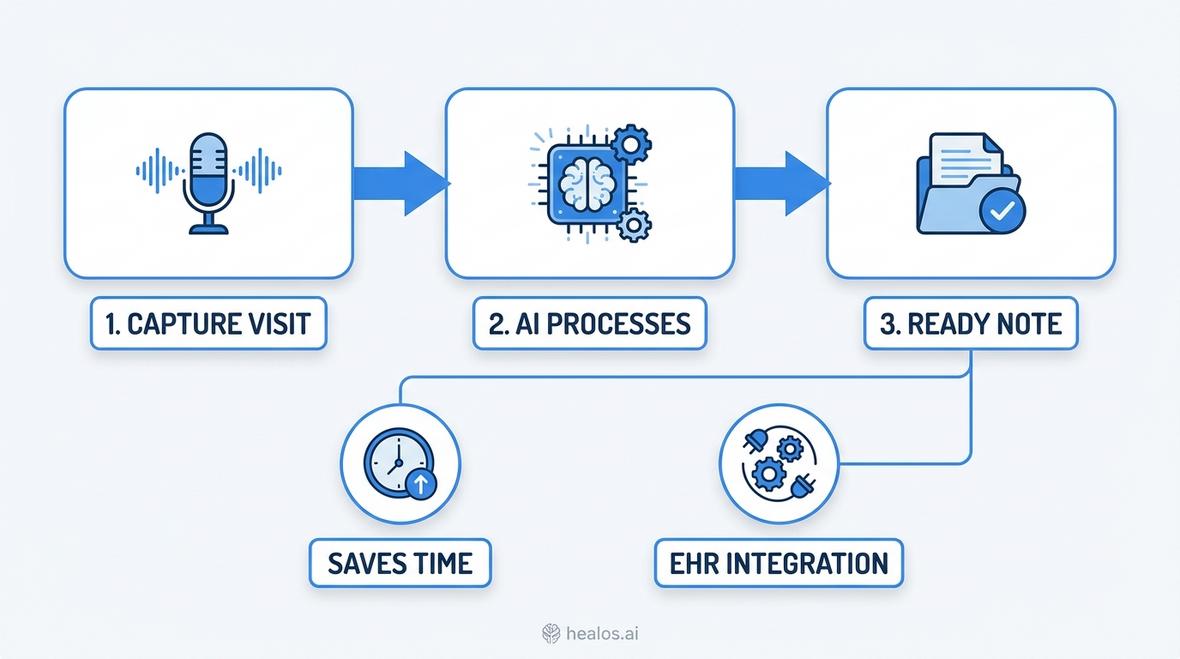
Step 1: Ambient Voice Capture
The process begins when a provider starts an encounter. AI medical notes systems use ambient listening technology typically via a smartphone, tablet, or in-room microphone to capture the entire conversation between clinician and patient. This is done passively, without requiring the provider to dictate in structured command language. The audio is encrypted and transmitted securely to comply with HIPAA regulations.
Step 2: AI Processing and Structuring
Once captured, the audio is processed by advanced NLP algorithms that transcribe the conversation, identify clinical terminology, and extract key data points: chief complaint, history of present illness, review of systems, physical exam findings, assessment, and plan. The AI then structures this information according to the practice's preferred template. Research from Stanford HAI on LLMs outperforming humans on medical summaries found that in blind tests, physician evaluators rated AI-generated summaries as at least as good as human-written summaries 45% of the time and superior 36% of the time on completeness, correctness, and conciseness.
Step 3: EHR Integration and Review
The completed note is pushed directly into the EHR Epic, Athena, eClinicalWorks, or any other system via API or integration layer. The clinician reviews the note for accuracy, makes any necessary edits, and signs off. This entire process typically takes minutes rather than the 10-20 minutes required for manual documentation. For practice managers seeking seamless workflows, platforms like HealOS AI Scribe offer pre-built integrations with dozens of EHR systems.
Quality and Accuracy of AI Medical Notes
Evidence-Based Performance Metrics
While early AI documentation tools faced criticism for inaccuracies, the latest generation has achieved clinical-grade performance. A peer-reviewed study on usability and accuracy of AI scribe-generated notes found that systems producing high-quality transcripts could generate excellent-quality medical notes, with specific accuracy metrics showing error rates comparable to or better than human documentation. However, it is important to note that a University of Washington study comparing AI scribe notes to clinician-authored notes found that AI-generated notes were consistently lower in quality across domains including accuracy, thoroughness, and comprehensiveness, reinforcing that AI-generated notes should always be treated as drafts requiring clinician review and editing.
Specialty-Specific Customization
Not all AI medical notes solutions are created equal. The best platforms allow for deep customization by specialty psychiatry, cardiology, oncology, pediatrics, and more to ensure that terminology, assessment frameworks, and billing codes align with the unique needs of each practice. For example, psychiatry-specific AI scribes understand mental status exams and DSM-5 coding, while cardiology solutions capture detailed cardiovascular exam findings and echo interpretations.
Implementation Best Practices for Practice Managers
Start with a Pilot Program
Before rolling out AI medical notes across an entire practice, launch a pilot with 2-5 high-volume providers. This allows you to test workflows, measure time savings, and gather feedback without disrupting the entire organization. Track key metrics: documentation time per encounter, provider satisfaction scores, and note quality audits.
Invest in Training and Change Management
Even the most intuitive AI tools require onboarding. Allocate time for provider training sessions, create quick-reference guides, and designate a champion within the practice who can troubleshoot issues and share best practices. Resistance to change is natural; demonstrating early wins such as a provider finishing charting 2 hours earlier builds momentum.
Ensure Seamless EHR Integration
Confirm that your chosen AI medical notes platform integrates natively with your EHR. Avoid solutions that require manual copy-paste or additional data entry steps, as these negate the efficiency gains. Platforms offering pre-built EHR integrations reduce implementation time from months to days.
Maintain HIPAA Compliance and Data Security
All AI medical notes systems must be fully HIPAA-compliant, with end-to-end encryption, business associate agreements (BAAs), and audit logs. Verify that the vendor undergoes regular third-party security audits and maintains SOC 2 Type II certification. Data breaches can devastate a practice financially and reputationally, so due diligence here is non-negotiable.
ROI and Cost-Benefit Analysis for AI Medical Notes
Quantifying Cost Savings
The financial case for AI medical notes is compelling. A full-time human scribe costs approximately $42,000 annually in salary and benefits, plus recruitment and training expenses. AI solutions typically range from $99 to $299 per provider per month—$1,200 to $3,600 annually representing savings of $38,400 to $40,800 per provider per year. For a practice with five providers, that translates to nearly $200,000 in annual savings.
Revenue Enhancement Through Better Documentation
Beyond cost savings, AI medical notes improve billing accuracy and completeness, leading to higher reimbursement rates. When documentation supports higher-level E/M codes and reduces undercoding, practices see revenue increases of 5-15%. Additionally, faster claim submissions and fewer denials accelerate cash flow, improving the practice's working capital position.
Time Savings and Productivity Gains
According to Kaiser Permanente's analysis of 2.5 million encounters, AI scribes saved nearly 16,000 hours of documentation time in 15 months. For an individual provider seeing 20 patients per day, saving 5 minutes per encounter equates to 100 minutes daily, or 8.3 hours per week enabling an additional 10-12 patient visits weekly without extending work hours. For practices focused on growth, this productivity gain is invaluable.
Choosing the Right AI Medical Notes Platform
Key Selection Criteria
1. EHR Integration: Does the platform integrate natively with your EHR? How quickly can it be deployed?
2. Customization: Can templates be customized for your specialty and workflow preferences?
3. Accuracy: What are the documented accuracy rates? Are there peer-reviewed studies or user testimonials?
4. Pricing: What is the total cost of ownership, including setup fees, per-provider subscriptions, and support?
5. Support: What level of customer support is provided? Is there a dedicated implementation team?
6. Compliance: Is the platform HIPAA-compliant with a signed BAA? What certifications does it hold?
Why HealOS Stands Out: The Unified Agent Approach
Unlike point solutions that only handle documentation, HealOS offers a unified platform that automates the entire administrative workflow: AI scribes, AI receptionists, insurance verification, prior authorization, claims processing, and more. This 'unified agent' approach means practice managers deploy a single platform rather than stitching together disparate vendors, reducing complexity and total cost of ownership. For overwhelmed managers seeking operational efficiency and financial health, this integrated approach is a strategic advantage. Explore HealOS AI Scribe to see how seamless EHR integration and customizable templates can transform your practice.
Specialty-Specific Use Cases for AI Medical Notes
Psychiatry and Mental Health
Psychiatrists and therapists spend significant time documenting patient mood, affect, thought content, and safety assessments. AI medical notes platforms designed for behavioral health can capture nuanced psychiatric terminology and structure notes according to DAP or SOAP formats. Learn more about AI scribes for psychiatry.
Primary Care and Family Medicine
Primary care providers face high patient volumes and wide-ranging chief complaints. AI medical notes enable rapid documentation of routine visits, chronic disease management, and preventive care, freeing time for complex cases. Discover how individual providers can leverage AI to increase capacity.
Cardiology
Cardiology encounters involve detailed exam findings, echo interpretations, and procedure notes. Specialty-trained AI medical notes systems understand cardiovascular terminology and can auto-populate procedure codes. Explore cardiology-specific solutions.
Pediatrics
Pediatric visits require documenting growth milestones, parental concerns, and immunization records. AI tools customized for pediatrics streamline well-child visits and reduce documentation time. See how pediatrics practices benefit from AI scribes.
Overcoming Common Objections and Concerns
Concern: 'AI Notes Are Not Accurate Enough'
While early systems struggled, current-generation AI medical notes achieve clinical-grade accuracy, particularly when trained on specialty-specific data. The University of Washington study highlighted that AI notes should be reviewed and edited by clinicians a step already standard in clinical workflows. With proper oversight, AI-generated notes meet or exceed the quality of human documentation.
Concern: 'It Will Disrupt Our Workflow'
Modern AI medical notes platforms are designed for minimal disruption. Providers simply start the app at the beginning of an encounter and receive a completed note minutes later. Training takes 1-2 hours, and most users report full proficiency within a week. Pilot programs demonstrate rapid adoption and high satisfaction.
Concern: 'We Cannot Afford the Upfront Cost'
AI medical notes solutions typically operate on subscription models with no large upfront capital expenditures. At $99-$299 per provider per month, the investment is immediately offset by eliminating scribe salaries, reducing overtime, and improving billing accuracy. For budget-conscious practices, the ROI is measurable within the first quarter.
The Future of AI Medical Notes: Trends and Innovations
Multimodal AI: Integrating Audio, Visual, and EHR Data
Next-generation AI medical notes will incorporate visual inputs photos of skin lesions, X-rays, or exam videos alongside audio to create even richer documentation. Integration with wearable devices and remote patient monitoring will enable AI to pre-populate notes with objective data before the encounter begins.
Predictive Analytics and Clinical Decision Support
AI systems will evolve beyond documentation to provide real-time clinical decision support, flagging potential drug interactions, suggesting differential diagnoses, and recommending evidence-based treatment protocols directly within the note.
Interoperability and Data Exchange
As interoperability standards mature, AI medical notes will seamlessly share data across health information exchanges (HIEs), enabling continuity of care and reducing redundant documentation when patients see multiple providers. Explore EHR integration strategies for more insights.
Frequently Asked Questions
Are AI Medical Notes HIPAA-Compliant?
Yes, reputable AI medical notes platforms are fully HIPAA-compliant, with end-to-end encryption, signed business associate agreements, and regular security audits. Always verify compliance before implementation.
How Much Time Do AI Medical Notes Save?
Most providers report saving 5-10 minutes per encounter, translating to 1-2 hours per day for high-volume practices. Kaiser Permanente's study documented nearly 16,000 hours saved across 2.5 million encounters.
What Is the Average Cost of AI Medical Notes?
Subscription pricing typically ranges from $99 to $299 per provider per month, depending on features and integrations. This is significantly less expensive than hiring human scribes.
What Is the Accuracy Rate of AI Medical Notes?
Leading platforms report accuracy rates of 95-98% for transcription and clinical data extraction. However, all AI-generated notes should be reviewed and edited by the clinician before signing.
Can AI Medical Notes Integrate with My Existing EHR?
Most modern AI platforms offer pre-built integrations with major EHR systems including Epic, Cerner, Athena, eClinicalWorks, and more. Confirm compatibility before purchase.
Conclusion
AI medical notes represent a paradigm shift in clinical documentation, offering practice managers a powerful tool to address staffing shortages, reduce provider burnout, and improve financial health. By automating the time-consuming process of note creation, these systems enable providers to see more patients, deliver better care, and reclaim work-life balance all while reducing operational costs and improving revenue cycle performance. The evidence is clear: practices that adopt AI medical notes see measurable ROI within months, higher provider satisfaction, and stronger competitive positioning. For the overwhelmed practice manager seeking to scale without adding headcount, the unified agent approach of platforms like HealOS delivers seamless EHR integration, specialty customization, and comprehensive workflow automation in a single solution. The future of healthcare documentation is here and it is powered by AI.