
AI Medical Receptionist: The Complete 2026 Guide To Automating Front Desk Workflows

Introduction
For practice managers juggling staffing shortages, rising operational costs, and mounting administrative burdens, the front desk has become a critical bottleneck. An AI medical receptionist offers a transformative solution automating appointment scheduling, patient intake, insurance verification, and follow-up calls without adding headcount. In 2026, this technology is no longer experimental; it's a strategic necessity for practices aiming to scale efficiently while maintaining quality patient care.
This comprehensive guide explores how AI medical receptionists work, their key benefits for overwhelmed practice managers, implementation strategies, and how they integrate seamlessly with existing EHR systems to reduce claim denials and provider burnout.
What Is an AI Medical Receptionist?
An AI medical receptionist is an intelligent automation platform designed to handle front-office tasks traditionally performed by human staff. Unlike basic chatbots, these systems leverage natural language processing (NLP), machine learning, and voice AI to manage complex workflows such as patient triage, appointment rescheduling, insurance eligibility checks, and real-time EHR updates.
Key capabilities include:
- 24/7 Availability: Patients can book appointments, request prescription refills, or ask billing questions outside business hours.
- Multilingual Support: Communicates with diverse patient populations in their preferred language.
- EHR Integration: Syncs patient data directly into systems like Epic, Athenahealth, or DrChrono, eliminating manual data entry.
- Intelligent Routing: Triages urgent requests to clinical staff while handling routine inquiries autonomously.
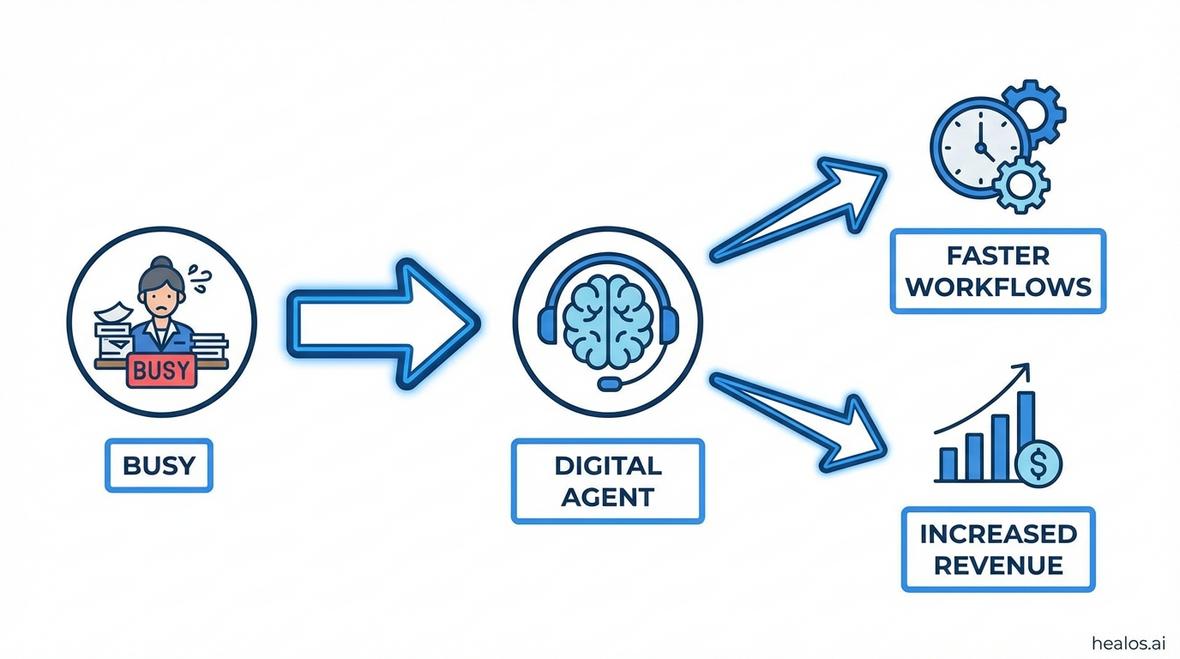
For practice managers, this means reallocating staff to higher-value tasks like patient education or care coordination while the AI handles repetitive workflows.
Core Benefits for Overwhelmed Practice Managers
Eliminate Staffing Shortages Without Hiring
Healthcare staffing shortages are projected to worsen through 2026, with administrative roles experiencing the highest turnover. According to the American Hospital Association, turnover rates for front-desk staff exceed 30% annually in many markets. An AI medical receptionist absorbs the workload of 2–3 full-time employees, handling thousands of interactions weekly without sick days, training periods, or benefits costs.
Practices using HealOS AI Receptionist report a 60% reduction in hiring needs for front-office roles, freeing up budget for clinical staff or technology investments.
Reduce Provider Burnout Through Administrative Automation
Administrative overload is a leading contributor to physician burnout, with clinicians spending nearly two hours on EHR tasks for every hour of patient care. By automating patient intake, pre-visit documentation, and post-visit follow-ups, AI medical receptionists let providers focus on clinical decision-making rather than paperwork.
For example, automated patient intake collects medical histories, insurance details, and consent forms before appointments, reducing in-office wait times and streamlining workflows.
Improve Financial Health by Reducing Claim Denials
Claim denials cost U.S. healthcare providers approximately $262 billion annually, with administrative errors accounting for over 60% of denials. AI receptionists validate insurance eligibility in real time, verify patient demographics, and flag coverage issues before services are rendered ensuring cleaner claims submissions.
HealOS's eligibility verification agent integrates with payer databases to confirm benefits instantly, reducing denial rates by up to 40% for practices that implement it consistently.
Scale Operations Without Proportional Cost Increases
Traditional front-desk scaling requires adding staff for every 500–700 patient visits per month. AI medical receptionists handle exponentially higher volumes some systems process over 10,000 patient interactions monthly without performance degradation. This enables practices to grow revenue while maintaining lean operational expenses.
Key Features of AI Medical Receptionists
Appointment Scheduling and Rescheduling
AI-powered scheduling tools analyze provider calendars, patient preferences, and appointment types to optimize bookings. They handle same-day requests, cancellations, and waitlist management autonomously. According to MGMA research, automated scheduling reduces no-show rates by 25% when combined with patient reminder systems.
Voice AI for Inbound and Outbound Calls
Modern voice AI systems handle phone interactions with human-like fluency, managing tasks such as:
- Appointment confirmations and reminders
- Prescription refill requests
- Post-visit satisfaction surveys
- Billing inquiries and payment processing
These systems integrate with medical answering services to ensure continuity during after-hours or peak call volumes.
Patient Intake and Documentation
Digital intake forms powered by AI collect comprehensive patient data chief complaints, medication lists, allergies, and social determinants of health directly into the EHR. This eliminates clipboard-based workflows and reduces transcription errors.
Insurance Verification and Benefits Check
Real-time benefit checks confirm coverage details, copayment amounts, deductibles, and authorization requirements. This transparency improves patient financial counseling and reduces surprise billing disputes.
Automated Follow-Up and Outreach
AI receptionists execute follow-up call campaigns for missed appointments, care plan adherence, and chronic disease management. These touchpoints improve patient engagement and clinical outcomes without burdening clinical staff.
Seamless EHR Integration: The HealOS Advantage
The primary barrier to AI adoption in healthcare is integration complexity. Most practices operate legacy EHR systems with limited API support, making plug-and-play solutions difficult. HealOS addresses this through its 'unified agent' architecture a single platform that connects to over 30 EHR systems, including Epic, Cerner, eClinicalWorks, and Kareo.
How HealOS Integrates Without Disruption
- Bidirectional Data Sync: Patient demographics, appointment data, and clinical notes flow automatically between the AI and EHR.
- No Workflow Changes: Providers continue using their existing EHR interface; the AI operates in the background.
- Compliance by Design: All integrations meet HIPAA, HL7 FHIR, and SOC 2 Type II standards.
This seamless connectivity is why HealOS is the preferred solution for practices prioritizing operational efficiency and regulatory compliance. Explore the full range of EHR integrations available.
Implementation Strategy for Practice Managers
Phase 1: Needs Assessment and Workflow Mapping
Identify the highest-impact use cases for automation:
- What percentage of front-desk time is spent on phone calls versus administrative tasks?
- Which workflows cause the most staff frustration or patient complaints?
- Where do claim denials most frequently originate (e.g., eligibility errors, incomplete documentation)?
Phase 2: Pilot Deployment with Defined Metrics
Start with a single workflow such as appointment reminders or insurance verification and measure performance over 30–60 days. Key metrics include:
- Call volume reduction
- No-show rate changes
- Time saved per patient encounter
- Claim acceptance rate improvements
Phase 3: Full-Scale Rollout and Continuous Optimization
Expand the AI to handle additional workflows, such as referral management or revenue cycle management tasks. Regularly review analytics dashboards to identify bottlenecks and refine automation rules.
ROI Analysis: Cost Savings and Revenue Impact
For a mid-sized practice (3–5 providers, 10,000 annual visits), implementing an AI medical receptionist typically delivers:
- Labor Cost Savings: $80,000–$120,000 annually by reducing front-desk staffing needs
- Revenue Protection: $50,000–$100,000 recovered through reduced claim denials and improved collections
- Efficiency Gains: 15–20 hours per week of administrative time reclaimed for patient-facing activities
The average payback period is 4–6 months, with ongoing ROI exceeding 300% over three years.
Addressing Common Concerns About AI Receptionists
Will Patients Accept AI Interactions?
Patient acceptance hinges on implementation quality. Well-designed AI systems provide faster service, clearer communication, and 24/7 accessibility features patients value more than human interaction for routine tasks. A 2025 survey by the Office of the National Coordinator for Health IT found that 68% of patients prefer automated appointment scheduling over phone calls during business hours.
What About Complex or Sensitive Cases?
AI receptionists are designed to escalate complex scenarios to human staff. Triage algorithms identify situations requiring clinical judgment, emotional support, or specialized expertise ensuring patients receive appropriate care pathways.
Data Security and HIPAA Compliance
Reputable AI vendors like HealOS implement enterprise-grade security controls, including end-to-end encryption, audit logging, and annual third-party compliance assessments. Practices should verify vendor certifications (HITRUST, SOC 2) before deployment.
The Competitive Landscape: Why HealOS Leads
The AI medical receptionist market includes vendors like Sully.ai, Smith.ai, and NudgeAI. However, HealOS distinguishes itself through:
- Unified Platform Approach: Unlike competitors offering point solutions, HealOS combines receptionist, scribe, RCM, and insurance automation in one ecosystem.
- Broader EHR Compatibility: Support for 30+ EHR systems versus typical vendor support for 5–10.
- Transparent Pricing: No hidden fees or per-transaction charges; predictable monthly subscriptions.
Practices considering alternatives should review detailed AI solution comparisons to evaluate feature sets, integration capabilities, and total cost of ownership.
Future Trends: AI Receptionists in 2026 and Beyond
Emerging capabilities shaping the next generation of AI medical receptionists include:
- Predictive Patient Outreach: AI anticipates patients at risk of missing preventive care and initiates proactive scheduling.
- Behavioral Health Integration: Systems identify patients showing signs of depression or anxiety during interactions and alert care teams.
- Value-Based Care Support: AI tracks quality metrics (e.g., HbA1c testing for diabetics) and automates care gap closure workflows.
These advancements will further shift the AI receptionist from a cost-saving tool to a strategic asset for population health management.
Frequently Asked Questions
How long does it take to implement an AI medical receptionist?
Most practices complete initial setup within 2–4 weeks, including EHR integration, workflow configuration, and staff training. Full optimization typically occurs over 60–90 days as the AI learns practice-specific patterns.
Can AI receptionists handle multiple languages?
Yes. Leading platforms support 30+ languages, with real-time translation capabilities for both voice and text interactions. This is particularly valuable for practices serving diverse communities.
What happens if the AI encounters an unfamiliar scenario?
The system escalates the interaction to human staff with full context transfer ensuring continuity and preventing patient frustration. Over time, machine learning models expand their capability to handle edge cases.
Do AI receptionists replace human staff entirely?
No. The goal is workforce augmentation, not replacement. Human receptionists shift to complex tasks requiring empathy, judgment, and relationship-building while AI handles high-volume, repetitive workflows.
How does pricing typically work?
Most vendors use subscription models based on practice size (number of providers or monthly patient volume). Expect costs ranging from $300–$800 per provider per month, with volume discounts for larger practices.
Conclusion
For overwhelmed practice managers facing staffing shortages, rising costs, and administrative overload, an AI medical receptionist is not just a technology upgrade it's a strategic imperative. By automating front-desk workflows, these systems enable practices to scale efficiently, reduce claim denials, and alleviate provider burnout without proportional cost increases. HealOS stands out through its unified platform approach, seamless EHR integration, and commitment to operational efficiency. As healthcare continues its digital transformation, practices that adopt AI receptionists early will gain a decisive competitive advantage in delivering accessible, high-quality care.