
AI Powered Healthcare Platform: Complete Guide To Automating Practice Operations And Reducing Administrative Burden

The modern healthcare landscape demands more from practice managers than ever before. Between staffing shortages, mounting administrative tasks, and the constant pressure to maintain financial health while delivering quality patient care, the burden has become unsustainable. An ai powered healthcare platform offers a transformative solution automating workflows, reducing claim denials, and enabling practices to scale without adding headcount.
For overwhelmed practice managers, the promise of automation isn't just about efficiency it's about survival. With provider burnout at record highs and administrative tasks consuming up to 70% of staff time, the need for intelligent, integrated solutions has never been more critical. This comprehensive guide explores how an ai powered healthcare platform can revolutionize practice operations, specifically addressing the pain points that keep managers awake at night.
Understanding AI Powered Healthcare Platforms
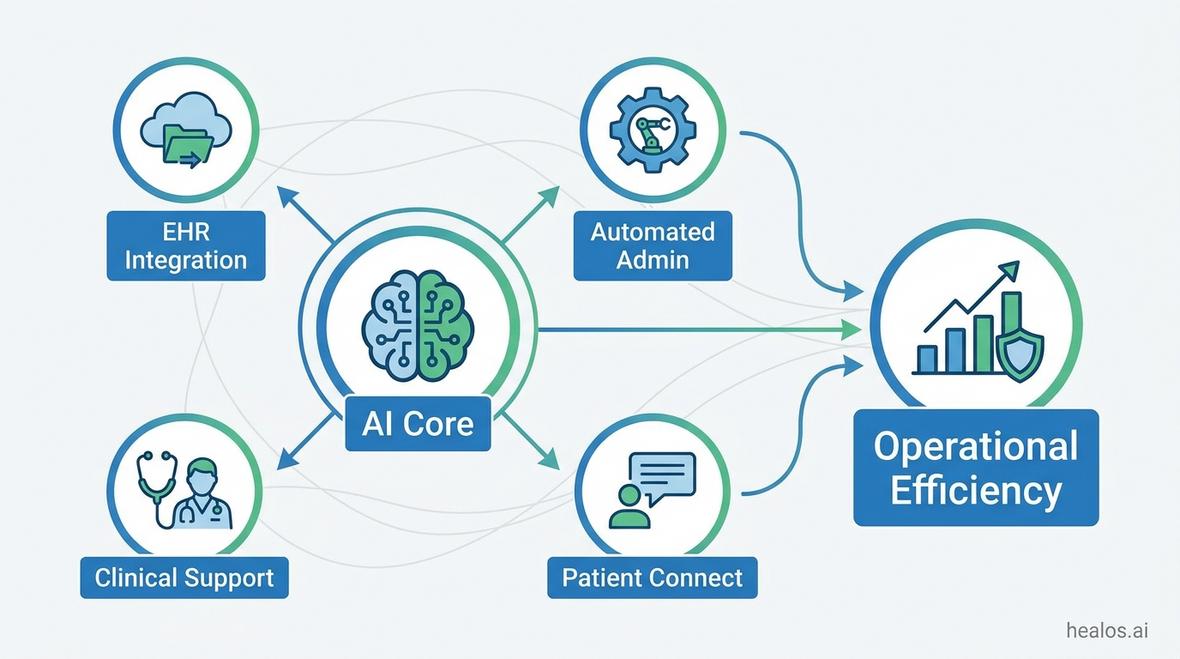
An ai powered healthcare platform represents a unified ecosystem of intelligent agents designed to handle the full spectrum of practice operations. Unlike point solutions that address single tasks, comprehensive platforms integrate seamlessly with existing EHR systems to orchestrate everything from patient intake to revenue cycle management.
These platforms leverage artificial intelligence to automate repetitive tasks, predict workflow bottlenecks, and optimize resource allocation. Systematic review of AI in healthcare and impact on efficiency and workflow demonstrates that AI implementations in healthcare settings consistently deliver measurable improvements in efficiency and accuracy, with documented reductions in task completion time.
The unified agent approach distinguishes leading platforms from legacy automation tools. Rather than deploying separate systems for documentation, billing, and patient communication, an integrated ai powered healthcare platform coordinates these functions through interconnected AI agents that share data and learn from practice patterns.
Core Components of a Modern Healthcare Platform
A comprehensive ai powered healthcare platform typically includes several key modules working in concert:
- Clinical Documentation Automation: AI scribes that capture patient encounters and generate accurate clinical notes without manual input
- Revenue Cycle Management: Automated claims processing, denial management, and payment posting that reduces financial leakage
- Patient Communication: Intelligent receptionists handling scheduling, reminders, and intake workflows
- Administrative Workflows: Document processing, referral management, and insurance verification
The AI scribe functionality exemplifies how these components integrate automatically documenting visits while simultaneously extracting billing codes and updating the EHR without requiring staff intervention.
Addressing Staffing Shortages and Provider Burnout
Staffing shortages represent the most pressing operational challenge for practice managers today. The traditional response hiring additional administrative staff has become financially untenable and logistically difficult given tight labor markets. An ai powered healthcare platform offers an alternative path forward.
Provider burnout stems largely from excessive documentation burden. Evidence that automation and AI reduce documentation time and burnout reveals that digital tools specifically designed to reduce documentation significantly decrease both time spent on charting and burnout scores among healthcare providers.
By automating clinical documentation through ambient listening technology, platforms enable providers to focus on patient interaction rather than computer screens. The medical scribe agent captures conversations in real-time, generates comprehensive notes, and populates the EHR automatically eliminating hours of after-hours charting that contributes to burnout.
Scaling Without Adding Headcount
The ability to handle increasing patient volume without proportional staff growth represents a game-changer for practice economics. An ai powered healthcare platform enables this scalability through intelligent automation of high-volume tasks.
Consider the front desk operations: traditional practices require one receptionist per 1,000-1,500 patient encounters. With an AI receptionist handling phone calls, appointment scheduling, and patient intake, practices can manage significantly higher volumes with minimal human oversight.
Similarly, back-office functions that previously required dedicated staff insurance verification, prior authorizations, claims follow-up become automated workflows managed by AI agents. This automation doesn't eliminate jobs; it reallocates human talent to higher-value activities that require empathy and clinical judgment.
Improving Financial Health and Reducing Claim Denials
Claim denials erode practice profitability more than any other factor. Industry data shows that 5-10% of claims are initially denied, and practices recover only 60% of denied amounts. For overwhelmed practice managers, reducing denials directly impacts financial sustainability.
An ai powered healthcare platform attacks denials at multiple points in the revenue cycle. Upfront insurance verification through automated eligibility checking ensures coverage before services are rendered. Real-time coding assistance validates that documentation supports billed procedures, reducing technical denials.
The platform's denial management capabilities identify patterns in rejections, automatically generate appeals with supporting documentation, and track submission deadlines functions that typically require experienced billing specialists. By catching errors before submission and expediting appeals when denials occur, practices see measurable improvements in clean claim rates and days in accounts receivable.
Complete Revenue Cycle Optimization
Beyond denial reduction, comprehensive ai powered healthcare platform solutions optimize the entire revenue cycle. Revenue cycle management agents coordinate multiple functions:
- Automated Claims Submission: AI reviews documentation completeness and coding accuracy before electronic submission
- Payment Posting: Intelligent reconciliation of payments against expected reimbursements, flagging underpayments automatically
- AR Monitoring: Continuous tracking of aging accounts with automated follow-up workflows
- Patient Collections: Gentle, consistent outreach for patient responsibility balances
This integrated approach eliminates the revenue leakage that occurs when manual processes miss follow-ups or fail to identify underpayments. Practices implementing comprehensive automation typically see 15-25% improvements in collection rates within the first year.
Seamless EHR Integration and the Unified Agent Approach
The single most important factor in platform success is EHR integration quality. An ai powered healthcare platform that requires duplicate data entry or operates in isolation from clinical workflows will fail to deliver promised efficiency gains.
Leading platforms achieve seamless integration through multiple connection methods native API integrations for major EHR systems, HL7 interfaces for legacy systems, and intelligent screen scraping for platforms lacking modern APIs. The comprehensive integration capabilities ensure that automation works regardless of existing technology infrastructure.
The unified agent approach means that different automation modules share context and data. When the AI receptionist schedules an appointment, that information flows automatically to the clinical documentation agent, which prepares a pre-visit summary. After the encounter, billing codes flow to revenue cycle agents without manual handoffs. This orchestration eliminates the fragmentation that plagues point solution implementations.
Implementation and Onboarding Considerations
Practice managers evaluating ai powered healthcare platform solutions must consider implementation complexity. The best platforms minimize disruption through phased rollouts and white-glove onboarding support.
Typical implementation follows this progression:
- Discovery and Configuration: Platform teams map existing workflows and configure agents to match practice patterns (1-2 weeks)
- EHR Integration: Technical teams establish secure connections and validate data flow (2-3 weeks)
- Pilot Testing: Limited rollout with select providers to refine configurations (2-4 weeks)
- Full Deployment: Practice-wide launch with ongoing optimization (1-2 weeks)
During this process, dedicated implementation specialists ensure that staff receive training and that workflows transition smoothly. The goal is to achieve measurable efficiency gains within 60-90 days of initial deployment.
Real-World Impact: Practice Transformation Through Automation
The theoretical benefits of an ai powered healthcare platform only matter if they translate to measurable practice improvements. Successful implementations demonstrate profound operational transformations.
Consider documentation efficiency: practices implementing AI scribes report 60-75% reductions in time spent on clinical documentation. For a provider seeing 20 patients daily, this represents 2-3 hours reclaimed time that can accommodate additional patients or simply reduce after-hours charting.
Front desk automation yields similarly dramatic results. An automated medical answering service handles routine calls 24/7 without staffing costs, improving patient satisfaction while reducing payroll expenses. Practices typically see 40-50% reductions in phone-related staff time.
Revenue cycle improvements manifest as both accelerated cash flow and reduced operational costs. Automated claims processing and denial management typically reduce days in AR by 15-25% while decreasing billing department workload by 30-40%. These improvements directly strengthen practice financial health.
Measuring Platform ROI
Practice managers must justify technology investments with clear return-on-investment calculations. An ai powered healthcare platform delivers ROI through multiple channels:
- Labor Cost Avoidance: Automation eliminates the need for additional hires as volume grows
- Revenue Enhancement: Better coding accuracy and reduced denials increase collections
- Provider Productivity: Reduced documentation burden enables increased patient capacity
- Staff Retention: Decreased administrative burden improves job satisfaction and reduces turnover costs
Most practices achieve full ROI within 6-12 months of implementation, with ongoing annual savings of 20-30% compared to traditional staffing models for equivalent volumes.
Specialty-Specific Applications and Customization
Different medical specialties face unique operational challenges that generic automation cannot adequately address. A sophisticated ai powered healthcare platform offers specialty-specific configurations and workflows.
For behavioral health practices, therapy-focused automation handles session documentation, treatment planning, and outcomes tracking with templates designed for mental health workflows. Psychiatry practices benefit from medication management documentation and regulatory compliance features.
Cardiology practices require integration with diagnostic equipment and specialized documentation for procedures. Cardiology-specific agents automate pre-procedure clearances, results reporting, and complex coding for interventional procedures.
Group practices face coordination challenges that individual providers don't encounter. Multi-provider automation includes scheduling optimization, provider-to-provider communication, and consolidated reporting across the organization.
Customization and Flexibility
Beyond specialty templates, leading ai powered healthcare platform solutions offer deep customization capabilities. Practices can configure documentation templates, workflow triggers, and reporting dashboards to match specific operational preferences.
Custom templates ensure that generated documentation matches provider preferences and specialty standards. Workflow automation rules can be tailored to practice-specific policies for example, automatically routing certain insurance verifications for manual review while fully automating others based on payer reliability.
This flexibility ensures that automation enhances rather than disrupts established workflows, increasing staff adoption and maximizing efficiency gains.
Security, Compliance, and Risk Management
Practice managers bear responsibility for protecting patient data and ensuring regulatory compliance. An ai powered healthcare platform must meet stringent security and privacy standards.
HIPAA compliance represents the baseline requirement. Leading platforms achieve compliance through encryption at rest and in transit, comprehensive access controls, business associate agreements, and regular security audits. Technical safeguards include data segregation, audit logging, and breach notification procedures.
Beyond HIPAA, platforms must address state-specific privacy laws, payer credentialing requirements, and specialty-specific regulations. Automated compliance monitoring flags potential issues such as documentation gaps that could trigger audits before they become problems.
Risk management extends to clinical accuracy. While AI dramatically improves efficiency, providers retain responsibility for clinical decisions. Quality platforms include validation workflows that enable quick provider review and approval of AI-generated content before finalization.
The Future of Healthcare Automation
The current generation of ai powered healthcare platform solutions represents just the beginning of healthcare's automation journey. Emerging capabilities promise even greater operational transformation.
Predictive analytics will enable platforms to anticipate workflow bottlenecks, patient no-shows, and billing issues before they occur. Machine learning models trained on practice-specific data will continuously optimize scheduling, resource allocation, and revenue cycle processes.
Natural language processing advances will expand automation beyond structured workflows into unstructured communication automatically triaging patient messages, extracting clinical information from faxes and external records, and generating patient education materials tailored to individual health literacy levels.
Interoperability improvements will enable seamless data exchange across the healthcare ecosystem, reducing duplicate testing, streamlining referrals, and improving care coordination. Automated referral processing will evolve from internal workflow automation to comprehensive network coordination.
Selecting the Right Platform for Your Practice
With numerous vendors offering ai powered healthcare platform solutions, practice managers face difficult selection decisions. Several key factors differentiate leading platforms from inadequate alternatives.
Integration depth and breadth matter most. Evaluate not just whether a platform claims EHR integration, but how deeply it connects read/write capabilities, real-time synchronization, and support for your specific EHR version. Request demonstrations with your actual EHR environment, not generic examples.
Assess the breadth of automation coverage. Platforms focusing solely on documentation or billing require integration with other tools, creating complexity and data silos. Comprehensive solutions like those offering complete document automation alongside clinical and financial workflows deliver superior outcomes.
Implementation support and ongoing optimization separate successful deployments from abandoned projects. Evaluate vendor commitment to onboarding, training, and continuous improvement. The best platforms provide dedicated success managers who proactively identify optimization opportunities.
Finally, consider total cost of ownership beyond subscription fees. Implementation costs, training time, and integration expenses can significantly impact ROI. Transparent pricing and clear implementation timelines indicate vendor maturity and reliability.
Frequently Asked Questions
How long does it take to implement an ai powered healthcare platform?
Implementation timelines vary based on practice size and complexity, but most deployments reach full functionality within 60-90 days. This includes EHR integration, staff training, and workflow optimization. Phased rollouts allow practices to start seeing benefits within the first 2-3 weeks.
Will AI automation replace my existing staff?
An ai powered healthcare platform is designed to augment, not replace, healthcare staff. Automation handles repetitive, high-volume tasks, allowing staff to focus on complex cases requiring human judgment and empathy. Most practices redeploy staff to higher-value activities rather than reducing headcount.
How does AI handle complex medical cases?
AI agents excel at routine cases with clear patterns but flag complex or ambiguous situations for human review. The platform learns from provider corrections and practice patterns, continuously improving accuracy. Providers always retain final authority over clinical documentation and decisions.
What happens if the AI makes a mistake?
Quality platforms include validation workflows where providers review AI-generated content before finalization. All outputs include confidence scores, with low-confidence items automatically flagged for additional review. Audit trails track all AI actions and human modifications for accountability.
Can the platform integrate with my current EHR system?
Leading ai powered healthcare platform solutions support integration with virtually all major EHR systems through native APIs, HL7 interfaces, or intelligent automation. During the evaluation process, vendors should demonstrate integration with your specific EHR version and confirm supported functionality.
How much does an ai powered healthcare platform cost?
Pricing models vary, with most platforms charging per-provider monthly subscriptions ranging from $200-$500 per provider depending on feature scope. Enterprise pricing for large groups typically offers volume discounts. Most practices achieve positive ROI within 6-12 months through labor cost avoidance and revenue improvements.
Is patient data secure with AI automation?
Reputable platforms maintain HIPAA compliance through encryption, access controls, comprehensive security audits, and business associate agreements. Data remains within secure healthcare-grade infrastructure, and platforms undergo regular third-party security assessments. Always verify certifications and review security documentation before implementation.
Can the platform be customized to match our workflows?
Yes, leading solutions offer extensive customization including documentation templates, workflow rules, specialty-specific configurations, and reporting dashboards. During implementation, configuration specialists work with your team to map existing workflows and optimize platform settings to match practice preferences.
Conclusion
For overwhelmed practice managers facing staffing shortages, provider burnout, and financial pressures, an ai powered healthcare platform represents a strategic imperative rather than a nice-to-have technology enhancement. The unified agent approach seamlessly integrating clinical documentation, revenue cycle management, and patient communication delivers operational transformation that enables practices to scale without proportionally increasing administrative burden.
The evidence is compelling: automation reduces documentation time by 60-75%, improves clean claim rates by 15-25%, and enables practices to handle significantly higher patient volumes with existing staff. By addressing the core pain points of modern practice management, these platforms don't just improve efficiency they make sustainable practice growth possible in an increasingly challenging healthcare environment.