
AI Receptionist For Medical Office: Complete Guide To Automating Front Desk & Scaling Without Hiring

Introduction
The healthcare industry is grappling with an unprecedented staffing crisis. According to the BLS JOLTS report on healthcare and social assistance quit and vacancy rates, job openings in healthcare and social assistance remain alarmingly high, while turnover continues to strain practice operations. For practice managers overwhelmed by administrative burdens, the traditional solution of hiring more front-desk staff is no longer sustainable financially or operationally.
This is where an AI receptionist for medical office becomes a game-changer. By automating patient intake, appointment scheduling, phone triage, and follow-up workflows, AI receptionists enable practices to scale operations without increasing headcount. For the overwhelmed practice manager focused on financial health and operational efficiency, AI-powered front desk automation offers a pathway to reduce claim denials, alleviate provider burnout, and maintain seamless patient experiences all while integrating directly with existing EHR systems.
In this comprehensive guide, we'll explore how an AI receptionist for medical office works, the specific workflows it automates, the ROI it delivers, and how solutions like HealOS AI Receptionist are transforming medical practices across specialties.
What Is an AI Receptionist for Medical Office?
An AI receptionist for medical office is an intelligent software solution that automates the core responsibilities of a traditional front-desk receptionist. Powered by natural language processing (NLP), machine learning, and voice AI, these systems handle patient interactions across multiple channels phone, SMS, email, and web chat without human intervention.
Core Capabilities of AI Receptionists
- 24/7 Availability: Patients can book appointments, ask questions, and receive assistance at any time, reducing missed calls and improving patient satisfaction.
- Appointment Scheduling: Automated booking, rescheduling, and cancellations synced directly with your practice management system.
- Phone Triage: Intelligent call routing based on patient urgency, directing critical cases to providers while handling routine inquiries autonomously.
- Patient Intake: Collects insurance information, medical history, and consent forms digitally before appointments.
- Follow-Up Automation: Sends appointment reminders, post-visit surveys, and care instructions without manual intervention.
- EHR Integration: Seamlessly updates patient records, eliminating double data entry and reducing errors.
Unlike basic chatbots or call-answering services, a true AI receptionist for medical office operates as a unified agent handling complex, multi-step workflows and making context-aware decisions just like a skilled human receptionist would.
Why Medical Practices Need an AI Receptionist Now
Staffing Shortages and Turnover
The healthcare staffing crisis is real and worsening. Practice managers face constant recruitment challenges, high turnover rates among administrative staff, and the financial burden of competitive salaries and benefits. An AI receptionist for medical office eliminates dependence on hiring cycles, reduces training overhead, and ensures consistent front-desk performance regardless of staffing fluctuations.
Overwhelming Administrative Burden
Front-desk staff spend an average of 77% of their time on administrative tasks scheduling, insurance verification, patient callbacks, and data entry. This leaves little bandwidth for patient-centered interactions. By automating these repetitive workflows, AI receptionists free human staff to focus on complex patient needs and relationship-building.
Financial Health and Claim Denials
Inaccurate patient information, missed insurance verifications, and incomplete intake forms contribute significantly to claim denials. An AI receptionist for medical office ensures data accuracy from the first touchpoint, reducing denial rates and accelerating revenue cycles. This directly addresses the top priority of overwhelmed practice managers: protecting the financial health of the practice.
Provider Burnout from Administrative Overload
When front-desk inefficiencies cascade into provider workflows double-booked appointments, incomplete patient histories, or excessive phone interruptions clinicians experience heightened burnout. Automating front-desk operations with an AI receptionist creates a smoother patient flow, allowing providers to focus on clinical care rather than administrative firefighting.
Key Workflows Automated by AI Receptionists
Automated Appointment Scheduling
AI receptionists handle the entire scheduling lifecycle booking, rescheduling, and cancellations across phone, web, and SMS channels. The system checks provider availability in real-time, applies scheduling rules (e.g., new patient vs. follow-up, specialty requirements), and confirms appointments automatically. This eliminates phone tag, reduces no-shows through automated reminders, and maximizes provider utilization.
For practices using HealOS Appointment Scheduling, integration with EHR and practice management systems ensures seamless synchronization without manual data entry.
Patient Intake and Registration
Before a patient ever steps foot in your office, an AI receptionist for medical office collects critical information demographics, insurance details, medical history, and consent forms. Digital intake forms are delivered via email or SMS, completed on the patient's smartphone, and automatically uploaded to the EHR. This process reduces lobby wait times, improves data accuracy, and ensures your team has everything needed for a smooth visit.
Learn more about AI-powered patient intake and how it transforms front-desk efficiency.
Intelligent Phone Triage and Call Routing
Not every call requires a live staff member. An AI receptionist for medical office uses natural language understanding to assess call urgency and intent. Routine questions (office hours, directions, prescription refills) are handled autonomously. Urgent clinical concerns are escalated to triage nurses or providers immediately. This intelligent routing reduces hold times, improves patient satisfaction, and allows human staff to focus on high-value interactions.
Explore AI medical answering for 24/7 call coverage without hiring night staff.
Follow-Up Calls and Patient Reminders
Post-appointment care coordination is critical for patient outcomes and practice revenue. AI receptionists automate follow-up calls to confirm medication adherence, schedule next appointments, and collect patient feedback. Appointment reminders sent via SMS, email, and voice calls reduce no-show rates by up to 30%, protecting practice revenue and improving continuity of care.
Check out automated follow-up calls and patient reminder systems to see the impact on practice efficiency.
Insurance Verification and Eligibility Checks
Manual insurance verification is time-consuming and error-prone. An AI receptionist for medical office automates eligibility checks before appointments, verifying coverage, copays, deductibles, and prior authorization requirements. This proactive approach reduces claim denials, accelerates payment cycles, and eliminates surprises for patients at check-in.
For deeper automation, see AI-powered eligibility verification and benefit check automation.
ROI and Cost Savings: The Financial Case for AI Receptionists
Reducing Headcount Without Reducing Service
The average medical receptionist salary ranges from $32,000 to $45,000 annually, plus benefits, payroll taxes, and training costs. An AI receptionist for medical office typically costs a fraction of this often $200 to $500 per month while providing 24/7 coverage, zero sick days, and consistent performance. For a practice with three front-desk staff, automating 60-70% of routine tasks can reduce the need for one to two full-time positions, delivering annual savings of $40,000 to $80,000.
Revenue Protection Through Denial Reduction
Claim denials due to incomplete patient information, incorrect insurance details, or missed authorizations cost practices thousands monthly. By automating insurance verification, patient intake, and data validation, AI receptionists reduce denial rates by 15-25%. For a practice with $2 million in annual revenue, a 20% reduction in a 10% denial rate translates to $40,000 in recovered revenue annually.
No-Show Reduction and Appointment Optimization
No-shows cost U.S. healthcare practices an estimated $150 billion annually. Automated appointment reminders via SMS, voice, and email reduce no-show rates by 20-30%. For a practice with 100 weekly appointments and a baseline 15% no-show rate, reducing this to 10% recovers 5 appointments weekly 260 annually. At an average visit value of $150, this represents $39,000 in recovered revenue.
Scalability Without Hiring
As practices grow adding providers, opening new locations, or expanding service lines traditional front-desk models require proportional staffing increases. An AI receptionist for medical office scales instantly, handling increased call volumes, appointment bookings, and patient inquiries without additional cost or training time. This enables practices to grow revenue without linearly increasing administrative overhead.
Seamless EHR Integration: The HealOS Advantage
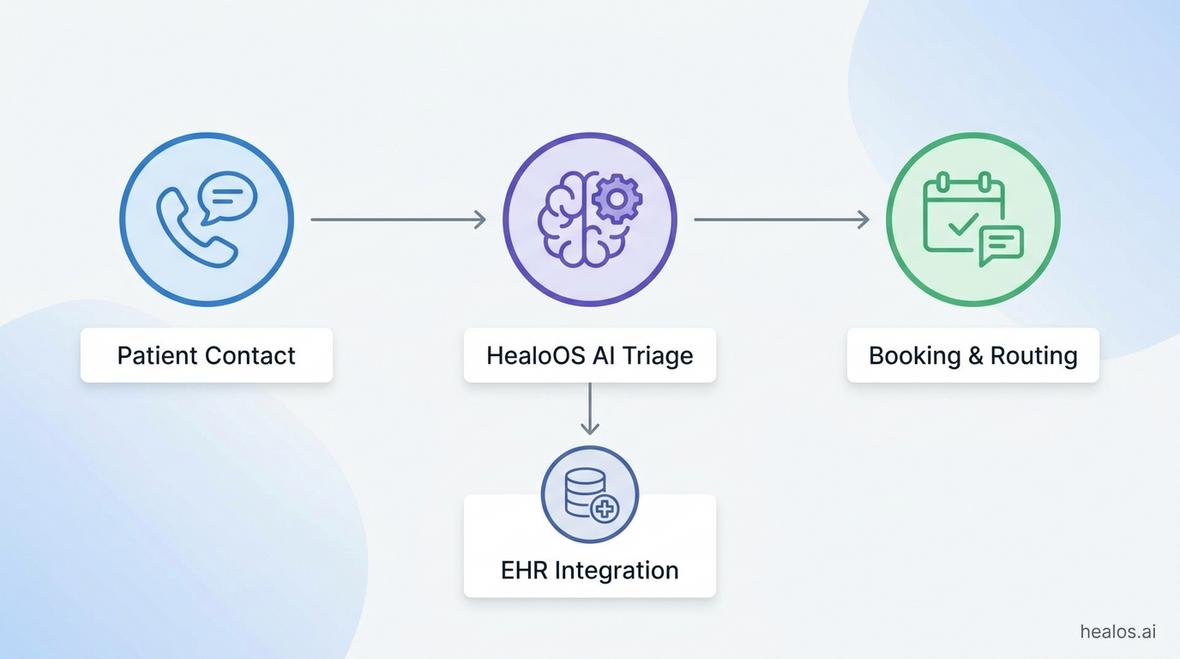
The true value of an AI receptionist for medical office lies in its ability to integrate seamlessly with existing EHR and practice management systems. Without integration, automation creates silos disconnected data, manual re-entry, and workflow friction. HealOS AI Receptionist stands out for its unified agent approach, connecting directly with leading EHR platforms to ensure bidirectional data flow.
How EHR Integration Works
When a patient schedules an appointment via the AI receptionist, the system:
- Checks real-time provider availability in your EHR.
- Books the appointment and updates the EHR schedule instantly.
- Collects patient intake information and writes it directly to the patient's chart.
- Triggers automated insurance verification and updates eligibility status in the EHR.
- Sends appointment reminders and logs patient responses.
This closed-loop automation eliminates double data entry, reduces errors, and ensures your team always has accurate, up-to-date information. Explore HealOS EHR integrations to see supported platforms.
Implementation and Adoption: What to Expect
Onboarding and Configuration
Modern AI receptionists are designed for rapid deployment. The typical onboarding process includes:
- EHR Integration Setup: API connections configured to sync schedules, patient data, and appointment workflows.
- Custom Workflow Mapping: Tailoring the AI to your practice's specific scheduling rules, insurance requirements, and triage protocols.
- Voice and Messaging Training: Customizing the AI's tone, language, and responses to reflect your practice's brand.
- Staff Training: Brief sessions to familiarize your team with the new system and handoff protocols.
Most practices are fully operational within 1-2 weeks, with minimal disruption to daily operations.
Patient Adoption and Satisfaction
Patients appreciate the convenience of 24/7 access, instant responses, and reduced wait times. Early concerns about 'talking to a robot' dissipate quickly when the AI provides accurate, helpful, and human-like interactions. Practices using AI receptionists report increased patient satisfaction scores, fewer complaints about phone hold times, and positive feedback about digital intake convenience.
Specialty-Specific Considerations
An AI receptionist for medical office adapts to the unique workflows of different specialties:
Primary Care and Family Medicine
High appointment volumes, diverse patient demographics, and complex insurance requirements make AI receptionists ideal for primary care. Automating routine physicals, vaccine appointments, and follow-up visits frees staff to handle urgent care triage and care coordination.
Specialty Practices (Cardiology, Orthopedics, Oncology)
Specialty practices often require prior authorizations, referral coordination, and complex scheduling rules. AI receptionists handle these workflows automatically, ensuring patients arrive with all necessary documentation and clearances. See specialty-specific solutions for cardiology, orthopedics, and oncology.
Mental Health and Psychiatry
Privacy, confidentiality, and appointment flexibility are paramount in mental health practices. AI receptionists provide discreet, HIPAA-compliant intake, flexible self-scheduling, and automated session reminders reducing no-shows and improving continuity of care. Learn more about AI for psychiatry practices.
Frequently Asked Questions
Is an AI receptionist for medical office HIPAA-compliant?
Yes. Reputable AI receptionist platforms like HealOS are built with HIPAA compliance at their core, featuring end-to-end encryption, secure data storage, audit logging, and Business Associate Agreements (BAAs). Patient data is protected throughout every interaction.
How much does an AI receptionist cost?
Pricing varies by platform and feature set, but most AI receptionist solutions range from $200 to $800 per month. This is significantly less expensive than hiring a full-time receptionist, with the added benefit of 24/7 availability and zero downtime.
Will an AI receptionist replace my live front-desk staff?
Not entirely. AI receptionists handle routine, repetitive tasks scheduling, intake, reminders freeing your human staff to focus on complex patient interactions, empathy-driven care coordination, and exception handling. The best model is a hybrid approach where AI and human staff complement each other.
Does it work with my EHR?
Leading AI receptionist platforms integrate with major EHR systems including Epic, Cerner, Athenahealth, eClinicalWorks, and more. Check with your vendor to confirm compatibility. HealOS offers broad EHR integration support visit HealOS integrations for details.
How long does implementation take?
Most practices are fully operational within 1-2 weeks, including EHR integration, workflow customization, and staff training. The process is designed to minimize disruption and deliver immediate value.
Conclusion
For overwhelmed practice managers facing staffing shortages, rising administrative burdens, and financial pressures, an AI receptionist for medical office offers a transformative solution. By automating appointment scheduling, patient intake, phone triage, and follow-up workflows, AI receptionists enable practices to scale operations without increasing headcount delivering measurable ROI through cost savings, revenue protection, and improved patient satisfaction.
With seamless EHR integration and a unified agent approach, platforms like HealOS AI Receptionist empower practices to reclaim operational efficiency, reduce provider burnout, and focus on what matters most: delivering exceptional patient care. The future of front-desk automation is here and it starts with choosing the right AI partner.