
AI Scribe For Doctors: Complete 2026 Guide To Reducing Admin Burden & Reclaiming Patient Time

Introduction
For practice managers drowning in staffing shortages and watching providers burn out from endless documentation, the promise of AI scribe for doctors technology represents more than innovation it's a lifeline. In 2026, healthcare practices face a stark reality: administrative tasks consume up to 77% of clinical time, leaving physicians exhausted and patients underserved. The overwhelmed practice manager knows this pain intimately: claim denials pile up, charting backlogs grow, and hiring another scribe or administrator seems financially impossible.
This is where AI-powered clinical documentation steps in. Unlike traditional human scribes that cost upwards of $42,000 annually per provider, modern AI scribe solutions deliver real-time, accurate documentation at a fraction of the cost often under $1,200 per provider yearly. For practices struggling with operational efficiency and financial health, the choice becomes clear: adopt intelligent automation or continue bleeding resources.
This comprehensive guide explores how AI scribe for doctors technology works, its measurable impact on practice operations, cost-benefit analysis, implementation strategies, and why solutions like HealOS AI Scribe are transforming healthcare delivery for overwhelmed practice managers nationwide.
What Is an AI Scribe for Doctors?
An AI scribe for doctors is an artificial intelligence-powered platform that listens to patient-provider conversations and automatically generates clinical documentation in real time. Using advanced natural language processing (NLP) and ambient voice recognition, these systems capture medical dialogue, interpret clinical context, and produce structured notes SOAP notes, progress notes, referral letters without manual typing or dictation delays.
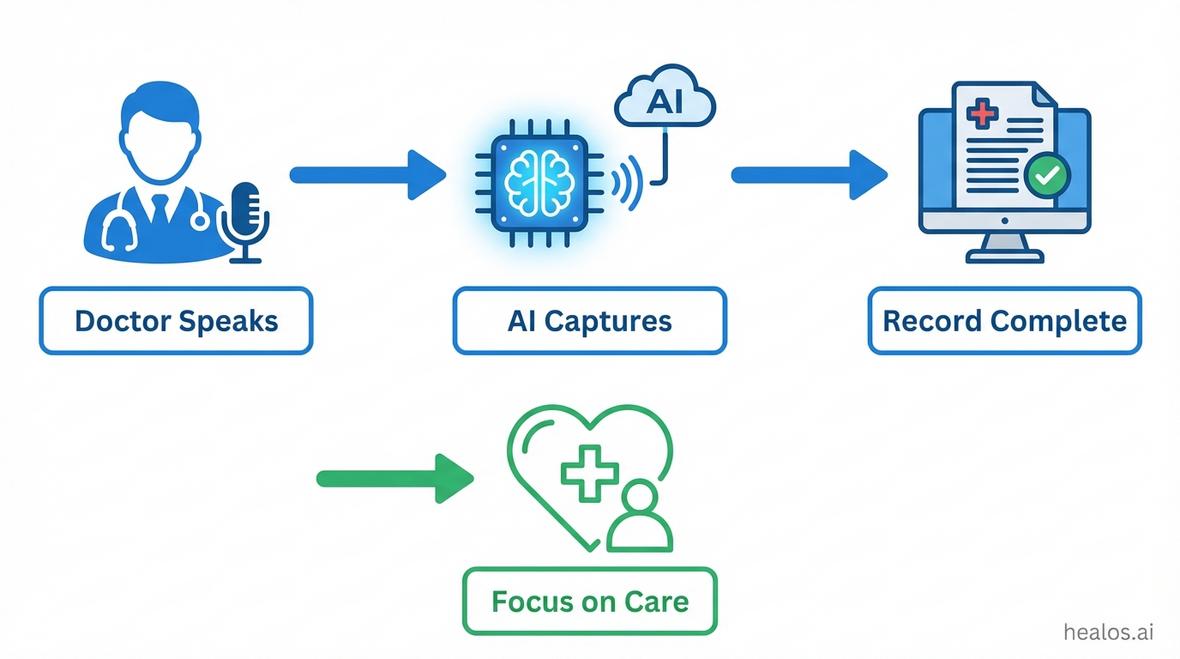
Unlike legacy medical transcription software that requires manual dictation, AI scribes operate passively in the background. They distinguish between patient speech and provider commentary, identify clinical terminology, and map conversational content to appropriate documentation sections. The result? Providers spend more face-to-face time with patients while the medical scribe software handles the paperwork.
How AI Scribes Work: The Technology Behind the Automation
Modern AI scribe platforms leverage multiple AI technologies simultaneously:
- Ambient Listening: Continuous audio capture during consultations without requiring physicians to press buttons or dictate formally.
- Speech Recognition: Converts spoken words into text with medical-grade accuracy, handling accents, medical jargon, and overlapping speech.
- Natural Language Understanding: Interprets clinical context, differentiating between symptoms, diagnoses, treatment plans, and patient history.
- Structured Data Extraction: Automatically populates EHR fields, ICD-10 codes, and billing information from unstructured conversation.
- Contextual Learning: Adapts to individual provider documentation styles, specialty-specific terminology, and custom templates over time.
For practice managers, this technology stack translates into one critical outcome: reduced administrative overhead without sacrificing documentation quality or compliance. According to research from the American Medical Association, physicians using AI scribes report up to 70% reduction in after-hours charting time, commonly known as 'pajama time.'
The Business Case: Why Practice Managers Need AI Scribes Now
For the overwhelmed practice manager, every decision must justify its ROI. The case for AI scribe for doctors technology rests on three pillars: cost savings, operational efficiency, and revenue protection.
Cost Comparison: Human Scribes vs. AI Solutions
Traditional human medical scribes cost between $35,000 and $50,000 annually per full-time equivalent, plus benefits, training, and turnover expenses. In contrast, AI scribe platforms typically range from $99 to $300 per provider monthly an annual cost of $1,188 to $3,600.
| Solution Type | Annual Cost per Provider | Scalability | Availability |
|---|---|---|---|
| Human Scribe | $42,000 - $50,000 | Limited by hiring | Office hours only |
| AI Scribe | $1,200 - $3,600 | Unlimited | 24/7 availability |
This price differential alone delivers savings of approximately $38,000 to $46,000 per provider annually. For a five-provider practice, that's over $200,000 in recaptured budget enough to hire additional clinical staff, invest in new equipment, or improve profit margins.
Reducing Claim Denials Through Documentation Accuracy
Incomplete or inaccurate documentation is a leading cause of claim denials. According to the Healthcare Financial Management Association, up to 30% of initial claims are denied, with documentation errors accounting for a significant portion. Each denied claim requires staff time to appeal, delays cash flow, and risks permanent revenue loss.
AI scribe for doctors platforms mitigate this risk by ensuring comprehensive, structured documentation that meets payer requirements. By capturing all relevant clinical details during the encounter and automatically suggesting appropriate diagnosis codes, AI scribes reduce coding errors and support claims on first submission. For practice managers focused on financial health, this means faster reimbursements and fewer appeals directly improving the revenue cycle.
Addressing Staffing Shortages and Provider Burnout
Physician burnout has reached crisis levels, with studies showing over 50% of providers reporting symptoms. Administrative burden, particularly documentation load, is the top contributor. When physicians spend two hours on EHR tasks for every hour of patient care, dissatisfaction and turnover become inevitable.
For practice managers, this creates a vicious cycle: burned-out providers reduce patient volume or leave entirely, increasing pressure on remaining staff and making recruitment harder. Implementing an AI medical dictation solution breaks this cycle by removing the documentation bottleneck. Providers reclaim hours weekly, patient satisfaction improves, and retention strengthens all without adding headcount.
Key Features of an Effective AI Scribe for Doctors
Not all AI scribe platforms deliver equal value. Practice managers evaluating solutions should prioritize these essential features:
Seamless EHR Integration
The best AI scribe for doctors integrates directly with existing electronic health record systems Epic, Cerner, Athenahealth, AdvancedMD, and others. This 'unified agent' approach eliminates double data entry and ensures documentation flows directly into the patient chart without manual copying or pasting. HealOS integrations support dozens of EHR platforms, making implementation frictionless regardless of your current technology stack.
Specialty-Specific Customization
General-purpose transcription tools often fail to capture the nuances of specialized care. Whether your practice focuses on cardiology, psychiatry, pediatrics, or orthopedics, your AI scribe must understand specialty vocabulary, common procedures, and documentation standards. Advanced platforms learn provider preferences and adapt templates accordingly, ensuring notes match clinical expectations.
Multilingual Support and Medical Translation
Diverse patient populations require medical translation capabilities. Leading AI scribes can process conversations in multiple languages and produce English documentation, or vice versa, ensuring accurate communication and compliance with language access requirements.
Real-Time Documentation with Ambient Listening
Providers should never need to pause care to operate their scribe. Ambient AI technology captures conversations naturally, without button presses or dictation commands. This 'hands-free' operation maintains patient engagement while ensuring complete documentation.
HIPAA Compliance and Enterprise-Grade Security
Clinical data demands the highest security standards. Your AI scribe must offer end-to-end encryption, HIPAA compliance, Business Associate Agreements (BAAs), and transparent data handling policies. Solutions lacking these protections expose your practice to regulatory penalties and reputational damage.
Implementation Guide: How to Deploy AI Scribes in Your Practice
For overwhelmed practice managers, the idea of implementing new technology can feel daunting. However, modern AI scribe for doctors platforms are designed for rapid deployment with minimal disruption.
Step 1: Assess Your Documentation Workflow
Before selecting a solution, map your current documentation process. Identify bottlenecks: How much time do providers spend charting after hours? Where do documentation errors occur most frequently? What percentage of claims face denials due to incomplete notes? This baseline data will help you measure ROI post-implementation.
Step 2: Evaluate AI Scribe Vendors
Compare platforms based on cost, EHR compatibility, specialty fit, and customer support. Request demos and trial periods. Ask about training requirements, implementation timelines, and ongoing support. Look for transparent pricing without hidden fees.
Step 3: Run a Pilot Program
Start with a small group of providers ideally those most burdened by documentation or most tech-savvy. Monitor metrics like time saved per encounter, documentation quality, and provider satisfaction. Use this data to refine workflows before full rollout.
Step 4: Train Staff and Providers
Even intuitive platforms require onboarding. Provide hands-on training sessions, documentation templates, and ongoing support. Emphasize how the tool reduces workload rather than replacing human judgment. Address privacy concerns and demonstrate compliance features.
Step 5: Monitor and Measure Outcomes
Track KPIs including documentation time, claim denial rates, provider satisfaction scores, and patient throughput. Adjust templates and workflows based on feedback. Celebrate wins publicly to build momentum and encourage adoption across the practice.
ROI and Financial Impact: Real Numbers from Real Practices
The return on investment for AI scribe for doctors technology is measurable and substantial. Consider these real-world examples:
Case Study: Five-Provider Family Practice
A family medicine practice with five physicians implemented AI scribes and tracked outcomes over 12 months. Results included:
- Documentation Time: Reduced from an average of 2.5 hours daily per provider to under 30 minutes a savings of nearly 2 hours per day per provider.
- Annual Time Savings: Approximately 2,500 hours reclaimed across the practice.
- Cost Savings: Eliminated plans to hire two additional human scribes at $42,000 each, saving $84,000 annually.
- Revenue Impact: Increased patient capacity by 15% due to reduced charting burden, adding roughly $120,000 in additional revenue.
- Net ROI: Over 300% in the first year.
Claim Denial Reduction and Revenue Cycle Improvement
Another practice reported a 22% reduction in claim denials after AI scribe implementation, attributed to more comprehensive documentation and accurate coding suggestions. For a practice processing $3 million in annual claims, this translates to approximately $660,000 in claims that would have been denied but were paid on first submission dramatically improving cash flow and reducing administrative appeals workload.
For practice managers balancing tight budgets, these financial outcomes make revenue cycle management improvements through AI scribes a strategic priority.
How HealOS Compares to Other AI Scribe Solutions
When evaluating AI scribe for doctors platforms, practice managers often compare multiple vendors. Here's how HealOS stacks up against popular alternatives:
HealOS vs. Freed AI
Freed AI alternatives are frequently considered, but HealOS offers broader functionality beyond scribing. While Freed focuses primarily on ambient documentation, HealOS provides a unified platform including AI receptionist, insurance automation, and referral management critical for practice managers seeking comprehensive workflow automation.
HealOS vs. DeepScribe
HealOS vs. DeepScribe comparisons reveal pricing and flexibility differences. DeepScribe's enterprise focus often means higher costs and longer implementation cycles, whereas HealOS scales affordably for practices of all sizes with rapid deployment options.
HealOS vs. Suki AI
Suki AI emphasizes voice commands and physician-driven dictation, which can interrupt patient flow. HealOS prioritizes true ambient listening, allowing natural conversation without provider intervention. Additionally, HealOS integrates more deeply with claims follow-up and denial management workflows key concerns for practice managers focused on revenue protection.
Addressing Common Concerns About AI Scribes
Accuracy and Reliability
Practice managers often worry about AI documentation errors. Leading platforms report accuracy rates exceeding 95%, with continuous learning improving performance over time. Providers always review and edit notes before signing, maintaining clinical oversight while drastically reducing drafting time.
Patient Acceptance
Will patients object to AI recording their visits? Studies show most patients accept or prefer AI scribes once informed, particularly when they notice providers maintaining eye contact rather than staring at screens. Transparent communication about privacy protections and clinical benefits alleviates concerns.
Regulatory and Legal Compliance
AI-generated documentation must meet the same legal and regulatory standards as human-generated notes. Reputable platforms ensure HIPAA compliance, audit trails, and legally defensible documentation. Practice managers should verify vendor certifications and review contracts carefully.
The Future of AI Scribes in Healthcare: What's Next?
AI scribe technology continues evolving rapidly. Emerging capabilities include:
- Predictive Analytics: Identifying patients at risk for readmission or non-compliance based on conversation patterns.
- Automated Coding and Billing: Real-time assignment of CPT and ICD-10 codes with rationale, reducing claim denials further.
- Integration with Population Health: Aggregating documentation data to identify trends, gaps in care, and quality improvement opportunities.
- Voice-Activated Workflow Triggers: Automatically ordering labs, scheduling follow-ups, or sending patient education materials based on visit content.
For forward-thinking practice managers, adopting AI scribe for doctors technology now positions practices to leverage these future innovations as they arrive, maintaining competitive advantage and operational excellence.
How to Select the Right AI Scribe for Your Practice
When choosing an AI scribe platform, practice managers should ask vendors:
- What EHR systems do you integrate with, and how seamless is the integration?
- What is your average implementation timeline?
- What training and support do you provide during onboarding and beyond?
- How do you handle specialty-specific terminology and documentation standards?
- What are your pricing tiers, and are there hidden fees or usage limits?
- How do you ensure HIPAA compliance and data security?
- Can you provide references from practices similar to ours?
- What is your policy on data ownership and retention?
Transparent answers to these questions reveal which vendors truly understand practice management challenges and deliver on their promises.
Getting Started with HealOS: Your Path to Reduced Admin Burden
If you're a practice manager overwhelmed by staffing shortages, provider burnout, and claim denials, HealOS AI Scribe offers a proven path forward. With seamless EHR integration, specialty-specific customization, and a unified platform approach that extends beyond scribing to insurance verification, AI receptionist services, and document automation, HealOS addresses the full spectrum of administrative challenges facing modern practices.
Implementation begins with a simple demo and needs assessment. HealOS teams work closely with practice managers to map workflows, customize templates, and train staff. Many practices report going live within days, not months, with measurable time savings visible immediately.
Frequently Asked Questions
How much does an AI scribe for doctors cost?
AI scribe platforms typically cost between $99 and $300 per provider monthly, translating to $1,188 to $3,600 annually. This is significantly less expensive than human scribes, which cost $35,000 to $50,000 per year.
Will AI scribes replace human medical scribes entirely?
AI scribes automate documentation but do not replace clinical judgment. Many practices use AI scribes as their primary solution, reserving human scribes for complex cases or training purposes. The trend is toward AI-first workflows with human oversight.
Are AI scribes HIPAA compliant?
Reputable AI scribe vendors, including HealOS, provide HIPAA-compliant platforms with encryption, audit trails, and Business Associate Agreements. Always verify compliance certifications before implementation.
How long does it take to implement an AI scribe?
Implementation timelines vary by platform and practice size. Many AI scribes, including HealOS, can be deployed within 24 to 72 hours, with full staff training completed in one to two weeks.
Can AI scribes work with any EHR system?
Leading AI scribe platforms integrate with major EHR systems such as Epic, Cerner, Athenahealth, and dozens of others. Always confirm compatibility with your specific EHR before purchasing.
Do AI scribes support telehealth visits?
Yes, most modern AI scribes support both in-person and telehealth encounters, capturing audio from virtual platforms and generating documentation just as they would for office visits.
Conclusion
For practice managers facing the twin crises of staffing shortages and provider burnout, AI scribe for doctors technology is no longer optional it's essential. By automating clinical documentation, reducing claim denials, and reclaiming thousands of hours annually, AI scribes deliver measurable ROI while improving provider satisfaction and patient care quality.
Whether you're managing a solo practice or a multi-provider group, platforms like HealOS offer the seamless integration, affordability, and comprehensive feature set needed to scale operations without increasing headcount. The time to act is now: evaluate your options, pilot a solution, and join the growing number of practices transforming their workflows with intelligent automation. Your providers, staff, and patients will thank you.