
AI-Powered Medical Scribe: The Complete 2026 Guide To Automating Clinical Documentation And Reducing Provider Burnout

Introduction
The administrative burden on healthcare providers has reached a critical tipping point. Practice managers across the United States are grappling with staffing shortages, escalating costs, and providers drowning in documentation tasks that consume hours beyond patient care. Enter the ai-powered medical scribe—a transformative solution that automates clinical documentation, reduces burnout, and streamlines workflows without adding headcount.
This comprehensive guide explores how ai-powered medical scribe technology is reshaping practice operations in 2026, addressing the specific pain points of overwhelmed practice managers while delivering measurable ROI through reduced claim denials and operational efficiency gains.
What Is an AI-Powered Medical Scribe?
An ai-powered medical scribe is an intelligent automation system that listens to patient-provider conversations, captures clinical details in real time, and generates structured documentation directly into electronic health record (EHR) systems. Unlike traditional human scribes or basic transcription tools, these AI agents use natural language processing and machine learning to understand medical context, extract relevant information, and format notes according to specialty-specific requirements.
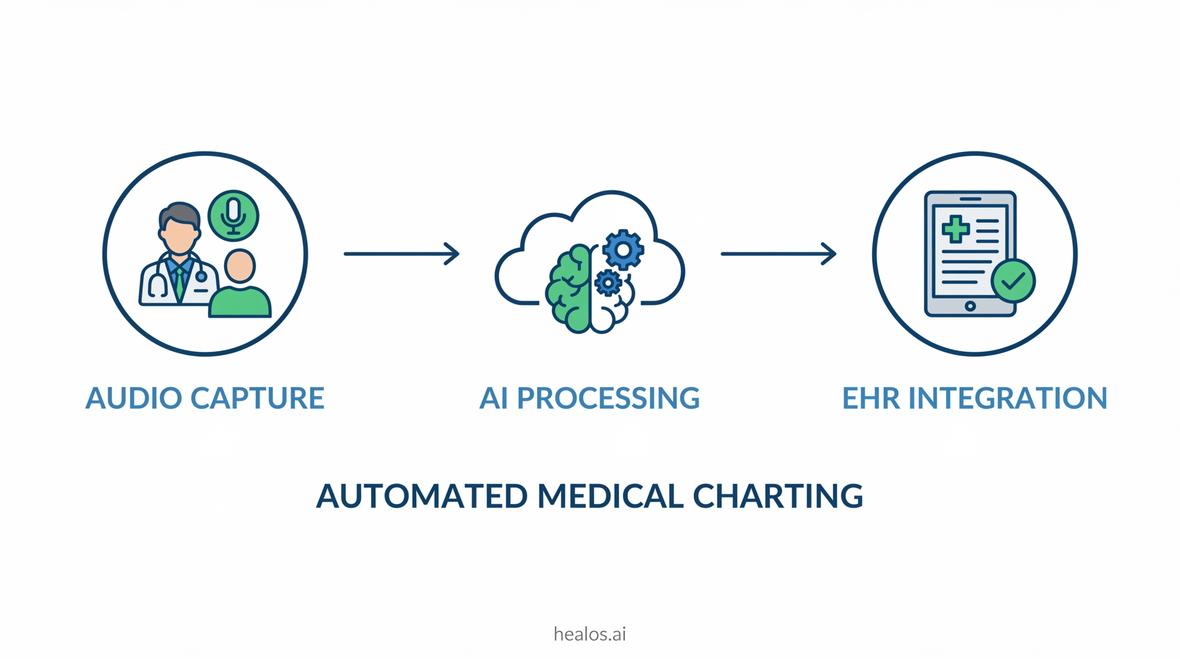
The workflow is remarkably simple: audio from clinical encounters is captured via smartphone, tablet, or ambient microphone; the AI processes this input through sophisticated algorithms; and completed documentation is automatically integrated into your existing EHR platform all within minutes of the encounter ending.
Why Practice Managers Need AI-Powered Medical Scribes in 2026
Addressing the Healthcare Staffing Crisis
The healthcare staffing shortage has intensified dramatically. Practice managers face unprecedented challenges recruiting qualified medical scribes, administrative personnel, and even clinical staff. With turnover rates climbing and salary expectations rising, the traditional model of scaling through headcount is financially unsustainable.
According to research on AI clinical scribes, these solutions are fueled by the need to reduce physician burnout and administrative burdens, enabling time reallocation to patient care across specialties. This shift allows practices to handle increased patient volumes without proportionally increasing staff costs.
Combating Provider Burnout from Excessive Documentation
Physicians spend an average of two hours on documentation for every hour of direct patient care. This excessive charting burden leads to burnout, decreased job satisfaction, and ultimately affects patient care quality. The phenomenon known as 'pajama time'—where providers complete charts at home after hours has become normalized but remains unsustainable.
AI scribe technology for doctors directly addresses this crisis by automating the most time-consuming aspect of clinical work. Providers can focus on patient interactions while the AI handles documentation in the background, dramatically reducing after-hours work and restoring work-life balance.
Improving Financial Health and Reducing Claim Denials
Incomplete or inaccurate documentation is a leading cause of claim denials, directly impacting practice revenue. According to CMS 2025 guidance supporting AI-generated notes, the Centers for Medicare & Medicaid Services now permits AI-generated documentation with physician review, reducing claim denials and administrative burden.
An ai-powered medical scribe ensures comprehensive, consistent documentation that captures all billable services, supports proper coding, and includes necessary medical justification. This thoroughness translates to fewer denials, faster reimbursement cycles, and improved cash flow critical metrics for any practice manager monitoring financial health.
Key Features of AI-Powered Medical Scribe Solutions
Seamless EHR Integration
For practice managers, technology adoption hinges on integration capabilities. The most effective ai-powered medical scribe platforms offer native integrations with major EHR systems including Epic, Cerner, Athenahealth, eClinicalWorks, and dozens of others. HealOS provides seamless EHR integrations that eliminate manual data transfer and ensure documentation flows directly into existing workflows.
This seamless connectivity means no workflow disruption, minimal training requirements, and immediate productivity gains essential considerations when evaluating solutions for implementation across your practice.
The Unified Agent Approach
Traditional point solutions address individual pain points one tool for scheduling, another for documentation, yet another for billing. This fragmented approach creates integration nightmares and workflow inefficiencies. The unified agent approach from HealOS consolidates multiple automation functions into a single, cohesive platform.
This architecture delivers operational advantages: single vendor relationship, unified data model, streamlined training, and coordinated workflows that span from patient intake through revenue cycle management. For practice managers juggling multiple priorities, this consolidation represents significant administrative relief.
Specialty-Specific Customization
Generic documentation templates rarely meet the nuanced requirements of specialized care. Leading ai-powered medical scribe platforms offer customizable templates for diverse specialties including psychiatry, cardiology, pediatrics, orthopedics, and oncology.
These customizations ensure that generated notes include specialty-specific terminology, follow appropriate documentation standards, and capture the unique clinical elements relevant to each field. This precision improves both clinical utility and billing accuracy.
Implementation and ROI: What Practice Managers Need to Know
Cost Comparison: Human Scribes vs. AI-Powered Solutions
Traditional human medical scribes cost practices between $35,000-$50,000 annually per full-time equivalent, including salary, benefits, training, and overhead. In contrast, ai-powered medical scribe solutions typically range from $99-$299 per provider per month representing annual costs of $1,188-$3,588.
This dramatic cost differential means a practice with five providers could save over $200,000 annually by transitioning from human scribes to AI automation. These savings can be redirected toward practice growth initiatives, provider compensation, or margin improvement all strategic priorities for practice managers.
Productivity Gains and Patient Volume Capacity
Beyond direct cost savings, ai-powered medical scribe technology enables providers to see more patients without sacrificing documentation quality. By eliminating the documentation bottleneck, providers can increase daily patient encounters by 15-25%, directly boosting practice revenue without proportional cost increases.
For a practice generating $500,000 in annual revenue per provider, a 20% capacity increase translates to an additional $100,000 in revenue with minimal incremental costs. This operational leverage is precisely what overwhelmed practice managers need to achieve sustainable growth.
Reducing Claim Denials Through Comprehensive Documentation
Incomplete documentation accounts for a significant percentage of initial claim denials. Automated denial management combined with comprehensive AI-generated documentation creates a powerful defense against revenue leakage.
Practices implementing ai-powered medical scribe solutions report denial rate reductions of 30-50%, translating to hundreds of thousands of dollars in preserved revenue for mid-sized practices. This financial impact directly addresses practice managers' core responsibility for maintaining financial health.
Addressing Common Concerns About AI Medical Scribes
Accuracy and Clinical Reliability
Practice managers rightfully question whether AI can match human accuracy in clinical documentation. Leading ai-powered medical scribe platforms now achieve 95-98% accuracy rates on specialty-specific documentation, with continuous improvement through machine learning.
Importantly, these systems are designed with physician review workflows built in ensuring clinical validation before finalization. This physician-in-the-loop approach satisfies regulatory requirements while maintaining quality standards.
HIPAA Compliance and Data Security
Healthcare data security is non-negotiable. Reputable ai-powered medical scribe vendors maintain comprehensive HIPAA compliance programs including Business Associate Agreements, encryption at rest and in transit, regular security audits, and SOC 2 Type II certifications.
HealOS maintains rigorous HIPAA compliance with enterprise-grade security protocols, ensuring practice managers can confidently adopt the technology without regulatory risk.
Provider Adoption and Training Requirements
Technology adoption depends on user acceptance. The most successful ai-powered medical scribe implementations prioritize intuitive interfaces and minimal training requirements. Most platforms enable providers to become proficient within 1-2 hours of initial training, with full adoption typically occurring within the first week.
For practice managers concerned about disruption, this rapid adoption curve means minimal productivity dip during transition and quick return to and beyond baseline efficiency levels.
Market Landscape and Adoption Trends
Global Growth and Market Adoption
The AI medical writing and scribing market is experiencing explosive growth. According to industry analysis, Asia Pacific dominated with 30.41% share in 2024, highlighting global adoption for efficiency in medical documentation.
This international momentum validates the technology's efficacy and signals continued innovation and investment in ai-powered medical scribe capabilities reducing risk for practice managers evaluating long-term technology partnerships.
Regulatory Environment and CMS Guidance
Regulatory clarity has been a critical enabler for widespread adoption. The Centers for Medicare & Medicaid Services 2025 guidance explicitly permits AI-generated documentation with physician review, removing a major barrier for practices previously hesitant due to compliance concerns.
This regulatory endorsement provides practice managers with the confidence to proceed with implementation, knowing that AI-generated notes meet federal standards when properly validated by clinical staff.
HealOS: The Unified Platform for Practice Automation
For practice managers seeking comprehensive automation beyond just documentation, HealOS offers a unified platform that extends across the entire patient journey. The platform includes not only ai-powered medical scribe capabilities but also AI receptionist functions, insurance eligibility verification, referral management, and comprehensive revenue cycle management automation.
This unified architecture delivers the seamless integration and workflow efficiency that overwhelmed practice managers desperately need. Rather than cobbling together disparate point solutions, practices can implement a single platform that addresses staffing challenges across multiple operational areas simultaneously.
Implementation Roadmap for Practice Managers
Phase 1: Evaluation and Vendor Selection
Begin by conducting a thorough needs assessment: identify documentation pain points, quantify current costs (human scribes, provider overtime, claim denials), and establish success metrics. Evaluate multiple ai-powered medical scribe vendors based on EHR compatibility, specialty customization, pricing structure, security credentials, and support offerings.
Phase 2: Pilot Deployment
Start with a limited pilot involving 2-3 providers across representative specialties. This controlled deployment allows you to validate accuracy, test workflows, identify training needs, and build internal champions before broader rollout. Aim for a 30-60 day pilot period with clear evaluation criteria.
Phase 3: Full Practice Rollout
Once pilot success is validated, develop a phased rollout plan that sequences provider onboarding, provides adequate training resources, establishes support protocols, and monitors adoption metrics. Plan for 60-90 days to achieve full practice implementation with stable performance.
Phase 4: Optimization and Expansion
After baseline adoption, focus on optimization: refine custom templates, integrate additional workflow automations, leverage analytics to identify improvement opportunities, and expand to additional use cases like medical dictation or session analytics.
Measuring Success: Key Performance Indicators
Practice managers should track specific metrics to validate ai-powered medical scribe ROI:
- Documentation Time Reduction: Measure minutes saved per encounter (target: 40-60% reduction)
- Provider Satisfaction Scores: Track burnout indicators and work-life balance improvements
- Patient Volume Capacity: Monitor daily encounters per provider (target: 15-25% increase)
- Claim Denial Rate: Measure documentation-related denials (target: 30-50% reduction)
- Days in A/R: Track collection cycle improvements from better documentation
- Cost per Encounter: Calculate total documentation cost reduction
Establish baseline measurements before implementation and conduct monthly reviews during the first six months to demonstrate value and identify optimization opportunities.
The Future of AI-Powered Medical Scribes
The evolution of ai-powered medical scribe technology continues rapidly. Emerging capabilities include predictive clinical decision support integrated within documentation workflows, automated prior authorization letter generation based on clinical notes, real-time coding suggestions to maximize reimbursement, and multi-language support for diverse patient populations.
For forward-thinking practice managers, early adoption positions practices to leverage these advancing capabilities, maintain competitive advantages in provider recruitment (offering superior work-life balance), and build operational resilience against ongoing staffing challenges.
Frequently Asked Questions
How accurate are AI-powered medical scribes compared to human scribes?
Leading ai-powered medical scribe platforms achieve 95-98% accuracy on specialty-specific documentation, comparable to or exceeding human scribe performance. The key advantage is consistency AI maintains accuracy across all encounters without fatigue-related errors that affect human scribes.
What is the typical implementation timeline for an AI medical scribe?
Most practices complete initial setup and provider training within 1-2 weeks. A recommended 30-60 day pilot phase allows for workflow refinement before full rollout. Complete practice-wide adoption with stable performance typically occurs within 90 days of initial deployment.
Does AI-generated documentation meet regulatory requirements?
Yes, when properly implemented with physician review. CMS 2025 guidance explicitly permits AI-generated documentation with physician validation. Reputable vendors design their systems to comply with federal and state documentation requirements, ensuring regulatory adherence.
How does AI scribing integrate with existing EHR systems?
Modern ai-powered medical scribe platforms offer native integrations with major EHR systems including Epic, Cerner, Athenahealth, eClinicalWorks, and many others. Integration typically occurs via secure APIs that enable direct documentation insertion into patient charts without manual data transfer.
What is the cost difference between human and AI medical scribes?
Human medical scribes cost $35,000-$50,000 annually per FTE, while AI solutions typically range from $1,188-$3,588 annually per provider representing 90-95% cost savings. This dramatic difference enables practices to scale documentation support without proportional cost increases.
Conclusion
For overwhelmed practice managers facing staffing shortages, provider burnout, and financial pressures, the ai-powered medical scribe represents a transformative solution that addresses multiple pain points simultaneously. By automating clinical documentation, these intelligent systems reduce costs by 90%+, increase provider capacity by 15-25%, decrease claim denials by 30-50%, and restore work-life balance for clinical staff.
The technology has matured to enterprise-grade reliability, regulatory clarity supports adoption, and unified platforms like HealOS extend automation benefits across entire practice workflows. The question for practice managers is no longer whether to adopt AI scribing, but how quickly implementation can begin to capture these substantial operational and financial benefits.