
Ambient Clinical Intelligence: The Complete 2026 Guide To Transforming Healthcare Documentation

What is Ambient Clinical Intelligence?
Ambient clinical intelligence represents a paradigm shift in healthcare documentation, leveraging artificial intelligence to passively capture, analyze, and document patient-provider interactions in real time. Unlike traditional dictation or manual charting, this technology operates in the background during clinical encounters, transforming natural conversations into structured clinical notes without interrupting the patient-physician relationship.
At its core, ambient clinical intelligence combines advanced speech recognition, natural language processing (NLP), and machine learning algorithms to understand medical terminology, clinical context, and documentation requirements. The system listens to conversations between healthcare providers and patients, identifies clinically relevant information, and automatically generates comprehensive clinical notes that integrate seamlessly with electronic health record (EHR) systems.
This technology addresses one of healthcare's most pressing challenges: the administrative burden of documentation. Physicians currently spend nearly two hours on EHR tasks for every hour of direct patient care, contributing significantly to widespread burnout. Ambient clinical intelligence offers a solution by automating this process, allowing clinicians to focus on what matters most patient care.
How Ambient Clinical Intelligence Works
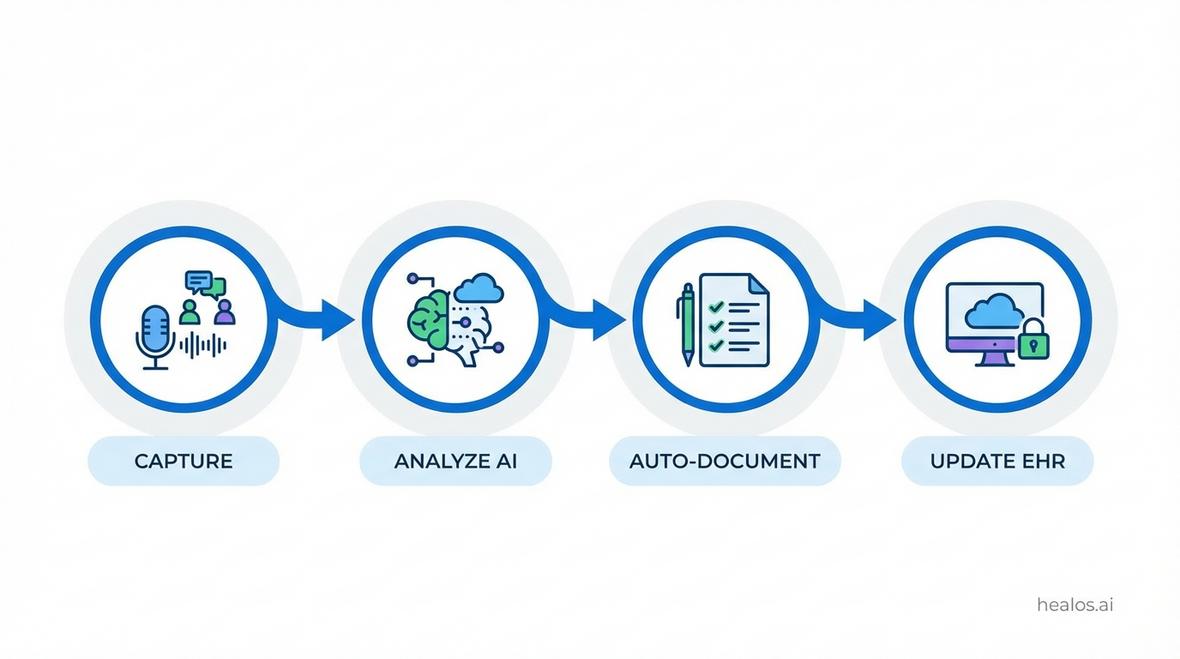
The operational framework of ambient clinical intelligence involves four distinct stages that transform verbal clinical encounters into structured documentation:
1. Capture Stage
The process begins when healthcare providers activate the ambient listening technology at the start of a patient encounter. Using strategically placed microphones or smartphone applications, the system captures the complete dialogue between clinician and patient. Advanced audio processing filters background noise, isolates individual speakers, and ensures high-quality audio input for accurate transcription.
2. Analyze AI Stage
Once captured, the audio data undergoes sophisticated AI analysis. Natural language processing algorithms parse the conversation, identifying medical terminology, symptoms, diagnoses, treatment plans, and other clinically significant elements. The AI distinguishes between relevant clinical information and conversational filler, understanding context and medical reasoning. Machine learning models trained on millions of clinical encounters enable the system to recognize specialty-specific terminology and documentation patterns.
3. Auto-Document Stage
Following analysis, the system automatically generates structured clinical notes in formats familiar to healthcare providers, such as SOAP (Subjective, Objective, Assessment, Plan) notes, progress notes, or specialty-specific templates. The documentation includes appropriate medical codes, billing information, and all elements required for compliance and reimbursement. This stage typically takes only minutes after the encounter concludes, dramatically reducing the time physicians spend on after-hours charting.
4. Update EHR Stage
The final stage involves secure integration with the practice's existing EHR system. The generated documentation flows directly into the patient's electronic record, maintaining all security protocols and HIPAA compliance requirements. Providers review the auto-generated notes, make any necessary adjustments, and finalize the documentation with a simple approval process. This seamless integration eliminates duplicate data entry and ensures documentation accuracy.
Key Benefits of Ambient Clinical Intelligence
The implementation of ambient clinical intelligence delivers transformative benefits across multiple dimensions of healthcare delivery:
Reduced Administrative Burden
Healthcare providers experience dramatic reductions in documentation time, often saving 2-3 hours daily. This translates to reclaiming evenings and weekends previously spent completing charts. The technology eliminates 'pajama time'—the hours clinicians spend documenting after regular work hours significantly improving work-life balance and reducing burnout rates.
Enhanced Patient Engagement
By freeing clinicians from the computer screen during patient encounters, ambient clinical intelligence restores eye contact and human connection to medical appointments. Patients report higher satisfaction when their providers can focus entirely on them rather than typing notes. This improved engagement strengthens the therapeutic relationship and may enhance clinical outcomes through better communication and shared decision-making.
Improved Documentation Quality
AI-powered documentation enhances coding accuracy, supports better billing, and reduces claim denials, according to research from the OpenPR Healthcare Technology Report. The technology enables managing more patients efficiently while maintaining comprehensive documentation standards. Automated systems capture nuanced clinical details that might be overlooked in rushed manual documentation, resulting in more complete and accurate medical records.
Increased Clinical Productivity
With documentation handled automatically, providers can see more patients without extending work hours. Some practices report capacity increases of 10-20% without adding staff or extending hours. This productivity gain improves practice revenue while simultaneously reducing provider stress, creating a sustainable model for long-term practice success.
Compliance and Risk Mitigation
Ambient clinical intelligence systems are designed with HIPAA compliance as a foundational requirement, ensuring all captured data meets stringent security and privacy standards. Comprehensive documentation reduces malpractice risk by creating detailed records of clinical decision-making, treatment rationales, and patient education provided during encounters.
Market Growth and Adoption Trends
The ambient clinical intelligence market is experiencing explosive growth as healthcare organizations recognize the technology's transformative potential. According to SNS Insider research, Asia-Pacific is projected to grow fastest at 31.66% CAGR, propelled by hospital digitalization, telehealth improvements, and government AI initiatives.
North America currently dominates the market, driven by high EHR adoption rates, advanced healthcare infrastructure, and significant investments in digital health technologies. However, emerging markets are rapidly accelerating adoption. The Data M Intelligence report indicates that Asia-Pacific drives 27% market share growth via digital health expansion, AI implementation in hospitals, and substantial investments in China, India, and Southeast Asia.
This growth reflects broader healthcare digitalization trends, with ambient clinical intelligence positioned as a critical component of modern healthcare technology stacks. Healthcare systems investing in this technology report rapid return on investment through improved operational efficiency, reduced labor costs, and enhanced revenue capture through better documentation and coding.
Implementation Considerations for Healthcare Practices
Successfully deploying ambient clinical intelligence requires thoughtful planning and consideration of several key factors:
Selecting the Right Solution
Healthcare organizations should evaluate ambient clinical intelligence platforms based on accuracy rates, specialty-specific capabilities, EHR integration options, and cost structures. Leading solutions like Healos AI Scribe offer comprehensive features including custom note templates, multi-specialty support, and seamless integration with major EHR systems.
Training and Adoption
Successful implementation requires adequate training for clinical staff. Providers need to understand how to activate the system, review generated notes, and make corrections when necessary. Most platforms offer comprehensive onboarding support, and many practices report staff proficiency within days of initial training.
Workflow Integration
Ambient clinical intelligence should complement existing clinical workflows rather than disrupt them. Practices should map current documentation processes and identify optimal integration points. Many organizations begin with pilot programs in specific departments or with early adopter physicians before expanding system-wide.
Patient Communication
Transparency with patients about the use of AI documentation technology builds trust and ensures comfort with the process. Simple explanations about how the technology works, what data is captured, and how privacy is protected typically result in high patient acceptance rates.
Ambient Clinical Intelligence vs. Traditional Documentation Methods
Understanding how ambient clinical intelligence compares to traditional documentation approaches highlights its advantages:
| Method | Time Required | Accuracy | Patient Engagement | Cost |
|---|---|---|---|---|
| Manual EHR Entry | High (2+ hrs daily) | Variable | Low (provider distracted) | Low initial, high labor |
| Traditional Dictation | Moderate | Moderate | Moderate | Moderate |
| Human Scribes | Low for provider | High | High | Very High ($42K+ annually) |
| Ambient Clinical Intelligence | Very Low | Very High (98%+) | Very High | Low ($1,200-3,600 annually) |
This comparison demonstrates why ambient clinical intelligence is rapidly becoming the preferred documentation solution across healthcare settings. The technology delivers human scribe-level benefits at a fraction of the cost, making it accessible even for small practices.
Specialty-Specific Applications
Ambient clinical intelligence adapts to the unique documentation requirements of various medical specialties:
Primary Care
Primary care providers benefit from ambient documentation for routine wellness visits, chronic disease management, and acute care encounters. The technology handles the diverse documentation needs of family medicine and internal medicine practices efficiently.
Psychiatry and Mental Health
Mental health providers using specialized psychiatry AI scribe solutions can focus entirely on therapeutic engagement while the system captures session details, mental status examinations, and treatment planning discussions. This specialty particularly benefits from hands-free documentation that preserves the therapeutic alliance.
Pediatrics
Pediatricians using AI scribe technology for pediatrics can engage with both young patients and their parents while ensuring comprehensive documentation of developmental milestones, immunization records, and family education.
Cardiology and Specialty Care
Specialists in fields like cardiology benefit from AI systems trained on specialty-specific terminology, procedure documentation, and complex clinical reasoning patterns unique to their practice areas.
Security, Privacy, and HIPAA Compliance
Ambient clinical intelligence platforms must meet rigorous security standards to protect sensitive patient health information. Reputable solutions implement multiple layers of security:
End-to-End Encryption: All audio recordings and generated documentation are encrypted both in transit and at rest, ensuring data cannot be intercepted or accessed by unauthorized parties.
HIPAA Compliance: Leading platforms maintain full HIPAA compliance, including Business Associate Agreements (BAAs), regular security audits, and compliance certifications. Healthcare organizations should verify that any ambient intelligence solution they consider has documented HIPAA compliance.
Data Retention Policies: Secure platforms implement clear data retention and deletion policies, ensuring audio recordings are processed and then securely deleted according to established timelines, typically within 24-48 hours of documentation completion.
Access Controls: Role-based access controls ensure only authorized personnel can access patient data, with comprehensive audit trails tracking all system interactions.
The Future of Ambient Clinical Intelligence
The evolution of ambient clinical intelligence continues to accelerate, with several emerging trends shaping its future:
Advanced Clinical Decision Support
Next-generation systems will move beyond documentation to provide real-time clinical decision support, flagging potential drug interactions, suggesting evidence-based treatment protocols, and identifying patients who may benefit from specific preventive interventions.
Multilingual Capabilities
Expanding language support will enable ambient systems to document encounters conducted in multiple languages, automatically translating conversations and generating documentation in the provider's preferred language. Solutions like Healos medical translation features are already pioneering this capability.
Integration with Remote Care
As telehealth becomes a permanent fixture of healthcare delivery, ambient clinical intelligence will evolve to seamlessly document virtual encounters with the same accuracy and efficiency as in-person visits, supporting the needs of virtual care providers.
Predictive Analytics
Future systems will analyze documentation patterns to identify population health trends, predict patient deterioration, and support proactive care management, transforming ambient intelligence from a documentation tool into a comprehensive clinical intelligence platform.
Choosing the Right Ambient Clinical Intelligence Platform
Healthcare organizations evaluating ambient clinical intelligence solutions should consider these critical factors:
Accuracy and Reliability: Look for platforms with documented accuracy rates of 95% or higher. Request demonstration cases in your specific specialty to assess real-world performance.
EHR Integration: Seamless integration with your existing EHR system is essential. Verify that the platform supports your specific EHR and understand the technical requirements for integration. Check available integrations before making a decision.
Customization Capabilities: The ability to create custom templates, modify documentation formats, and adapt to your practice's specific workflows ensures the technology serves your needs rather than forcing you to adapt to rigid constraints.
Support and Training: Comprehensive onboarding, ongoing technical support, and regular training resources ensure successful adoption and maximize return on investment.
Cost Structure: Understand total costs including licensing fees, implementation costs, and ongoing subscription expenses. Calculate potential return on investment based on time savings and productivity gains.
Scalability: Choose a platform that can grow with your practice, supporting additional providers, locations, and specialties as your organization expands.
Frequently Asked Questions
How accurate is ambient clinical intelligence compared to human documentation?
Leading ambient clinical intelligence platforms achieve accuracy rates of 98% or higher, often exceeding human documentation accuracy. The technology captures details that might be missed in manual note-taking and maintains consistency across all encounters.
What does ambient clinical intelligence cost?
Costs vary by platform and practice size, but typically range from $100-300 per provider monthly. This represents significant savings compared to human scribes, which cost $42,000 or more annually per full-time equivalent.
How long does implementation take?
Most practices complete implementation within 1-2 weeks, with providers becoming proficient within days. Some platforms offer rapid deployment options enabling practices to begin using the technology within 24 hours.
Do patients accept AI documentation during appointments?
Studies show high patient acceptance rates when providers briefly explain the technology. Most patients appreciate having their physician's full attention rather than watching them type into a computer.
Does ambient clinical intelligence work for all medical specialties?
Yes, comprehensive platforms support multiple specialties including primary care, psychiatry, cardiology, orthopedics, pediatrics, and many others. Specialty-specific training ensures accurate capture of specialized terminology and documentation requirements.
Conclusion
Ambient clinical intelligence represents the future of healthcare documentation, delivering unprecedented efficiency, accuracy, and clinician satisfaction. By automating the burdensome task of clinical note-taking, this technology restores the patient-provider relationship, reduces burnout, and enables healthcare professionals to practice at the top of their license. As adoption accelerates globally, with particularly robust growth in Asia-Pacific markets, ambient clinical intelligence is poised to become the standard of care for medical documentation. Healthcare organizations that embrace this technology now position themselves for competitive advantage, improved financial performance, and enhanced patient outcomes in an increasingly digital healthcare landscape.