
Average Medical Billing Collection Rates: How To Improve Revenue Recovery In 2026

For practice managers facing staffing shortages and mounting administrative burdens, understanding average medical billing collection rates is crucial to maintaining financial health. Collection rates measure how effectively your practice converts billed charges into actual revenue a metric that directly impacts cash flow, operational sustainability, and your ability to invest in patient care.
The reality is stark: most healthcare practices struggle to collect what they're owed. According to a JAMA Network Open study finding mean patient cost-sharing repayment rates near 54% and declining, hospitals and clinicians are facing growing collections shortfalls. This comprehensive guide will help you benchmark your practice's performance, identify improvement opportunities, and implement automation strategies that reduce claim denials while scaling operations without adding headcount.
Understanding Average Medical Billing Collection Rates
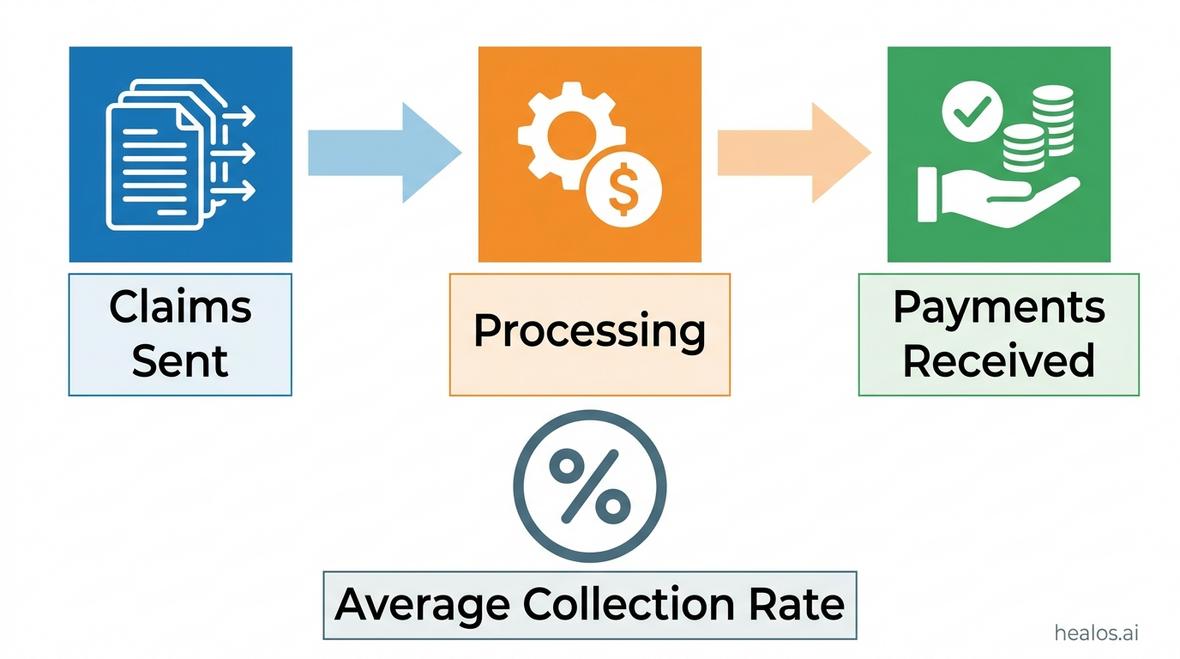
The average medical billing collection rate represents the percentage of billed charges that a practice successfully collects from both insurance payers and patients. This metric serves as a vital sign of your practice's financial health and operational efficiency.
Industry data shows significant variation across specialties and practice sizes. While high-performing practices achieve collection rates above 95%, many struggle to reach 75-85%. The difference often lies in automated workflows, denial management processes, and how effectively practices verify insurance eligibility before services are rendered.
How Collection Rates Are Calculated
Understanding the formula behind collection rates helps identify where revenue leakage occurs:
Gross Collection Rate = (Total Payments Received / Total Charges) × 100
Net Collection Rate = (Total Payments Received / [Total Charges - Contractual Adjustments]) × 100
The net collection rate provides a more accurate picture because it accounts for contractual write-offs with insurance payers. Most industry benchmarks reference net collection rates when discussing practice performance.
Industry Benchmarks by Specialty
Collection rate benchmarks vary significantly by specialty due to differences in payer mix, service complexity, and billing challenges:
- Primary Care Practices: 85-95% net collection rate
- Specialty Practices: 80-92% net collection rate
- Mental Health & Therapy: 75-88% net collection rate
- Surgical Specialties: 82-94% net collection rate
- Pediatrics: 80-90% net collection rate
Practices falling below these benchmarks typically experience issues with insurance verification, coding accuracy, or patient collections all areas where revenue cycle management automation delivers measurable improvements.
Factors Affecting Medical Billing Collection Rates
Multiple variables influence your practice's ability to collect revenue efficiently. Understanding these factors helps prioritize improvement initiatives that deliver the greatest financial impact.
Claim Denial Rates
Claim denials represent one of the largest obstacles to healthy collection rates. Industry studies indicate that 15-20% of initial claims are denied, and practices recover only about 60-65% of denied claim value after appeals.
Common denial reasons include:
- Insurance eligibility issues and expired coverage
- Missing or incorrect prior authorizations
- Coding errors or lack of medical necessity documentation
- Timely filing limit violations
- Coordination of benefits errors
Implementing automated denial management processes can reduce initial denial rates by 30-40% while improving recovery rates on unavoidable denials.
Patient Responsibility Collections
With high-deductible health plans becoming the norm, patient responsibility now represents 30-35% of total practice revenue for many specialties. The challenge? Patient collection rates average only 50-70%, significantly lower than insurance collection rates.
Research shows that patient cost-sharing repayment rates have declined to approximately 54% and continue falling, creating growing financial pressure on practices. This makes point-of-service collection and automated patient payment plans increasingly critical.
Strategies to improve patient collections include:
- Verifying insurance and estimating patient responsibility before appointments
- Collecting copays, deductibles, and previous balances at check-in
- Offering flexible payment plans with automated reminders
- Sending clear, itemized statements within 48 hours of service
- Implementing online payment portals for convenience
Insurance Verification Accuracy
Incomplete or inaccurate insurance verification leads to claim denials, payment delays, and patient dissatisfaction. Practices that verify coverage manually often miss critical details about authorization requirements, coverage limitations, and coordination of benefits.
Automated eligibility verification systems check coverage in real-time, flag authorization requirements, and identify coordination of benefits issues before services are rendered preventing denials before they occur.
Coding Accuracy and Documentation
Accurate medical coding directly impacts both claim acceptance rates and reimbursement levels. Undercoding leaves money on the table, while overcoding triggers audits and compliance issues.
Documentation quality determines coding accuracy. Providers who spend excessive time on charting often experience burnout, while rushed documentation leads to coding errors and denials. This is where AI-powered clinical documentation delivers dual benefits: reducing provider burnout while improving coding accuracy and specificity.
The Financial Impact of Below-Average Collection Rates
Even small improvements in collection rates translate to substantial revenue gains. Consider a practice with $2 million in annual net charges:
- At 80% collection rate: $1,600,000 collected
- At 90% collection rate: $1,800,000 collected
- Revenue gain from 10% improvement: $200,000 annually
Beyond direct revenue impact, poor collection rates create operational challenges:
- Cash flow instability affecting payroll and vendor payments
- Inability to invest in practice growth or technology
- Increased staff time spent on follow-up and appeals
- Provider burnout from financial stress
- Reduced patient satisfaction due to billing confusion
Proven Strategies to Improve Average Medical Billing Collection Rates
Improving collection rates requires a systematic approach addressing the entire revenue cycle from scheduling through final payment posting.
Automate Insurance Verification and Prior Authorization
Manual insurance verification consumes 10-15 minutes per patient and still misses critical coverage details. Automated systems verify eligibility in seconds, check prior authorization requirements, and flag potential issues before appointments.
Practices implementing automated benefit verification report 40-50% reduction in eligibility-related denials and improved patient collection rates through accurate cost estimates.
Implement Point-of-Service Collections
Collecting patient responsibility at the time of service improves collection rates by 30-40% compared to post-service billing. When patients understand their financial responsibility upfront and can pay immediately, collection becomes significantly easier.
Key point-of-service collection tactics include:
- Training front desk staff on financial conversations
- Using eligibility data to calculate accurate estimates
- Offering multiple payment options (card, check, payment plans)
- Implementing tablet-based check-in with integrated payment
Optimize Claim Scrubbing and Submission
Clean claims those submitted correctly the first time pay 3-4 weeks faster than claims requiring corrections. Automated claim scrubbing identifies coding errors, missing information, and policy violations before submission.
Advanced claim scrubbing systems use AI to learn payer-specific rules and flag potential denials based on historical patterns, improving first-pass acceptance rates to 95%+ for many practices.
Accelerate Payment Posting and Reconciliation
Delayed payment posting creates cash flow visibility issues and delays denial identification. Practices posting payments within 24-48 hours of receipt can identify and appeal denials while details are fresh.
Automated payment posting systems process electronic remittance advice (ERA) files instantly, flag underpayments, and route denials to appropriate staff for immediate action.
Implement Systematic AR Follow-Up
Accounts receivable aging beyond 90 days becomes increasingly difficult to collect. Systematic follow-up processes ensure no claim sits unpursued beyond 30 days.
Effective AR management includes:
- Daily work queues organized by payer, age, and amount
- Automated payer outreach for claim status updates
- Standardized appeal templates for common denial reasons
- Performance tracking by staff member and payer
Practices using automated AR monitoring reduce days in AR by 15-25% while improving overall collection rates.
Leverage Underpayment Detection Technology
Insurance underpayments when payers reimburse less than contracted rates often go unnoticed in busy practices. Studies suggest 1-3% of all insurance payments involve underpayments, representing significant revenue leakage.
Automated underpayment detection systems compare actual payments against contracted rates, flag discrepancies, and generate appeals automatically recovering revenue that would otherwise be lost.
The Role of Automation in Improving Collection Rates
For overwhelmed practice managers struggling with staffing shortages, automation offers the path to scaling revenue cycle operations without increasing headcount. Modern healthcare automation platforms handle repetitive tasks faster and more accurately than human staff while freeing your team for complex problem-solving and patient interaction.
The Unified Agent Approach
Traditional point solutions address individual revenue cycle bottlenecks but create integration headaches and workflow gaps. A unified approach connects all revenue cycle functions from insurance verification through collections in a single, integrated platform.
This integration enables intelligent workflows where information flows seamlessly between functions. For example, insurance verification data automatically populates claim forms, patient statements reflect real-time payment posting, and denial patterns trigger proactive coding education.
Seamless EHR Integration
Automation delivers maximum value when integrated directly with your existing EHR system. Look for solutions offering native integrations that eliminate duplicate data entry and enable bi-directional information flow.
Practices using integrated automation report 60-70% reduction in administrative time while improving data accuracy and reducing compliance risks associated with manual processes.
Measuring and Tracking Collection Rate Improvement
Sustainable improvement requires ongoing measurement and accountability. Establish baseline metrics before implementing changes, then track progress monthly to identify what's working and where additional focus is needed.
Key Metrics to Monitor
Beyond overall collection rates, track these supporting metrics:
- Days in AR: Target below 35 days for most specialties
- First-pass claim acceptance rate: Target above 95%
- Denial rate: Target below 5% of submitted claims
- Denial recovery rate: Target above 75% of denied amounts
- Patient collection rate: Track separately from insurance collections
- AR over 90 days: Target below 15% of total AR
Monthly trending of these metrics reveals whether improvements are sustainable or temporary fluctuations.
Benchmarking Against Industry Standards
Compare your practice's performance against specialty-specific benchmarks and top-quartile performers. This identifies whether you're chasing incremental gains or have significant improvement opportunities.
Many practice management systems and billing services provide benchmarking reports. If yours doesn't, industry associations often publish annual benchmarking data for members.
Common Mistakes That Hurt Collection Rates
Even well-intentioned practices make mistakes that undermine collection efforts. Avoid these common pitfalls:
- Waiting too long to follow up on denials: Appeal rights expire quickly, often within 30-90 days
- Failing to verify insurance before every visit: Coverage changes frequently; yesterday's verification is unreliable
- Not collecting patient responsibility upfront: Post-service collections are 40-50% less successful
- Accepting partial payments without tracking balances: Small balances add up to significant revenue leakage
- Ignoring payer trends: Systematic denials from specific payers indicate credentialing, coding, or contracting issues
- Underinvesting in staff training: Billing rules change constantly; outdated knowledge drives errors
The Future of Medical Billing Collections
The healthcare payment landscape continues evolving, with implications for collection strategies:
- Increased patient responsibility: High-deductible plans shift more payment burden to patients, requiring robust patient collection processes
- Value-based payment models: Alternative payment arrangements require different tracking and collection approaches
- Prior authorization proliferation: More services requiring authorization demands automated tracking and submission
- Price transparency requirements: Patients expect accurate cost estimates before service, requiring real-time eligibility and benefit data
- AI-powered automation: Machine learning optimizes denial prediction, appeal generation, and payment posting
Practices that embrace automation now position themselves to adapt quickly as payment models and requirements evolve.
Getting Started: Action Steps to Improve Your Collection Rates
Ready to improve your practice's average medical billing collection rates? Follow these implementation steps:
- Assess current performance: Calculate your net collection rate and benchmark against specialty standards
- Identify your biggest gaps: Analyze denial reasons, AR aging, and patient collection rates to find improvement opportunities
- Prioritize high-impact changes: Focus first on changes delivering the greatest financial return with minimal disruption
- Implement automation strategically: Start with insurance verification and claim scrubbing, then expand to payment posting and AR follow-up
- Train staff on new workflows: Technology only succeeds when staff understand and embrace new processes
- Monitor results monthly: Track key metrics to ensure improvements stick and identify additional opportunities
- Celebrate wins with your team: Share success metrics to build momentum and engagement
Conclusion
Understanding and improving average medical billing collection rates is essential for practice financial health, especially as patient cost-sharing continues rising and staffing challenges persist. By implementing automated workflows for insurance verification, claim scrubbing, payment posting, and denial management, practices can achieve collection rates above 90% while reducing administrative burden on overworked staff. The key is choosing integrated solutions that seamlessly connect with your existing EHR and address the full revenue cycle from scheduling through final payment. With the right automation partner, practices can scale operations, reduce claim denials, and improve financial performance without adding headcount, delivering the operational efficiency that overwhelmed practice managers need most.