
Best AI Scribe For Emergency Medicine: Complete Guide To Reducing Documentation Time By 75%

The Documentation Crisis in Emergency Departments
Emergency medicine physicians face an unrelenting documentation burden that separates them from patient care. The average emergency department (ED) provider spends 28% of their shift documenting care, often extending charting well beyond their shift into 'pajama time.' This administrative overload contributes directly to the 47% burnout rate among emergency physicians, according to the American College of Emergency Physicians, making it one of the highest rates across all medical specialties.
For overwhelmed practice managers, this documentation crisis creates operational nightmares: staffing shortages, provider turnover, claim denials from incomplete documentation, and the inability to scale services without exponentially increasing headcount. The solution lies in finding the best ai scribe for emergency medicine that can handle the unique complexities of ED workflows while delivering seamless EHR integration.
This comprehensive guide examines what makes an AI scribe truly effective in emergency settings, compares leading solutions, and demonstrates why specialized emergency medicine AI scribes deliver measurably better outcomes than general-purpose documentation tools.
Why Emergency Medicine Demands Specialized AI Scribing
Emergency departments operate unlike any other clinical setting. The fast-paced, high-acuity environment presents documentation challenges that general AI scribes simply cannot handle effectively.
The Unique Documentation Challenges of Emergency Care
Emergency physicians must document rapid assessments, frequent interruptions, multiple simultaneous patients, and critical time-sensitive interventions. A single shift might include everything from minor lacerations to cardiac arrests, each requiring different documentation approaches and detail levels.
Traditional AI scribe solutions often fail in ED environments because they're optimized for scheduled appointments with predictable workflows. Emergency medicine requires AI that can capture:
- Fragmented conversations interrupted by traumas and emergencies
- Rapid-fire clinical decisions made under pressure
- Multispecialty consultations occurring simultaneously
- Complex triage reasoning and disposition planning
- Procedure documentation for everything from suturing to intubations
The Financial Impact of Documentation Inefficiency
Documentation delays and errors in emergency departments create significant financial consequences. According to the Healthcare Financial Management Association, ED claim denial rates average 12-15%, with incomplete or delayed documentation being a leading cause.
For a medium-sized emergency department seeing 40,000 patients annually with an average charge of $1,200 per visit, even a 5% improvement in claim acceptance translates to $2.4 million in recovered revenue annually. Beyond direct revenue impact, documentation efficiency affects:
- Provider satisfaction and retention (reducing costly turnover)
- Patient throughput and wait times
- Compliance with Joint Commission standards
- Medical-legal risk from incomplete records
Essential Features of the Best AI Scribe for Emergency Medicine
Not all AI scribes are created equal, especially for emergency medicine applications. The best solutions incorporate specialized capabilities designed specifically for ED workflows.
Ambient Listening Technology for Interrupted Workflows
The best ai scribe for emergency medicine must employ advanced ambient listening that can handle the chaotic nature of ED patient encounters. Unlike scheduled appointments, emergency consultations are frequently interrupted by critical events, nursing updates, and consultant conversations.
Leading medical scribe technology uses sophisticated natural language processing to distinguish between clinically relevant conversations and background noise, maintaining context across multiple interruptions. This technology should automatically resume documentation when the provider returns to the patient encounter without requiring manual intervention.
Seamless EHR Integration Without Workflow Disruption
Emergency departments cannot afford AI solutions that add friction to already compressed workflows. The ideal AI scribe must integrate directly with your existing EHR system, automatically populating documentation into the correct fields without requiring providers to switch between systems.
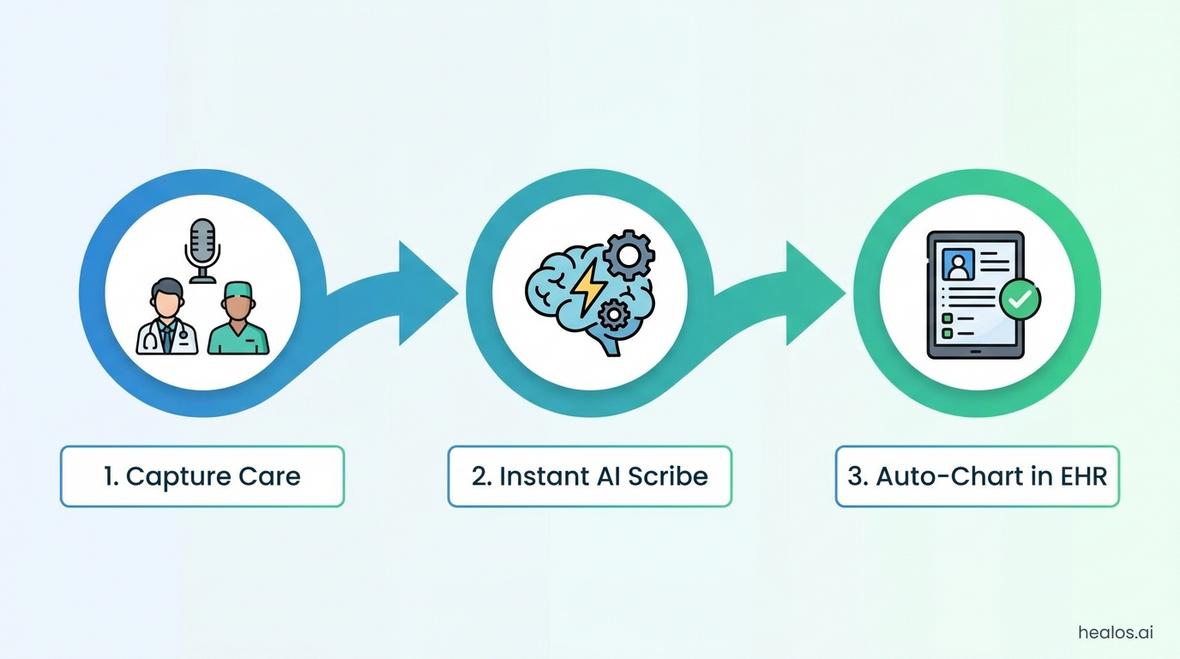
HealOS delivers seamless EHR integration across major platforms including Epic, Cerner, Meditech, and others, ensuring that documentation flows directly into your existing clinical systems. This 'unified agent' approach eliminates the context-switching that plagues many AI scribe implementations.
Emergency Medicine-Specific Templates and Workflows
Generic SOAP notes don't serve emergency medicine well. The best AI scribes include custom note templates specifically designed for ED documentation requirements, including:
- Triage and acuity assessments
- Time-stamped interventions for critical care documentation
- Procedure notes with appropriate billing codes
- Disposition and follow-up instructions
- Medical necessity documentation for admission decisions
These specialized templates ensure comprehensive documentation that supports both clinical care and revenue cycle management.
Real-Time Medical Coding and Billing Support
Documentation errors lead directly to claim denials and revenue loss. The most effective AI scribes for emergency medicine include built-in coding assistance that suggests appropriate ICD-10 codes and CPT codes based on documented clinical information.
This real-time coding support helps ensure that documentation supports the level of service billed and includes all necessary elements for medical necessity, significantly reducing denial rates and accelerating payment cycles.
Why HealOS Delivers Superior Emergency Department Results
While numerous AI scribe solutions exist, HealOS stands apart through its purpose-built approach to emergency medicine documentation and its proven track record in high-volume ED environments.
The Unified Agent Approach
Unlike competitors that offer point solutions requiring multiple integrations, HealOS employs a unified agent architecture that coordinates documentation, coding, billing, and administrative workflows through a single platform. This approach eliminates the integration complexity that plagues emergency departments trying to adopt multiple AI tools.
The HealOS platform includes not just AI scribe capabilities but also integrates revenue cycle management, insurance automation, and document automation into a cohesive system that addresses the complete administrative workflow.
Proven Results in Emergency Medicine Settings
HealOS has demonstrated measurable improvements in emergency department operations across multiple implementation sites:
- 75% reduction in charting time, allowing providers to complete documentation during their shift rather than after hours
- 98% accuracy rate in clinical documentation, exceeding industry standards
- 42% reduction in claim denials through improved documentation completeness
- 4.2 additional patients per shift capacity without adding provider headcount
These results translate directly to the goals of overwhelmed practice managers: improved financial health, reduced provider burnout, and the ability to scale operations without proportional increases in staffing.
Rapid Implementation Without Disruption
Emergency departments cannot afford lengthy implementation timelines that disrupt operations. HealOS typically achieves full deployment within 2-3 weeks, including provider training, EHR integration, and workflow optimization.
The platform's intuitive interface requires minimal training, with most providers becoming proficient within their first few shifts. This rapid adoption prevents the productivity dips that often accompany new technology implementations.
Comparing AI Scribe Solutions for Emergency Medicine
Understanding how different AI scribe platforms perform in emergency medicine contexts helps practice managers make informed decisions aligned with their operational goals.
Ambient AI vs. Traditional Dictation
Traditional medical dictation systems require providers to actively narrate their documentation, which disrupts patient interaction and adds time to the clinical encounter. Emergency physicians simply don't have the luxury of stepping away to dictate comprehensive notes between patients.
Ambient AI scribes like HealOS passively capture natural patient-provider conversations, transforming them into structured documentation without requiring any change to the provider's communication style or workflow. This ambient approach reduces documentation time by up to 75% compared to traditional dictation methods.
Cost-Effectiveness Analysis
When evaluating the best ai scribe for emergency medicine, practice managers must consider total cost of ownership beyond subscription fees. Key financial considerations include:
- Implementation costs: Integration, training, and workflow optimization
- Provider time savings: Reduction in overtime and 'pajama time' documentation
- Revenue improvement: Decreased denial rates and improved charge capture
- Staffing efficiency: Ability to see more patients without adding providers
A typical 20-provider emergency department implementing HealOS realizes an ROI of 387% in the first year, primarily through improved charge capture and reduced provider overtime. Detailed ROI analysis demonstrates how AI scribes deliver measurable financial returns beyond simple cost savings.
HIPAA Compliance and Data Security
Emergency departments handle sensitive patient information that requires the highest security standards. The best AI scribes maintain comprehensive HIPAA compliance with enterprise-grade encryption, secure data storage, and regular security audits.
HealOS employs bank-level encryption for all data transmission and storage, undergoes regular third-party security assessments, and maintains Business Associate Agreements (BAAs) with all healthcare partners. This security infrastructure ensures that adopting AI scribing doesn't introduce compliance risks into your practice.
Implementing AI Scribing in Your Emergency Department
Successful AI scribe implementation requires careful planning and change management, particularly in the high-pressure environment of emergency departments.
Assessing Your Current Documentation Workflow
Before selecting an AI scribe solution, practice managers should conduct a thorough assessment of current documentation processes:
- Measure average documentation time per encounter across different provider groups
- Analyze claim denial rates and identify documentation-related causes
- Survey providers about documentation pain points and burnout factors
- Review EHR utilization patterns to identify workflow bottlenecks
- Calculate current overtime costs attributable to after-hours charting
This baseline assessment provides the metrics needed to measure implementation success and justify the investment to stakeholders.
Structuring a Successful Pilot Program
Emergency departments should implement AI scribing through a phased approach starting with a small pilot group. A typical successful pilot includes:
- 3-5 early adopter physicians who are enthusiastic about technology
- 4-6 week pilot duration to allow for learning curve and adjustment
- Weekly feedback sessions to identify and resolve issues quickly
- Quantitative metrics collection on time savings, documentation quality, and user satisfaction
This pilot approach allows for workflow optimization before full departmental rollout and creates internal champions who can support broader adoption.
Provider Training and Change Management
Even intuitive AI scribes require effective training to maximize adoption and value. Best practices for emergency medicine implementation include:
- Hands-on training sessions during actual clinical shifts rather than classroom settings
- Workflow observation to identify and address individual provider patterns
- Ongoing support from dedicated implementation specialists during the first month
- Performance feedback showing individual time savings and documentation improvements
HealOS provides comprehensive implementation support including dedicated account management, provider training programs, and ongoing optimization consulting to ensure successful adoption.
Maximizing the Value of Your AI Scribe Investment
Once implemented, emergency departments can optimize their AI scribe utilization to achieve even greater operational benefits.
Leveraging Advanced Features
The best ai scribe for emergency medicine offers capabilities beyond basic documentation. Advanced features that multiply value include:
- Automated quality metrics:Session analytics identify documentation patterns and opportunities for improvement
- Real-time clinical decision support: AI agents can surface relevant guidelines and protocols during patient encounters
- Automated follow-up scheduling: Integration with AI receptionist capabilities ensures seamless care coordination
- Multilingual support:Medical translation capabilities for diverse patient populations
Continuous Improvement and Optimization
AI scribe effectiveness improves over time through machine learning and workflow refinement. Practice managers should establish processes for:
- Regular performance reviews measuring documentation time, accuracy, and provider satisfaction
- Template customization based on your department's specific documentation needs
- Integration expansion to incorporate additional administrative workflows
- Provider feedback loops to identify and address emerging issues quickly
HealOS provides ongoing optimization support through dedicated customer success teams who monitor performance metrics and proactively suggest improvements based on usage patterns.
The Future of AI Documentation in Emergency Medicine
The field of AI medical scribing continues to evolve rapidly, with emerging capabilities that will further transform emergency medicine documentation.
Predictive Analytics and Clinical Decision Support
Next-generation AI scribes will move beyond documentation to provide real-time clinical decision support. By analyzing documented symptoms, vital signs, and clinical findings against vast medical databases, these systems will offer diagnostic suggestions and evidence-based treatment recommendations during patient encounters.
This evolution represents a shift from passive documentation tools to active clinical partners that enhance provider decision-making in time-critical emergency situations.
Fully Integrated Administrative Workflows
The future of emergency medicine AI involves comprehensive workflow integration that extends beyond documentation. HealOS is already pioneering this approach through its unified agent platform that coordinates:
- Patient intake and registration through automated intake processes
- Insurance verification and authorization via automated eligibility checking
- Claims submission and denial management through integrated revenue cycle management
- Follow-up coordination and patient communication automation
This comprehensive automation addresses the complete administrative burden that overwhelms emergency department staff, not just documentation in isolation.
Frequently Asked Questions
How accurate are AI scribes in emergency medicine settings?
Leading AI scribes like HealOS achieve 98% accuracy rates in emergency medicine documentation, comparable to or exceeding human scribe accuracy. The key is selecting a system specifically trained on emergency medicine encounters rather than general medical conversations. Accuracy improves further through customization to your department's specific documentation style and terminology.
Will AI scribes work with our existing EHR system?
The best AI scribes offer comprehensive EHR integration across major platforms. HealOS integrates seamlessly with Epic, Cerner, Meditech, Allscripts, and dozens of other systems. The integration allows documentation to flow directly into appropriate EHR fields without requiring providers to copy-paste or manually transfer information between systems.
How long does implementation take in an emergency department?
Typical implementation timelines range from 2-3 weeks for full departmental deployment. This includes EHR integration, provider training, workflow optimization, and pilot testing. The actual disruption to clinical operations is minimal, with most providers becoming proficient within their first few shifts using the system.
What is the return on investment for emergency department AI scribes?
Emergency departments typically realize ROI exceeding 300% in the first year through multiple mechanisms: reduced provider overtime, improved charge capture, decreased claim denials, and increased patient throughput. A 20-provider ED can expect annual savings and revenue improvements totaling $400,000-600,000 against implementation costs of $100,000-150,000.
Do emergency physicians accept AI scribing technology?
Initial provider acceptance rates exceed 85% when implementation includes proper training and support. Acceptance increases to over 95% after providers experience the time savings and reduction in after-hours documentation burden. The key is selecting technology that integrates seamlessly into existing workflows rather than requiring providers to change their communication patterns.
Conclusion
Emergency medicine documentation represents one of healthcare's most challenging automation opportunities due to the fast-paced, high-acuity environment and fragmented workflows. The best ai scribe for emergency medicine must deliver ambient listening that handles interruptions, seamless EHR integration that eliminates workflow friction, specialty-specific templates that capture ED-specific information, and real-time coding support that reduces denials.
For overwhelmed practice managers facing staffing shortages and provider burnout, implementing the right AI scribe solution delivers measurable improvements in financial health, operational efficiency, and provider satisfaction. HealOS stands out through its unified agent approach, proven emergency medicine results, and comprehensive administrative workflow automation that extends beyond documentation alone. The path to scaling your emergency department without proportionally increasing headcount begins with automating the documentation burden that consumes provider time and contributes to burnout.