
Best Medical AI Chatbot: Complete 2026 Guide To Automating Healthcare Workflows & Reducing Staff Burden

Understanding Medical AI Chatbots in Healthcare
The healthcare industry faces unprecedented challenges: staffing shortages, administrative overload, and mounting pressure to deliver exceptional patient care without increasing operational costs. For practice managers navigating these complexities, the best medical AI chatbot solutions have emerged as transformative tools that automate workflows, reduce claim denials, and alleviate provider burnout.
Medical AI chatbots represent sophisticated artificial intelligence systems designed specifically for healthcare environments. Unlike generic chatbots, these specialized tools integrate seamlessly with Electronic Health Records (EHR), understand medical terminology, maintain HIPAA compliance, and handle complex administrative tasks ranging from patient intake to insurance verification.
According to Chatbots in Healthcare: Patient Access and Administrative Efficiency Data, AI chatbots provide 24/7 patient access capabilities, automate symptom assessment, deliver medication reminders, and significantly improve administrative task deflection rates critical metrics for practice managers evaluating operational efficiency gains.
For the overwhelmed practice manager, the value proposition is clear: automate administrative workflows to scale your practice without increasing headcount. This comprehensive guide explores how the best medical AI chatbot platforms deliver on this promise while addressing your top concerns around EHR integration, financial health, and reducing the excessive charting burden that leads to provider burnout.
Essential Capabilities of the Best Medical AI Chatbot
When evaluating medical AI chatbot solutions, practice managers must look beyond basic automation features. The most effective platforms offer a unified agent approach—a single intelligent system that handles multiple administrative functions rather than requiring separate tools for each task.
Automated Patient Intake and Scheduling
The best medical AI chatbot solutions excel at front-desk automation. These systems handle appointment scheduling, patient registration, insurance information collection, and pre-visit questionnaires without human intervention. AI receptionist capabilities enable practices to manage patient communications 24/7, reducing no-show rates and improving patient satisfaction scores.
Advanced chatbots capture detailed patient histories, verify insurance eligibility in real-time, and flag potential coverage issues before appointments occur. This proactive approach prevents scheduling errors that lead to claim denials and revenue loss.
Seamless EHR Integration
True operational efficiency requires deep integration with existing practice management systems. The best medical AI chatbot platforms connect directly to major EHR systems, automatically populating patient records, updating appointment statuses, and synchronizing data across all systems.
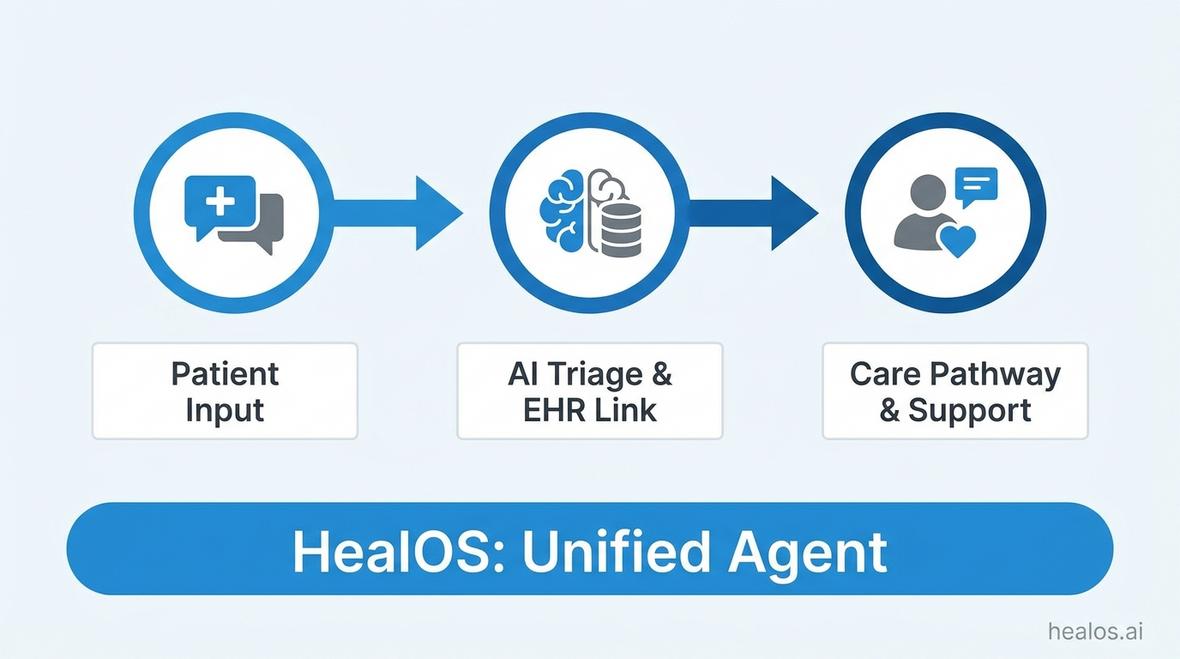
The HealOS unified agent architecture demonstrates this approach effectively. Patient information flows seamlessly from initial contact through AI triage, EHR linking, and personalized care pathways all without manual data entry. This integration eliminates duplicate work and reduces the administrative burden that contributes to staff burnout.
For practices using specific EHR systems, exploring available integrations ensures compatibility with your existing technology stack.
Insurance Verification and Prior Authorization
Insurance-related administrative tasks consume significant staff time and frequently cause claim denials when handled incorrectly. The best medical AI chatbot platforms automate eligibility verification, benefit checks, and prior authorization submissions.
These systems check patient coverage status in real-time, identify required authorizations before services are rendered, and automatically submit documentation to payers. By catching coverage issues early, practices reduce claim denials and improve cash flow directly addressing practice managers' concerns about financial health.
How Medical AI Chatbots Reduce Provider Burnout
Excessive charting represents one of the primary drivers of physician burnout. Providers spend hours documenting patient encounters, often working late into the evening on administrative tasks instead of focusing on patient care or personal time. The best medical AI chatbot solutions address this challenge through intelligent documentation automation.
Automated Clinical Documentation
Modern AI chatbots utilize ambient listening technology to capture patient-provider conversations and automatically generate comprehensive clinical notes. AI scribe functionality transforms spoken dialogue into structured SOAP notes, progress notes, and specialty-specific documentation formats without requiring providers to type or dictate separately.
Research published in the AI Chatbots vs Human Healthcare Professionals: Empathy and Clinical Perception Study systematically compared AI chatbot performance to human healthcare professionals in text-based scenarios, finding significant potential for AI systems to support clinical effectiveness directly relevant for practice managers evaluating AI implementation ROI.
These documentation capabilities extend beyond simple transcription. The best systems understand medical context, insert appropriate ICD-10 codes, suggest relevant CPT codes, and ensure documentation meets billing requirements reducing claim denials caused by insufficient documentation.
Reducing After-Hours Charting
The phenomenon of 'pajama time'—providers completing charts after hours significantly contributes to burnout and work-life imbalance. Medical AI chatbots eliminate this burden by completing documentation in real-time during or immediately after patient encounters.
For practices struggling with this issue, strategies to eliminate after-hours documentation demonstrate how AI automation restores providers' personal time while maintaining documentation quality.
Financial ROI: Reducing Costs and Improving Revenue
Practice managers evaluating the best medical AI chatbot solutions must consider both cost savings and revenue enhancement. The financial case for AI automation extends far beyond simply replacing human staff.
Addressing Staffing Shortages Without Increasing Headcount
Healthcare staffing shortages drive up labor costs while limiting practice growth. The best medical AI chatbot platforms handle administrative volume equivalent to multiple full-time employees without the associated salary, benefits, and training costs.
Administrative tasks that previously required dedicated staff appointment scheduling, insurance verification, patient reminders, follow-up calls now operate autonomously. Practices can scale patient volume and services without proportionally increasing administrative headcount, directly addressing practice managers' core goal of scaling without adding staff.
Reducing Claim Denials and Improving Cash Flow
Claim denials represent a significant financial drain for medical practices. Common denial reasons missing information, incorrect codes, lack of prior authorization, eligibility issues stem from administrative errors that AI chatbots prevent.
The best medical AI chatbot solutions incorporate denial management capabilities that identify potential issues before claims submission, automatically correct coding errors, and ensure all required documentation accompanies claims. This proactive approach reduces denial rates and accelerates reimbursement.
For comprehensive revenue optimization, integrated revenue cycle management features track claims from submission through payment, automatically following up on outstanding claims and identifying underpayments.
Calculating Your Implementation ROI
Practice managers must quantify the financial impact of adopting the best medical AI chatbot solution. Key metrics include:
- Administrative Labor Savings: Calculate hours spent on scheduling, insurance verification, phone calls, and documentation. Multiply by hourly wages to determine potential savings.
- Denial Rate Reduction: Analyze current denial rates and associated revenue loss. Even modest denial reduction generates significant financial returns.
- Provider Productivity: Quantify additional patient encounters possible when providers spend less time on documentation.
- No-Show Reduction: Automated reminders and confirmations reduce missed appointments and associated revenue loss.
Most practices implementing comprehensive AI automation realize positive ROI within 3-6 months, with ongoing savings and revenue enhancement continuing indefinitely.
Implementation Considerations for Practice Managers
Successfully deploying the best medical AI chatbot requires careful planning and consideration of several critical factors.
HIPAA Compliance and Data Security
Medical AI chatbots handle sensitive patient information, making HIPAA compliance non-negotiable. The best platforms implement robust security measures including end-to-end encryption, secure data storage, comprehensive audit trails, and Business Associate Agreements (BAAs).
Practice managers should verify that any AI chatbot solution maintains HIPAA compliance certifications, undergoes regular security audits, and provides transparent documentation of data handling practices. These protections safeguard patient privacy while protecting practices from regulatory penalties.
Staff Training and Change Management
Technology adoption succeeds or fails based on user acceptance. The best medical AI chatbot implementations include comprehensive staff training, clear communication about how automation enhances rather than replaces human roles, and ongoing support during the transition period.
Practice managers should emphasize how AI chatbots eliminate tedious administrative tasks, allowing staff to focus on higher-value activities requiring human judgment and interpersonal skills. This framing reduces resistance and accelerates adoption.
Specialty-Specific Customization
Different medical specialties have unique documentation requirements, terminology, and workflow patterns. The best medical AI chatbot platforms offer specialty-specific configurations that understand the nuances of different practice types.
Whether your practice focuses on pediatrics, cardiology, psychiatry, or other specialties, ensure your chosen solution supports specialty-specific templates, documentation formats, and terminology.
Comparing Leading Medical AI Chatbot Solutions
The market offers numerous medical AI chatbot platforms, each with different capabilities, pricing models, and integration options. Practice managers must evaluate solutions based on their specific needs and priorities.
Unified Agent Approach vs. Point Solutions
Some vendors offer specialized tools addressing specific functions scribing only, scheduling only, or billing only. While these point solutions may excel in their narrow focus, they create integration challenges and require practices to manage multiple vendor relationships.
The best medical AI chatbot platforms adopt a unified agent approach, delivering comprehensive automation across all administrative functions through a single integrated system. This architecture simplifies implementation, reduces integration complexity, and provides a more seamless user experience.
Key Evaluation Criteria
When comparing medical AI chatbot solutions, practice managers should assess:
- EHR Integration Depth: Does the platform integrate natively with your existing EHR, or does it require manual data transfer?
- Automation Breadth: How many administrative functions does the platform automate? Does it address your highest-priority pain points?
- Accuracy and Reliability: What accuracy rates does the vendor document for documentation, coding, and data extraction?
- Implementation Timeline: How quickly can the solution be deployed? What resources does implementation require?
- Pricing Model: Is pricing transparent and predictable? Are there hidden fees or per-transaction charges?
- Support and Training: What ongoing support does the vendor provide? How comprehensive is initial training?
For detailed comparisons of leading platforms, explore AI solution comparisons that evaluate features, pricing, and capabilities side-by-side.
The HealOS Unified Agent Advantage
HealOS represents the evolution of medical AI chatbot technology, moving beyond simple automation tools to deliver a comprehensive unified agent platform designed specifically for overwhelmed practice managers seeking to scale without increasing headcount.
Comprehensive Workflow Automation
Rather than requiring separate tools for each administrative function, HealOS provides integrated automation across the entire patient journey:
- Front Desk Automation:AI-powered answering services and patient intake
- Clinical Documentation: Automated scribing and note generation
- Insurance Processing: Eligibility verification, prior authorization, and claim management
- Revenue Cycle: Denial management, payment posting, and AR follow-up
- Document Management: Automated fax processing and document extraction
This unified approach eliminates integration challenges and provides practice managers with a single platform addressing all major administrative pain points.
Deep EHR Integration
HealOS integrates natively with major EHR systems, ensuring data flows seamlessly between platforms without manual intervention. This integration depth differentiates HealOS from competitors requiring manual data transfer or offering only superficial connections.
Specialty-Specific Intelligence
Whether your practice serves therapy patients, manages oncology care, or operates as a multi-provider group practice, HealOS adapts to specialty-specific requirements with customized templates, terminology libraries, and workflow configurations.
Frequently Asked Questions
How secure are medical AI chatbots with patient data?
The best medical AI chatbot platforms implement enterprise-grade security measures including end-to-end encryption, HIPAA-compliant data storage, comprehensive access controls, and regular security audits. Reputable vendors provide Business Associate Agreements and maintain transparent security documentation. Always verify that any solution you consider maintains current HIPAA compliance certifications and undergoes independent security assessments.
How long does implementation typically take?
Implementation timelines vary based on practice size, EHR complexity, and automation scope. Basic AI receptionist functionality can often be deployed within days, while comprehensive unified agent implementations including deep EHR integration typically require 2-4 weeks. The best vendors provide dedicated implementation support, clear project timelines, and phased rollout options that minimize disruption to daily operations.
Will AI chatbots replace my staff?
Medical AI chatbots are designed to augment rather than replace human staff. These systems handle repetitive, time-consuming administrative tasks scheduling, data entry, insurance verification allowing staff to focus on complex problem-solving, patient relationship management, and activities requiring human judgment and empathy. Most practices redeploy staff to higher-value roles rather than reducing headcount, improving both operational efficiency and job satisfaction.
What accuracy rates can I expect from AI documentation?
Leading medical AI chatbot platforms achieve documentation accuracy rates exceeding 95% for clinical notes, with some vendors reporting accuracy above 98% for structured data extraction. Accuracy varies based on audio quality, specialty-specific terminology, and documentation complexity. The best systems continuously improve through machine learning and allow providers to quickly review and refine AI-generated documentation, ensuring clinical accuracy while dramatically reducing documentation time.
What ROI should I expect and how quickly?
Most practices implementing comprehensive AI automation realize positive ROI within 3-6 months. Financial benefits include reduced administrative labor costs, decreased claim denial rates, improved cash flow from faster reimbursement, increased provider productivity, and reduced no-show rates. Specific ROI depends on practice size, current inefficiencies, and automation scope, but annual savings of $50,000-$200,000 are common for medium-sized practices, with larger organizations realizing proportionally greater benefits.
How do patients respond to AI chatbots?
Patient acceptance of medical AI chatbots is generally high, particularly for routine administrative interactions. Patients appreciate 24/7 availability, immediate responses to scheduling and administrative questions, and reduced wait times. The key to patient satisfaction is transparency clearly communicating when patients interact with AI versus human staff and ensuring seamless escalation to human support for complex issues requiring personal attention. Well-designed AI chatbots enhance rather than diminish the patient experience.
Conclusion
For overwhelmed practice managers facing staffing shortages, administrative burden, and mounting pressure to improve financial performance, the best medical AI chatbot solutions offer a transformative path forward. These intelligent systems automate workflows that previously required multiple full-time staff, reduce claim denials through proactive error prevention, and dramatically decrease provider burnout by eliminating excessive documentation time. The unified agent approach exemplified by platforms like HealOS delivers comprehensive automation across all administrative functions through seamless EHR integration, enabling practices to scale patient volume and services without proportionally increasing headcount. As healthcare continues evolving toward greater efficiency and technology-enabled care delivery, medical AI chatbots have transitioned from optional enhancements to essential infrastructure for financially healthy, operationally efficient practices.