
Clintegrity: The Complete Guide To Clinical Integrity And Automated Coding Accuracy

What Is Clintegrity and Why Does It Matter for Modern Healthcare Practices?
In today's rapidly evolving healthcare landscape, the concept of clintegrity—a portmanteau of 'clinical' and 'integrity'—has emerged as a critical framework for ensuring both clinical documentation accuracy and coding compliance. For overwhelmed practice managers facing staffing shortages, mounting administrative burdens, and escalating claim denial rates, understanding clintegrity is no longer optional it's essential for financial survival and operational efficiency.
Clintegrity represents the convergence of clinical excellence and billing accuracy, ensuring that every patient encounter is documented, coded, and submitted for reimbursement with the highest degree of precision. This approach not only safeguards revenue cycles but also protects practices from compliance risks, audits, and the crushing administrative workload that contributes to provider burnout.
According to CDC National Health Statistics Report on admin burden, US physicians spend 15.3% of their work time on administrative tasks related to charting and coding, contributing significantly to burnout. However, practices that have adopted automation have seen a 40% reduction in this administrative burden, demonstrating the transformative potential of clintegrity-focused solutions.
The Three Pillars of Clintegrity in Healthcare Operations
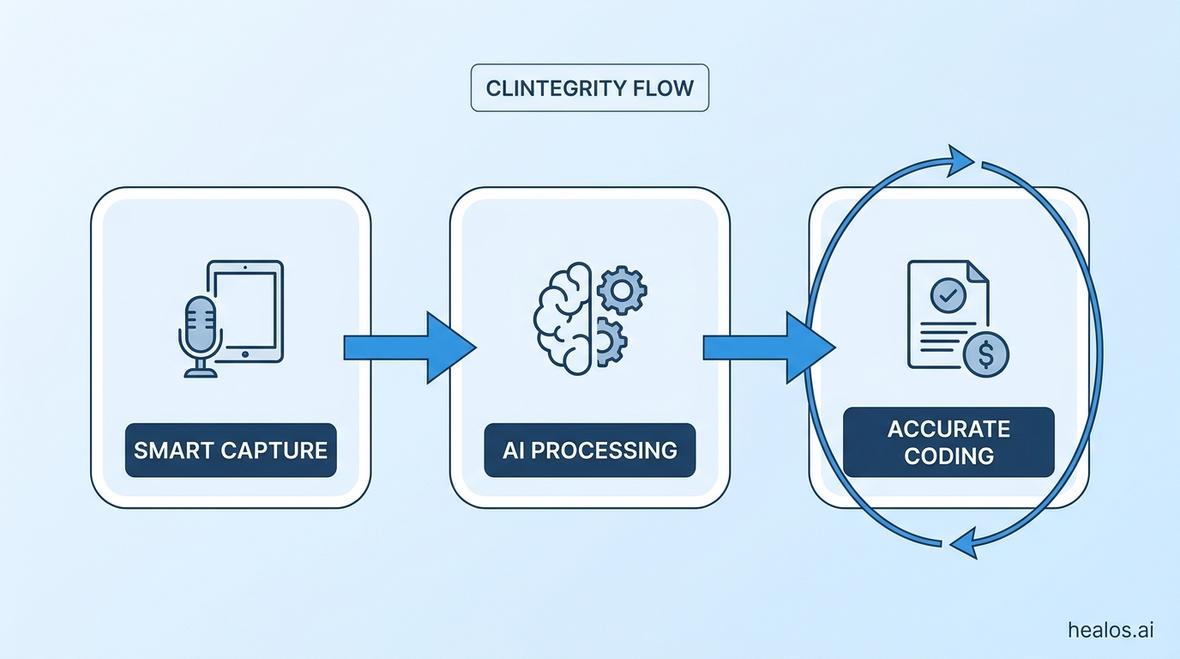
Effective clintegrity implementation rests on three foundational pillars that work in concert to create a seamless workflow from patient encounter to reimbursement. Understanding these components is crucial for practice managers seeking to modernize their operations without expanding headcount.
Smart Capture: Capturing Clinical Intelligence at the Point of Care
The first pillar involves intelligent data capture that begins at the moment of patient interaction. Traditional documentation methods require physicians to type extensive notes after appointments, creating both a time drain and opportunities for information loss. Smart capture systems utilize voice recognition, natural language processing, and ambient documentation technologies to record clinical encounters in real-time.
These systems can distinguish between relevant clinical information and conversational noise, automatically structuring data into standardized formats that downstream systems can process. For practice managers, this means providers spend less time on documentation and more time on patient care, directly addressing the burnout crisis while improving documentation completeness.
AI Processing: The Intelligence Engine Behind Accurate Coding
The second pillar leverages artificial intelligence and machine learning to transform captured clinical narratives into structured, codeable data. This processing layer analyzes documentation for diagnostic criteria, procedure descriptions, and medical necessity indicators, then maps these elements to appropriate CPT, ICD-10, and HCPCS codes.
Advanced AI engines don't simply perform keyword matching they understand clinical context, recognize diagnostic patterns, and apply payer-specific coding guidelines. This contextual awareness dramatically reduces coding errors, undercoding (which costs practices revenue), and overcoding (which triggers audits and compliance issues).
For organizations implementing AI-powered healthcare automation, the processing layer also performs real-time compliance checks, flagging potential issues before claims submission and creating an audit trail that demonstrates due diligence in coding accuracy.
Accurate Coding: Validation, Feedback, and Continuous Improvement
The third pillar establishes a continuous validation and improvement loop that ensures coding accuracy over time. This involves cross-referencing AI-suggested codes against clinical documentation, applying scrubbing rules, and incorporating feedback from claim adjudication results.
When a claim is denied or downcoded, the system captures that outcome and feeds it back into the AI training process, creating an ever-improving accuracy rate. This feedback loop is what separates static coding tools from true clintegrity platforms the ability to learn from real-world payer responses and continuously refine coding suggestions.
The Financial Impact of Clintegrity on Practice Revenue Cycles
For practice managers whose primary concern is financial health and reducing claim denials, the quantifiable impact of clintegrity implementation cannot be overstated. The revenue cycle in healthcare is notoriously complex, with multiple opportunities for revenue leakage at every stage.
Reducing Claim Denials Through Documentation Excellence
Industry data consistently shows that 5-10% of all healthcare claims are denied on first submission, with roughly 65% of denied claims never being resubmitted. The primary causes of denials coding errors, lack of medical necessity documentation, and missing information are precisely the issues that clintegrity systems address.
By ensuring that documentation captures all necessary clinical detail at the point of care, AI processing applies correct codes with supporting evidence, and validation systems catch errors before submission, practices can reduce their denial rates by 40-60% within the first year of implementation. For a mid-sized practice processing $5 million in annual claims, this translates to $200,000-$400,000 in recovered revenue.
Capturing Full Reimbursement: Addressing Undercoding
Undercoding the failure to capture all billable services or to use the most specific codes available is often an invisible revenue drain. Providers focused on patient care may document thoroughly but fail to mention every procedure or may use less specific codes to avoid audit risk.
Clintegrity systems analyze complete encounter documentation and identify all codeable services, ensuring that practices capture the full scope of work performed. This can increase revenue capture by 12-18% for practices that have historically underutilized evaluation and management codes or failed to bill for ancillary services.
Organizations leveraging medical coding and billing automation see particularly strong results in specialty practices where complex procedures and modifier usage significantly impact reimbursement levels.
Operational Efficiency: Scaling Without Adding Headcount
The overwhelming administrative burden facing healthcare practices creates a seemingly impossible dilemma: how to grow patient volume and revenue without proportionally increasing back-office staff. Clintegrity offers a solution by automating the most time-intensive components of the revenue cycle.
Reducing Manual Coding and Chart Review Time
Traditional coding workflows require human coders to review every chart, interpret clinical documentation, research appropriate codes, and manually enter billing information. This process typically takes 10-15 minutes per encounter for established patients and 20-30 minutes for complex cases.
With clintegrity automation, AI systems perform the initial coding in seconds, presenting suggestions to human coders for validation rather than requiring full manual coding. This shifts the coder's role from data entry to quality assurance, reducing the time per chart by 60-70% and allowing existing staff to process 2-3 times their previous volume.
Practices implementing seamless EHR integration with clintegrity platforms eliminate duplicate data entry entirely, as information flows automatically from clinical documentation through coding to claim submission without manual intervention.
Addressing Staffing Shortages and Turnover Challenges
The healthcare industry faces critical shortages of certified medical coders and billing specialists, with turnover rates exceeding 30% annually in many markets. Recruiting, training, and retaining these professionals represents a significant ongoing expense and operational risk.
Clintegrity systems mitigate this challenge by reducing dependence on highly specialized human coders. Entry-level staff can validate AI-generated codes with appropriate training, and the system's built-in compliance checks reduce the risk of errors from less experienced personnel. This flexibility allows practices to maintain operations even during staffing transitions and reduces the overall salary burden for coding functions.
Reducing Provider Burnout Through Documentation Relief
Provider burnout has reached crisis levels, with documentation burden identified as one of the top contributing factors. Physicians report spending two hours on administrative tasks for every hour of direct patient care, with charting consuming the majority of that time.
The Promise of Ambient Documentation
Clintegrity platforms that incorporate ambient documentation capabilities allow providers to have natural conversations with patients while AI systems listen, interpret, and generate structured notes in the background. This eliminates the need for providers to type during appointments or spend hours after clinic completing charts.
Early adopters of these technologies report that providers save 1-2 hours per day on documentation, allowing them to see additional patients, leave work on time, or simply have more present, engaged interactions during appointments. This directly addresses the burnout crisis while simultaneously improving patient satisfaction and practice capacity.
For practices utilizing AI scribe technology, the documentation is not only completed faster but also more comprehensive, as the AI captures details that providers might forget to document manually, improving both clinical quality and coding accuracy.
Improving Work-Life Balance and Job Satisfaction
The downstream effect of reduced documentation burden extends beyond time savings to fundamental improvements in provider job satisfaction. When physicians can focus on patient care rather than administrative tasks, their sense of professional fulfillment increases, retention improves, and recruitment becomes easier.
Practice managers seeking to retain valuable providers and attract new talent can leverage clintegrity implementation as a competitive advantage, offering a work environment that values provider time and reduces administrative friction.
Compliance and Audit Protection in the Era of Increased Scrutiny
As payers and government agencies intensify audit activities and fraud detection efforts, practices must demonstrate not only that their coding is accurate but that they have robust processes in place to ensure ongoing compliance.
Creating Comprehensive Audit Trails
Clintegrity platforms automatically create detailed audit trails that document the basis for every coding decision. When an auditor questions a particular code, the practice can demonstrate that the code was supported by specific clinical documentation, applied according to current coding guidelines, and validated through automated compliance checks.
This documentation significantly reduces audit risk and provides a strong defense in the event of payer disputes. For practice managers responsible for compliance, this automated audit trail eliminates the need for manual documentation of coding rationale and creates a systematic approach to compliance that satisfies regulatory requirements.
Staying Current with Constantly Changing Coding Guidelines
Coding guidelines, payer policies, and reimbursement rules change constantly, with thousands of updates occurring annually across CPT, ICD-10, and payer-specific requirements. Keeping human coders trained on all these changes is both expensive and imperfect.
AI-powered clintegrity systems are updated automatically as new guidelines are released, ensuring that every code suggested reflects the most current standards. This eliminates the lag time between guideline publication and implementation, reducing the risk of denials due to outdated coding practices.
Seamless EHR Integration: The Key to Clintegrity Success
The effectiveness of any clintegrity solution depends heavily on its ability to integrate with existing EHR systems without creating additional workflow friction. Practice managers who have experienced failed technology implementations understand that even the most sophisticated tool is worthless if providers won't use it.
The Unified Agent Approach to Healthcare Automation
Rather than requiring providers to log into separate systems or copy-paste information between platforms, modern clintegrity solutions employ a unified agent approach that operates within the existing EHR interface. This means providers continue their normal documentation workflows while AI agents work invisibly in the background to capture information, suggest codes, and prepare claims.
Organizations implementing autonomous healthcare agents see dramatically higher adoption rates because the technology adapts to existing workflows rather than forcing providers to change their practices.
Bidirectional Data Flow and Real-Time Updates
True integration requires bidirectional data flow, where information moves seamlessly from the EHR to the coding system and back again. When a code is suggested or a compliance issue is identified, that information must appear immediately in the provider's workflow, allowing for real-time corrections before the encounter is completed.
This real-time feedback loop is what transforms clintegrity from a back-office billing function to a point-of-care clinical support tool, helping providers document more thoroughly and accurately while they still have the patient in front of them.
Implementing Clintegrity: A Practical Roadmap for Practice Managers
For practice managers ready to implement clintegrity solutions, a structured approach ensures successful adoption and rapid return on investment.
Phase 1: Baseline Assessment and Goal Setting
Begin by quantifying your current state: What is your claim denial rate? How much time do providers spend on documentation? What is your coding accuracy rate? How many FTEs are dedicated to coding and billing? Establishing these baselines allows you to measure the impact of clintegrity implementation and demonstrate ROI to stakeholders.
Set specific, measurable goals such as 'reduce claim denials by 40% within six months' or 'decrease provider documentation time by 90 minutes per day.' These concrete targets guide your implementation strategy and vendor selection.
Phase 2: Solution Selection and Vendor Evaluation
Evaluate clintegrity platforms based on their integration capabilities with your specific EHR, their AI accuracy rates, their approach to compliance and audit protection, and their track record with practices similar to yours in size and specialty.
Request demonstrations using your actual clinical documentation to see how the system performs with real-world data. Ask about training requirements, implementation timelines, and ongoing support structures.
For practices seeking comprehensive solutions, platforms like HealOS offer integrated approaches that combine ambient documentation, AI coding, and autonomous billing in a single unified system.
Phase 3: Pilot Implementation and Refinement
Rather than attempting practice-wide implementation immediately, begin with a pilot group of 2-3 providers or a single department. This allows you to identify workflow issues, refine training approaches, and demonstrate success before broader rollout.
Monitor key metrics weekly during the pilot, gather feedback from participating providers and staff, and make adjustments to workflows and configuration before expanding to additional users.
Phase 4: Full Deployment and Continuous Optimization
Once the pilot demonstrates success, roll out clintegrity to the full practice in phases, ensuring adequate training and support for each group. Continue monitoring performance metrics and soliciting user feedback to identify opportunities for optimization.
Remember that clintegrity is not a one-time implementation but an ongoing process of refinement and improvement as your practice evolves and as AI systems continue to learn from your specific documentation patterns and payer relationships.
Measuring ROI: Key Performance Indicators for Clintegrity Success
To justify ongoing investment in clintegrity solutions and demonstrate value to practice owners and financial stakeholders, practice managers should track specific KPIs that reflect both financial and operational impact.
Financial Metrics
- Claim denial rate: Track the percentage of claims denied on first submission monthly, with a target reduction of 40-60% within the first year.
- Days in A/R: Monitor the average number of days between service and payment, which should decrease as coding accuracy improves and claims are submitted more quickly.
- Revenue per encounter: Measure whether more complete coding is capturing additional billable services, with increases of 12-18% typical for previously underutilizing practices.
- Cost per encounter: Calculate the total cost of coding and billing operations per patient visit, which should decrease even as accuracy improves.
Operational Metrics
- Provider documentation time: Track time spent on charting per day per provider, targeting reductions of 60-90 minutes daily.
- Coding throughput: Measure how many charts each coder can process per day, which should increase by 2-3x with AI assistance.
- Chart completion rate: Monitor the percentage of charts completed within 24 hours of the encounter, which improves with streamlined documentation.
- Provider satisfaction scores: Survey providers regularly on their satisfaction with documentation workflows and administrative burden.
The Future of Clintegrity: Emerging Trends and Capabilities
As AI technology continues to advance and regulatory frameworks evolve, clintegrity systems will become increasingly sophisticated and integrated into every aspect of healthcare delivery.
Predictive Analytics and Proactive Intervention
Future clintegrity platforms will move beyond reactive coding to proactive clinical and financial guidance, analyzing patterns across patient populations to identify documentation gaps before encounters occur, suggesting optimal care pathways that balance clinical outcomes with reimbursement potential, and predicting claim denial risk in real-time.
Integration with Value-Based Care Models
As healthcare continues its shift from fee-for-service to value-based reimbursement, clintegrity systems will evolve to track quality metrics, patient outcomes, and cost efficiency alongside traditional coding accuracy. This will allow practices to optimize for both traditional billing and alternative payment models simultaneously.
Platforms offering comprehensive healthcare workflow automation are already beginning to bridge this gap, providing unified views of practice performance across multiple reimbursement frameworks.
Overcoming Common Implementation Challenges
Despite the clear benefits of clintegrity, practice managers often encounter obstacles during implementation. Anticipating and addressing these challenges proactively increases the likelihood of successful adoption.
Provider Resistance to Technology Change
Physicians who have spent decades developing their documentation workflows may resist new technologies, particularly if previous implementations have failed or created additional work. Address this by involving providers in the selection process, demonstrating time savings during pilots, and emphasizing how the technology supports rather than replaces clinical judgment.
Integration Complexity with Legacy Systems
Practices using older EHR systems or multiple disconnected platforms may face technical challenges in achieving seamless integration. Work with vendors who have experience with your specific technology stack and be prepared to invest in interface development or consider EHR upgrades if integration proves impossible.
Data Quality and Documentation Variability
AI systems perform best when trained on consistent, high-quality documentation. If your practice has significant variability in documentation styles or quality, you may need to implement standardization initiatives before or alongside clintegrity deployment to achieve optimal results.
Frequently Asked Questions About Clintegrity
What is the typical ROI timeline for clintegrity implementation?
Most practices begin seeing measurable improvements in claim denial rates and provider documentation time within 30-60 days of implementation. Full ROI, including recovered revenue and reduced staffing costs, typically occurs within 6-12 months depending on practice size and baseline efficiency.
Do I need to hire additional IT staff to maintain clintegrity systems?
No. Modern cloud-based clintegrity platforms are maintained by the vendor, with updates and technical support included in subscription pricing. Your existing IT staff will need to support initial integration but ongoing maintenance is minimal.
How does clintegrity handle specialty-specific coding requirements?
Advanced clintegrity systems can be configured for specialty-specific coding guidelines and are trained on documentation patterns from similar practices. This ensures that the AI understands the nuances of specialties like cardiology, orthopedics, or behavioral health and applies appropriate specialty-specific codes.
Will clintegrity replace my medical coders?
Clintegrity augments rather than replaces human coders, shifting their role from manual code assignment to quality assurance and exception handling. This allows practices to process more volume with existing staff rather than requiring layoffs, and many practices redeploy coding staff to other revenue cycle functions like denial management or prior authorization.
How do I ensure HIPAA compliance with AI documentation systems?
Reputable clintegrity vendors build their platforms with HIPAA compliance as a foundational requirement, including encryption, access controls, and business associate agreements. During vendor evaluation, request documentation of their compliance frameworks, security audits, and incident response procedures.
Conclusion
For overwhelmed practice managers facing the dual challenges of staffing shortages and escalating administrative burdens, clintegrity represents a transformative approach to healthcare operations. By integrating smart capture, AI processing, and continuous validation, clintegrity systems address the root causes of claim denials, revenue leakage, and provider burnout simultaneously. The combination of seamless EHR integration and the unified agent approach ensures that these benefits are realized without disrupting existing workflows or requiring extensive retraining. As healthcare continues its evolution toward greater complexity and accountability, practices that embrace clintegrity will find themselves better positioned to deliver exceptional patient care while maintaining financial health and operational efficiency. The question is no longer whether to implement clintegrity, but how quickly you can realize its benefits for your practice.