
Dragon Computer Software: The Complete 2026 Guide To Medical Dictation, Best Alternatives & Cost-Saving Automation

What Is Dragon Computer Software and Why It Matters for Healthcare in 2026
Dragon computer software, developed by Nuance Communications, has been a cornerstone of medical dictation and voice recognition technology for over two decades. Originally known as Dragon NaturallySpeaking, this speech-to-text solution evolved into specialized products like Dragon Medical One and Dragon Professional, designed to streamline clinical documentation and reduce the administrative burden on healthcare providers.
For the overwhelmed practice manager facing staffing shortages and provider burnout, Dragon computer software represents both a legacy solution and a reference point for evaluating modern AI-powered alternatives. While Dragon was revolutionary in its time, today's healthcare automation landscape offers unified, AI-driven platforms that integrate seamlessly with EHRs, automate entire workflows, and deliver superior ROI without the complexity of traditional dictation software.
This comprehensive guide explores Dragon computer software's capabilities, pricing, accuracy benchmarks, and most importantly how newer solutions like HealOS are transforming practice operations by going far beyond simple voice recognition to deliver complete workflow automation.
How Dragon Computer Software Works: Voice Recognition Technology Explained
Dragon computer software leverages continuous speech recognition algorithms to convert spoken words into text in real time. The technology uses acoustic and language models trained on vast datasets, enabling it to recognize medical terminology, abbreviations, and context-specific jargon with increasing accuracy as users train the system with their voice profiles.
Core Components of Dragon Medical Software
Dragon Medical One, the cloud-based iteration of Dragon computer software, offers several key features:
- Real-time dictation: Providers speak directly into their EHR or documentation system, and Dragon transcribes words instantly.
- Voice commands for navigation: Users can execute voice commands for editing and formatting documents, including deleting, copying, and moving text without touching a keyboard.
- Medical vocabulary libraries: Pre-loaded with thousands of clinical terms, drug names, and procedure codes to improve accuracy in healthcare contexts.
- Cloud-based profiles: Dragon Medical One stores voice profiles in the cloud, allowing providers to access personalized dictation from any workstation.
According to research from comparative error rate studies, Dragon medical abbreviation recognition error rates ranged from 12.0 to 13.9 percent, demonstrating improved accuracy over traditional transcription methods but still requiring significant manual correction.
Deployment Models: Desktop vs. Cloud
Dragon computer software is available in two primary deployment models:
- Dragon Professional Individual: Installed locally on Windows PCs, suitable for solo practitioners or small offices with limited IT infrastructure.
- Dragon Medical One: Cloud-based subscription service designed for healthcare organizations, offering centralized management, automatic updates, and remote accessibility.
For practice managers evaluating Dragon computer software, the cloud model offers easier scalability and eliminates the need for on-premise server maintenance, but it also introduces recurring subscription costs that can escalate quickly as headcount grows.
Dragon Computer Software Pricing in 2026: What Practice Managers Need to Know
Understanding the total cost of ownership for Dragon computer software is critical for overwhelmed practice managers seeking to automate workflows without breaking the budget.
License and Subscription Costs
Dragon Medical One typically costs between $500 and $1,200 per provider per year, depending on volume licensing agreements and feature sets. Dragon Professional Individual, the desktop version, ranges from $300 to $500 for a perpetual license, but requires additional costs for major version upgrades and lacks cloud-based mobility.
Hidden Costs and Implementation Challenges
Beyond the sticker price, Dragon computer software incurs several often-overlooked expenses:
- Training time: Providers must invest hours training their voice profiles and learning voice commands to achieve acceptable accuracy.
- IT support: Desktop installations require ongoing IT maintenance, troubleshooting microphone issues, and managing software updates.
- Correction overhead: Even with trained profiles, users spend significant time correcting transcription errors, especially with complex medical abbreviations.
- EHR integration gaps: Dragon provides basic dictation into EHR fields but does not automatically structure notes, code diagnoses, or trigger downstream billing workflows.
For practices already stretched thin by staffing shortages, these hidden costs can negate the time savings promised by voice recognition alone.
Dragon Computer Software Accuracy: Benchmarks and Real-World Performance
Accuracy is the linchpin of any clinical documentation solution. Dragon computer software has achieved industry recognition for its speech recognition capabilities, but how does it perform in real-world healthcare settings?
Published Error Rates and Studies
A comparative study on medical abbreviation recognition found that Dragon medical error rates hovered between 12.0% and 13.9%, particularly when handling abbreviations and acronyms common in clinical documentation. While this represents a significant improvement over manual typing for many users, it also means that roughly one in every eight to ten words may require correction.
The Marshfield Clinic's implementation of Dragon Medical One in 2013 demonstrated successful integration in a large rural health system, but providers reported ongoing challenges with ambient noise, microphone quality, and the need for frequent profile retraining.
Factors Affecting Accuracy in Practice
- Microphone quality: Dragon computer software performance degrades significantly with low-quality or improperly positioned microphones.
- Background noise: Busy clinics with patient chatter, phone calls, and equipment sounds reduce recognition accuracy.
- Accents and speech patterns: Non-native English speakers or providers with strong regional accents may experience higher error rates.
- Medical jargon: While Dragon includes extensive medical vocabularies, emerging drugs, procedures, and proprietary terms require manual addition to custom dictionaries.
For the overwhelmed practice manager, these variables translate into unpredictable productivity gains and ongoing training investments.
Dragon Computer Software vs. Modern AI Medical Scribes: The 2026 Showdown
While Dragon computer software pioneered medical voice recognition, the healthcare technology landscape has evolved dramatically. Today's AI-powered medical scribes, such as HealOS AI Scribe, offer ambient listening, automatic note structuring, EHR integration, and intelligent workflow automation that far exceeds simple dictation.
Key Differences Between Dragon and AI Medical Scribes
| Feature | Dragon Computer Software | Modern AI Medical Scribes (HealOS) |
|---|---|---|
| Technology | Command-based voice recognition | Ambient AI with natural language understanding |
| User Experience | Requires active dictation and voice commands | Passive listening during patient encounters |
| Note Structuring | Manual formatting by provider | Auto-generates SOAP, DAP, and custom templates |
| EHR Integration | Basic dictation into fields | Seamless bi-directional sync with 50+ EHRs |
| Coding Assistance | None | Automated ICD-10, CPT coding suggestions |
| Workflow Automation | Limited to dictation | End-to-end automation including billing, claims, referrals |
| Accuracy | 87-88% (requires training) | 98%+ with continuous learning |
| Setup Time | Hours of voice profile training | Instant, no training required |
For practice managers focused on reducing claim denials and operational inefficiencies, the unified agent approach offered by platforms like HealOS addresses multiple pain points simultaneously, rather than solving only the dictation bottleneck.
Cost Comparison: Dragon vs. AI Scribe Platforms
Dragon Medical One subscriptions typically range from $500-$1,200 per provider annually. In contrast, comprehensive AI scribe solutions like HealOS often deliver greater value at comparable or lower price points by eliminating the need for separate billing software, coding tools, and manual correction time.
Practices implementing AI scribes report dramatic cost savings compared to human scribes, with annual expenses dropping from $42,000 per provider to as low as $1,200 far below Dragon's total cost of ownership when hidden IT and training expenses are factored in.
Why Dragon Computer Software Falls Short for Modern Practice Management
Despite its historical significance, Dragon computer software faces several limitations that make it less suitable for practices aiming to scale operations without increasing headcount.
Narrow Scope: Dictation Without Automation
Dragon computer software excels at converting speech to text but stops there. It does not:
- Automatically structure clinical notes into standardized formats
- Suggest appropriate billing codes based on documented services
- Trigger prior authorization workflows
- Integrate with revenue cycle management (RCM) systems
- Automate patient follow-up or referral coordination
For the overwhelmed practice manager, this means Dragon addresses only one small piece of the administrative puzzle, leaving staff to manually handle coding, billing, insurance verification, and claims follow-up.
EHR Integration Gaps
While Dragon Medical One integrates with many popular EHRs, the integration is often superficial limited to dictating into text fields. Unlike modern AI-driven EHR integration platforms, Dragon does not extract structured data, auto-populate diagnosis codes, or sync documentation with billing workflows.
This lack of deep integration forces practices to maintain multiple disconnected systems, increasing the risk of data entry errors and claim denials.
Scalability Challenges
As practices grow, Dragon computer software licensing costs scale linearly with headcount. Additionally, each new provider requires individual voice profile training and ongoing IT support, creating operational bottlenecks that contradict the goal of scaling without increasing administrative staff.
Best Alternatives to Dragon Computer Software for Healthcare Practices in 2026
For practice managers seeking to automate administrative workflows and reduce provider burnout, several modern alternatives to Dragon computer software offer superior functionality, ease of use, and ROI.
HealOS: The Unified AI Automation Platform
HealOS represents the next generation of healthcare automation, combining ambient AI scribing, intelligent workflow orchestration, and seamless EHR integration into a single platform. Unlike Dragon computer software, which requires active dictation, HealOS passively listens to patient encounters and automatically generates structured clinical notes in real time.
Key advantages of HealOS over Dragon include:
- Ambient listening technology: No need for voice commands or manual dictation providers simply have natural conversations with patients.
- Auto-structured notes: Generates SOAP, DAP, progress notes, and specialty-specific templates instantly.
- Integrated coding and billing: Automatically suggests ICD-10 and CPT codes, reducing claim denials and accelerating reimbursement.
- Unified agent approach: A single platform manages AI scribe, AI receptionist, revenue cycle management, insurance automation, and referral management.
- No training required: Immediate deployment without voice profile setup or IT overhead.
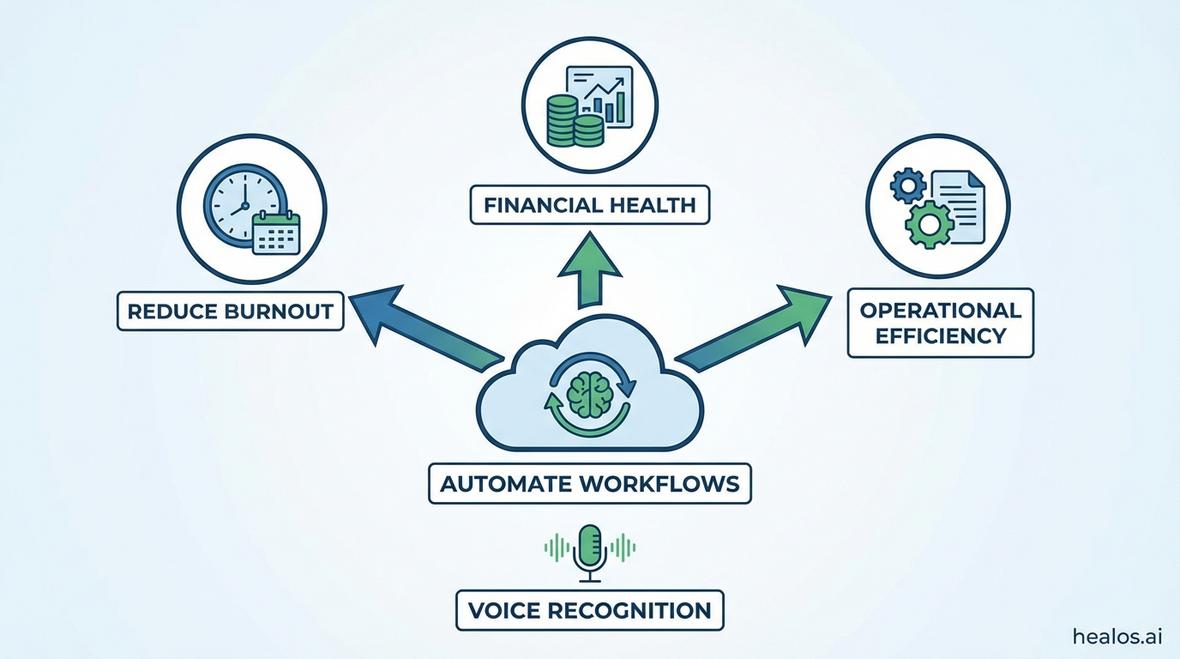
For overwhelmed practice managers, HealOS delivers the financial health and operational efficiency Dragon computer software cannot achieve alone.
Other Notable Alternatives
Several other AI scribe platforms have emerged as strong competitors to Dragon computer software:
- Freed AI: Focuses on rapid note generation with strong EHR integration but lacks the comprehensive workflow automation of HealOS.
- DeepScribe: Offers ambient listening and auto-documentation but at higher price points and with less flexible customization.
- Suki AI: Combines voice commands with AI assistance but retains some of the active dictation limitations of Dragon.
For detailed comparisons, practice managers can explore HealOS comparison pages to evaluate feature sets, pricing, and ROI across platforms.
Implementing Voice Recognition and Workflow Automation: Best Practices for Practice Managers
Whether adopting Dragon computer software or transitioning to a modern AI automation platform, successful implementation requires careful planning and change management.
Assess Your Practice's Workflow Needs
Before selecting a solution, map out your practice's administrative workflows to identify the highest-impact automation opportunities:
- Where do providers spend the most time on documentation?
- Which tasks cause the most staff frustration or errors?
- What percentage of claims are denied due to coding or documentation issues?
- How much time is lost to phone calls, faxes, and manual data entry?
Dragon computer software may address the first question but leaves the others unresolved. Platforms like HealOS tackle all four simultaneously.
Pilot Testing and Provider Buy-In
Start with a small pilot group of providers who are open to new technology. Monitor metrics such as:
- Time saved per patient encounter
- Documentation accuracy and completeness
- Provider satisfaction and perceived burnout reduction
- Impact on claim denial rates and revenue cycle speed
Successful pilots build momentum for practice-wide adoption and provide data to justify ongoing investment.
Training and Ongoing Support
While modern AI platforms require minimal training compared to Dragon computer software, providers still benefit from:
- Clear onboarding materials and video tutorials
- Dedicated support channels for troubleshooting
- Regular feedback sessions to optimize templates and workflows
HealOS offers comprehensive support and customization services to ensure seamless integration with existing practice operations.
The Future of Voice AI in Healthcare: Beyond Dragon Computer Software
As healthcare continues to digitize and automate, the role of voice recognition technology is expanding far beyond simple dictation. The future lies in intelligent agents that combine voice input with natural language processing, machine learning, and deep EHR integration to autonomously manage entire workflows.
Ambient Clinical Intelligence
Next-generation platforms leverage ambient listening to capture patient encounters without requiring providers to speak in structured dictation formats. This ambient clinical intelligence approach reduces cognitive load, improves patient engagement, and accelerates documentation completion.
Multimodal AI Agents
The future of healthcare automation involves multimodal AI agents that combine voice, text, and data inputs to execute complex tasks autonomously. Examples include:
- Prior authorization agents that gather clinical data, check payer requirements, and submit requests without human intervention.
- Denial management agents that identify claim denials, research root causes, and generate appeals automatically.
- Patient intake agents that collect insurance information, verify eligibility, and schedule appointments via conversational AI.
These capabilities represent a quantum leap beyond what Dragon computer software can deliver, positioning modern platforms like HealOS as the definitive solution for practices seeking to scale without increasing headcount.
Frequently Asked Questions About Dragon Computer Software
How accurate is Dragon computer software for medical dictation?
Dragon computer software achieves approximately 87-88% accuracy out of the box, with medical abbreviation error rates between 12.0% and 13.9% according to published studies. Accuracy improves with voice profile training but still requires manual correction, especially in noisy clinical environments.
What is the cost of Dragon Medical One per provider?
Dragon Medical One typically costs between $500 and $1,200 per provider per year, depending on licensing agreements. Additional costs include IT support, training time, and ongoing profile maintenance.
What are the best alternatives to Dragon computer software in 2026?
Modern AI medical scribe platforms such as HealOS, Freed AI, DeepScribe, and Suki AI offer superior ambient listening, auto-structured notes, and integrated workflow automation compared to Dragon's command-based dictation.
Does Dragon computer software integrate with all EHRs?
Dragon Medical One integrates with many popular EHRs but typically provides only basic dictation into text fields. It does not offer the deep, bi-directional integration and automated coding capabilities of modern AI platforms like HealOS.
How long does it take to train Dragon computer software?
Initial voice profile training for Dragon computer software typically requires 30-60 minutes, with ongoing adjustments needed to maintain accuracy. In contrast, modern AI scribes like HealOS require zero training and deliver immediate results.
Can Dragon computer software reduce provider burnout?
Dragon computer software can reduce typing time but does not address the broader administrative burdens that drive burnout, such as coding, billing, prior authorizations, and insurance verification. Comprehensive platforms like HealOS AI Scribe tackle these issues holistically.
Conclusion
Dragon computer software has played a pivotal role in bringing voice recognition to healthcare, but for the overwhelmed practice manager in 2026, it represents only a partial solution. While Dragon can reduce typing time, it lacks the comprehensive workflow automation, intelligent coding, and seamless EHR integration required to scale practices without increasing headcount or compromising financial health.
Modern AI-powered platforms like HealOS deliver a unified agent approach that automates not just dictation but entire administrative workflows from patient intake and clinical documentation to billing, claims management, and referral coordination. With superior accuracy, zero training requirements, and dramatically lower total cost of ownership, these next-generation solutions offer overwhelmed practice managers the operational efficiency and financial resilience they need to thrive in today's competitive healthcare landscape.