
Health AI Companies In 2026: Complete Guide To Choosing The Right Partner For Your Practice

Understanding Health AI Companies in 2026
The landscape of health AI companies has transformed dramatically, with artificial intelligence now touching every corner of healthcare operations. For practice managers facing staffing shortages and escalating administrative burdens, selecting the right AI partner is no longer optional it's essential for survival. According to research from Bessemer Venture Partners, only 30% of AI pilots reach production due to integration costs, security concerns, and limited in-house expertise. This statistic underscores why choosing a health AI company with seamless implementation capabilities is critical for overwhelmed practices.
Health AI companies in 2026 fall into several distinct categories: ambient clinical documentation platforms, revenue cycle management solutions, patient engagement systems, and unified workflow automation providers. Each addresses specific pain points, but the most effective solutions integrate across multiple domains. Practice managers must evaluate not just the technology itself, but the company's track record with EHR integration, implementation timelines, and measurable ROI on administrative efficiency.
The stakes are high. Research from Menlo Ventures shows that AI initiatives are projected to reduce documentation time by more than 50%, automating prior authorizations, referrals, and coding to combat provider burnout. For practices drowning in charting demands and claim denials, partnering with the right health AI companies can mean the difference between scaling efficiently and operational collapse.
Categories of Health AI Companies and Their Solutions
Clinical Documentation and Ambient Scribing Platforms
The most visible category of health AI companies focuses on clinical documentation. These platforms use ambient listening technology and natural language processing to automatically generate clinical notes from patient-provider conversations. Companies like DeepScribe, Freed AI, and Suki AI have gained traction, but their implementation complexity and cost structures vary dramatically.
According to Towards Healthcare, AI clinical decision support tools are now used by 40% of U.S. physicians daily and deployed across more than 10,000 hospitals. This widespread adoption reflects the acute need for solutions that reduce charting burden without compromising note quality. For practice managers, the key differentiator is seamless EHR integration—solutions that require manual copy-paste workflows defeat the purpose of automation.
The best AI scribe solutions in 2026 offer customizable templates, multi-specialty support, and bidirectional EHR sync that eliminates duplicate data entry. HealOS stands out by providing not just ambient scribing but a unified platform that extends to revenue cycle management and front-desk automation, addressing the full spectrum of administrative workflows that drain practice resources.
Revenue Cycle Management and Claims Automation
Another critical segment of health AI companies tackles the financial health challenges that keep practice managers awake at night. Claims denials, underpayments, and prior authorization delays directly impact practice viability. AI-powered RCM solutions automate eligibility verification, claims scrubbing, denial management, and payment posting tasks that traditionally require dedicated billing staff.
Health systems report significant efficiency gains from AI-driven RCM. The technology identifies underpayments through pattern recognition, flags claims likely to be denied before submission, and automates follow-up workflows. For small to mid-sized practices with limited billing teams, this automation is transformative. HealOS integrates prior authorization automation and denial management directly into clinical workflows, ensuring that revenue integrity doesn't require additional headcount.
The financial impact is measurable. Practices implementing comprehensive RCM automation report 20-30% reductions in claim denial rates and 15-25% improvements in days in accounts receivable. For overwhelmed practice managers, these metrics translate directly to financial stability and the ability to scale without proportional increases in administrative staff.
Patient Engagement and Front-Desk Automation
Staffing shortages hit front-desk operations hardest. Health AI companies addressing this pain point deploy conversational AI for phone answering, appointment scheduling, patient intake, and follow-up reminders. These AI receptionist solutions operate 24/7, handle multiple calls simultaneously, and integrate with practice management systems to update schedules in real time.
The ROI for front-desk automation is immediate. Practices eliminate the cost of after-hours answering services, reduce no-show rates through automated reminders, and free existing staff to focus on in-person patient interactions. HealOS provides comprehensive front-desk automation including patient intake, medical answering, and follow-up calls, ensuring no administrative touchpoint is neglected.
For practice managers evaluating health AI companies in this category, the critical questions are: How natural does the AI sound? How well does it handle complex scheduling scenarios? And most importantly, does it integrate bidirectionally with your existing systems to eliminate manual data reconciliation?
Key Evaluation Criteria for Selecting Health AI Companies
EHR Integration and Implementation Timeline
The number one reason AI pilots fail to reach production is integration complexity. Practice managers must prioritize health AI companies with proven EHR integration capabilities across major platforms like Epic, Cerner, Athenahealth, and AdvancedMD. Seamless integration means bidirectional data flow not just extracting data from the EHR, but writing back structured notes, updating schedules, and posting charges automatically.
Implementation timeline is equally critical. Practices cannot afford months of downtime during deployment. The best health AI companies offer rapid implementation often within 24-48 hours for core modules. HealOS exemplifies this approach with rapid deployment processes that minimize disruption and accelerate time-to-value.
When evaluating vendors, request specific case studies showing implementation timelines, integration scope, and post-deployment support. Ask about API access, webhook capabilities, and whether the solution supports HL7 and FHIR standards for future-proof interoperability.
Unified Platform vs. Point Solutions
Many practices make the mistake of cobbling together multiple point solutions one vendor for scribing, another for RCM, a third for front-desk automation. This fragmented approach creates new problems: data silos, integration maintenance overhead, and vendor management complexity. The most forward-thinking health AI companies offer unified platforms that address multiple administrative workflows through integrated AI agents.
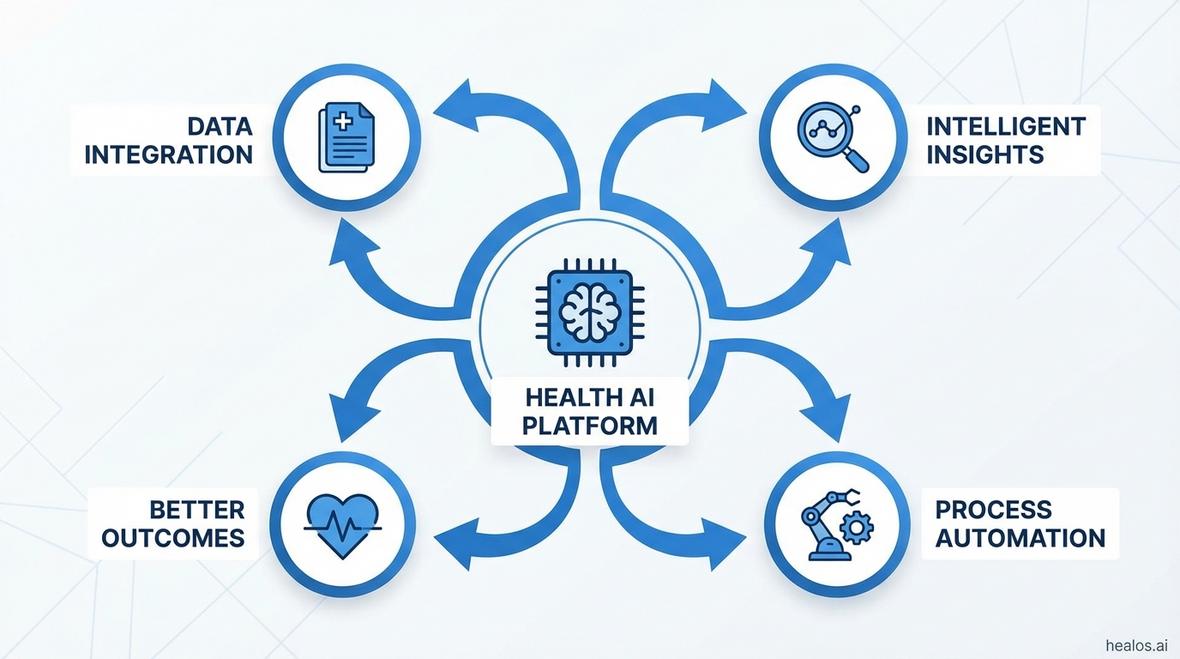
HealOS pioneered this 'unified agent' approach, where a single platform powers clinical documentation, revenue cycle management, patient engagement, and administrative automation. This architecture ensures data flows seamlessly across workflows, reduces training overhead, and provides practice managers with holistic analytics on operational performance. For practices seeking to scale without increasing headcount, unified platforms deliver superior ROI compared to stitching together disparate point solutions.
Security, Compliance, and HIPAA Safeguards
Healthcare data demands the highest security standards. Any health AI company handling protected health information (PHI) must demonstrate robust HIPAA compliance, including Business Associate Agreements (BAAs), end-to-end encryption, audit logging, and regular security assessments. Practice managers should verify SOC 2 Type II certification and ask detailed questions about data handling, storage locations, and breach notification procedures.
Research from the National Center for Biotechnology Information highlights that healthcare institutions in collaborations with tech giants receive AI algorithms or software for free or reduced price, gaining competitive advantages in efficiency and patient care. However, these arrangements often involve data sharing that may not align with practice-level security requirements. Independent health AI companies with transparent security postures offer greater control and accountability.
Cost-Benefit Analysis: What Practice Managers Need to Know
Pricing Models Across Health AI Companies
Health AI companies employ diverse pricing models: per-provider subscriptions, per-encounter fees, percentage of collections (for RCM solutions), and tiered feature packages. Understanding total cost of ownership is essential. A solution with a low monthly subscription but requiring expensive custom integrations may cost more than a higher-priced option with seamless out-of-the-box EHR connectivity.
Per-provider pricing typically ranges from $99 to $399 per month for clinical documentation tools. RCM solutions often charge 3-8% of collections managed. Front-desk automation may cost $200-500 monthly for small practices. For practice managers comparing vendors, request detailed pricing that includes implementation fees, training costs, and ongoing support not just the base subscription.
HealOS offers transparent, value-based pricing with no hidden implementation fees and comprehensive training included. The platform's unified approach often delivers lower total cost compared to assembling separate point solutions, while providing superior functionality across all administrative domains.
ROI Calculation Framework for AI Investments
Calculating ROI for health AI companies requires quantifying both hard savings (reduced staffing costs, improved collections) and soft benefits (reduced provider burnout, improved patient satisfaction). Start by documenting baseline metrics: hours spent on charting per week, claim denial rates, front-desk staffing costs, and days in accounts receivable.
Post-implementation, track changes in these metrics monthly. Most practices see measurable improvements within 60-90 days. According to data from Menlo Ventures referenced earlier, documentation time reductions of 50% translate to 10-15 hours reclaimed per provider weekly time that can be redirected to patient care or additional appointments. For a practice with five providers, that's 50-75 hours weekly, equivalent to 1.5 full-time employees.
On the revenue side, reducing claim denial rates from 8% to 5% for a practice with $2 million in annual collections represents $60,000 in recovered revenue. When combined with labor savings from front-desk automation and reduced charting overtime, comprehensive AI deployment typically achieves payback within 6-9 months and delivers 300-500% ROI over three years.
Specialty-Specific Considerations for Health AI Companies
Behavioral Health and Psychiatry
Mental health practices face unique documentation requirements, particularly around treatment plans, safety assessments, and session notes. Health AI companies serving this specialty must support SOAP, DAP, BIRP, and GIRP note formats, integrate with specialized EHRs like SimplePractice and TherapyNotes, and handle nuanced clinical language around mental status exams.
HealOS provides specialty-specific solutions for psychiatry and therapy practices, with templates optimized for behavioral health documentation requirements. The platform understands the unique workflows of psychiatric evaluations, medication management visits, and psychotherapy sessions, ensuring generated notes meet payer requirements without excessive editing.
Primary Care and Group Practices
Primary care practices juggle high patient volumes, diverse presenting complaints, and extensive quality reporting requirements. The right health AI companies for this specialty must handle rapid visit documentation, support preventive care tracking, and integrate with population health management tools. Group practices require multi-provider support, centralized analytics, and role-based access controls.
HealOS addresses these needs with high-volume documentation capabilities, quality measure tracking, and comprehensive practice-level dashboards. The platform's document automation extends to referral letters, prior authorizations, and patient education materials administrative tasks that typically consume significant staff time in busy primary care settings.
Specialty Practices: Cardiology, Oncology, Orthopedics
Specialty practices have domain-specific documentation needs that generic health AI companies may not address. Cardiology requires integration with EKG and echo systems; oncology demands chemotherapy protocol documentation and tumor board notes; orthopedics needs surgical operative reports and pre-op clearances. The best AI solutions offer specialty-specific templates and terminology libraries.
HealOS supports cardiology, oncology, and orthopedics with customizable templates that capture specialty-specific clinical elements. The platform learns practice-specific language patterns and documentation preferences, improving accuracy over time without requiring providers to change their natural communication style.
Implementation Best Practices When Working with Health AI Companies
Change Management and Staff Training
Technology is only as effective as adoption rates. Practice managers must develop comprehensive change management strategies when implementing solutions from health AI companies. This includes communicating the 'why' behind the change, addressing staff concerns about job security, and providing hands-on training that builds confidence.
Start with a pilot group of early adopters typically tech-savvy providers and staff who can become internal champions. Document their success stories and share improvements in workflow efficiency. Provide multiple training modalities: live sessions, video tutorials, and quick-reference guides. Most importantly, establish feedback loops so staff can report issues and see responsive improvements.
HealOS provides comprehensive implementation support including dedicated training sessions, ongoing coaching, and a robust HealOS Academy with self-paced learning resources. This multi-layered approach ensures high adoption rates and rapid realization of efficiency gains.
Measuring Success: KPIs and Continuous Improvement
Define clear success metrics before implementation. For clinical documentation, track time spent charting per encounter, note completion rates, and provider satisfaction scores. For RCM automation, monitor claim denial rates, days in A/R, and collection percentages. For front-desk automation, measure call abandonment rates, no-show percentages, and patient satisfaction with scheduling experience.
Review these metrics monthly with your AI vendor. The best health AI companies provide detailed analytics dashboards and proactively suggest optimizations based on usage patterns. Continuous improvement should be expected AI systems learn and improve over time, and vendors should regularly release enhancements based on aggregate user feedback.
Future Trends in Health AI Companies
Predictive Analytics and Proactive Workflow Management
The next generation of health AI companies is moving beyond automation to prediction. Advanced systems analyze patterns to predict which claims are likely to be denied, which patients are at risk of no-shows, and which clinical scenarios may require additional documentation. This proactive approach allows practices to address issues before they become problems.
HealOS is pioneering predictive capabilities in revenue cycle management, flagging potential documentation gaps that could lead to claim denials and suggesting corrective actions before submission. This shift from reactive to proactive management represents a significant evolution in how health AI companies deliver value.
Expanded Interoperability and Data Exchange
As healthcare moves toward value-based care, data exchange between practices, health systems, payers, and patients becomes critical. Future-focused health AI companies are building solutions that facilitate seamless data exchange through FHIR APIs, support CMS interoperability requirements, and enable practices to participate in health information exchanges without additional IT infrastructure.
These capabilities position practices to succeed in alternative payment models where care coordination and data sharing directly impact reimbursement. Practice managers should prioritize vendors with clear roadmaps for expanded interoperability capabilities.
Frequently Asked Questions About Health AI Companies
How long does it typically take to implement AI solutions from health AI companies?
Implementation timelines vary by solution complexity and practice size. Ambient scribing tools can often be deployed in 24-48 hours for single providers. Comprehensive platforms addressing clinical documentation, RCM, and front-desk automation typically require 1-2 weeks for full deployment, including EHR integration, staff training, and workflow optimization. The best health AI companies provide dedicated implementation managers to ensure smooth transitions.
What ROI should practices expect from AI automation?
Most practices see measurable ROI within 6-9 months through labor savings, improved collections, and increased provider capacity. Documentation time reductions of 40-60%, claim denial rate improvements of 20-40%, and front-desk automation can collectively deliver 300-500% ROI over three years. Smaller practices with limited administrative staff often see faster payback due to proportionally larger efficiency gains.
How do health AI companies ensure data security and HIPAA compliance?
Reputable health AI companies maintain HIPAA compliance through Business Associate Agreements, end-to-end encryption, role-based access controls, comprehensive audit logging, and regular security assessments. Look for vendors with SOC 2 Type II certification, clear data handling policies, and transparent breach notification procedures. Always review security documentation before signing contracts.
Do health AI companies support specialty-specific documentation requirements?
The best health AI companies offer specialty-specific templates and terminology libraries for fields like psychiatry, cardiology, orthopedics, pediatrics, and others. These customized solutions ensure generated documentation meets specialty-specific payer requirements and includes domain-specific clinical elements. Practices should verify specialty support during vendor evaluation.
Will AI automation replace my existing staff?
AI automation is designed to augment, not replace, healthcare staff. The technology eliminates repetitive, low-value tasks, allowing staff to focus on higher-value activities that require human judgment and empathy. Most practices redeploy staff to patient-facing roles, care coordination, or quality improvement initiatives rather than reducing headcount. The goal is scaling without proportional staff increases, not workforce reduction.
Conclusion
Selecting the right health AI companies is one of the most consequential decisions practice managers will make in 2026. The stakes financial health, operational efficiency, provider burnout, and patient satisfaction demand careful evaluation of integration capabilities, unified platform approaches, and measurable ROI. With only 30% of AI pilots reaching production due to implementation challenges, choosing vendors with proven deployment track records and seamless EHR connectivity is critical. HealOS stands out among health AI companies by offering a comprehensive, unified platform that addresses clinical documentation, revenue cycle management, and front-desk automation through integrated AI agents, delivering rapid implementation and measurable outcomes. For overwhelmed practice managers seeking to scale without increasing headcount, the right AI partner transforms administrative burden into strategic advantage.