
Healthcare AI Agents: The Complete 2026 Guide To Automating Practice Workflows And Reducing Provider Burnout

Introduction: The Healthcare Automation Revolution
Practice managers across the United States face an unprecedented staffing crisis. According to recent industry reports, administrative burdens consume up to 77% of clinician time, leaving providers exhausted and practices struggling to scale without exponentially increasing headcount. Enter healthcare AI agents—autonomous systems designed to handle repetitive workflows, reduce claim denials, and restore the financial health of medical practices.
For the overwhelmed practice manager, the promise is clear: automate administrative workflows, integrate seamlessly with existing EHR systems, and leverage a unified agent approach that coordinates multiple tasks without requiring separate tools for each function. This guide explores how healthcare AI agents are transforming practice operations in 2026, with actionable insights tailored to those managing staffing shortages and provider burnout.
What Are Healthcare AI Agents?
Healthcare AI agents are intelligent software systems that autonomously execute complex workflows from patient scheduling and insurance verification to clinical documentation and revenue cycle management. Unlike traditional automation tools that follow rigid scripts, these agents adapt to context, make decisions, and coordinate across multiple systems.
Research from AI agents reduce clinician cognitive burden shows that agentic AI systems significantly improve efficiency in protocol generation, documentation, and consultations. They operate continuously, learning from data patterns to optimize processes over time.
Key Characteristics of AI Agents
- Autonomy: Execute tasks without constant human supervision
- Context Awareness: Understand clinical and administrative nuances
- Interoperability: Integrate with EHRs, billing systems, and communication platforms
- Scalability: Handle increasing workloads without proportional cost increases
This AI agents shift healthcare from fragmented processes structural transformation moves organizations from fragmented processes toward integrated, adaptive systems that unify clinical and administrative workflows.
Why Practice Managers Need AI Agents in 2026
The current healthcare landscape presents three critical challenges for practice managers: staffing shortages, provider burnout, and financial pressures from claim denials. Healthcare AI agents address each of these pain points directly.
Solving the Staffing Crisis
Hiring qualified administrative staff has become increasingly difficult and expensive. AI agents can perform the work of multiple full-time employees across scheduling, billing, and patient communication without requiring benefits, training, or management oversight. For practices struggling to fill open positions, this represents an immediate capacity boost.
Reducing Provider Burnout Through Documentation Automation
Excessive charting and administrative tasks are primary drivers of provider burnout. AI scribe solutions capture clinical encounters in real-time, generating structured notes that integrate directly into EHR systems. This reduces after-hours documentation and allows providers to focus on patient care rather than data entry.
Improving Financial Health and Reducing Claim Denials
Claim denials cost practices significant revenue and require extensive follow-up work. Revenue cycle management agents automate eligibility verification, prior authorization, and denial management catching errors before submission and accelerating reimbursement cycles. According to $55 billion annual savings from agentic AI projections, successful implementation could save $55 billion annually in healthcare costs through improved scheduling and care support.
The Unified Agent Approach: Why Integration Matters
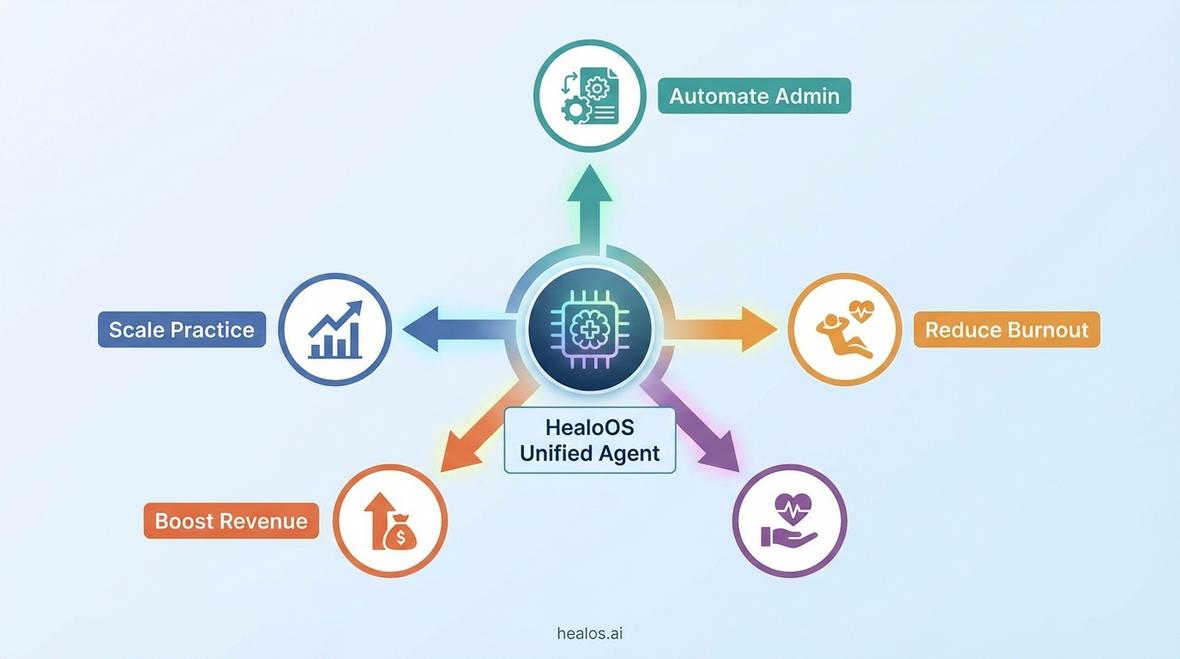
Traditional practice automation involves purchasing separate point solutions for each workflow one vendor for scheduling, another for billing, a third for documentation. This creates data silos, integration headaches, and fragmented patient experiences.
Healthcare AI agents operating under a unified architecture share context across workflows. When a patient calls to schedule an appointment, the agent simultaneously verifies insurance eligibility, checks prior authorization requirements, and prepares relevant clinical documentation templates all within a single interaction.
HealOS: Seamless EHR Integration and Unified Operations
HealOS delivers a comprehensive platform where multiple AI agents work in concert. AI receptionist capabilities handle patient intake and scheduling, while insurance automation agents manage verification and prior authorization. Clinical documentation flows automatically from encounters to billing, reducing manual handoffs and error rates.
This unified approach eliminates the need for practice managers to coordinate multiple vendors, negotiate separate contracts, or manage complex integration projects. Everything operates through a single dashboard with seamless EHR connectivity.
Core Administrative Workflows Automated by AI Agents
Healthcare AI agents excel at repetitive, high-volume tasks that traditionally consume significant staff time. Here are the critical workflows that can be fully or partially automated in 2026.
Patient Scheduling and Intake
Automated scheduling agents handle appointment booking, rescheduling, and cancellations across multiple channels phone, web, and patient portals. They optimize provider schedules based on appointment types, patient history, and insurance requirements. Patient intake automation collects demographic information, insurance details, and medical history before visits, reducing front-desk bottlenecks.
Insurance Verification and Eligibility Checking
Manual insurance verification is time-consuming and error-prone. AI agents query payer systems in real-time, confirming coverage, copays, and deductibles before appointments. This reduces no-shows due to coverage issues and ensures accurate billing from the start.
Prior Authorization Management
Prior authorization requests consume hours of administrative time and delay patient care. Prior authorization agents automatically gather clinical documentation, complete payer forms, and track approval status reducing turnaround time from days to hours.
Clinical Documentation and Charting
AI scribes listen to patient encounters, extract relevant clinical information, and generate structured notes in SOAP, DAP, or custom formats. This eliminates the need for providers to spend hours after clinic documenting visits, directly addressing burnout concerns.
Billing and Claims Processing
From charge capture to claim submission, AI agents automate the entire billing workflow. They validate coding accuracy, check for common denial triggers, and submit clean claims to payers. Post-submission, they monitor claim status and initiate appeals when necessary.
Denial Management and Appeals
Denial management automation analyzes rejection reasons, gathers supporting documentation, and files appeals within payer deadlines. This accelerates revenue recovery and reduces write-offs from unresolved denials.
Implementation Considerations for Practice Managers
Deploying healthcare AI agents requires thoughtful planning to ensure smooth adoption and maximum ROI. Practice managers should consider the following factors.
EHR Integration Requirements
Seamless EHR connectivity is non-negotiable. Solutions should integrate with major platforms like Epic, Cerner, Athenahealth, and specialty-specific systems without requiring extensive custom development. HealOS provides pre-built integrations with leading EHR vendors, minimizing implementation time.
Staff Training and Change Management
Even automated systems require staff buy-in and basic training. Allocate time for onboarding sessions, create workflow documentation, and designate internal champions who can troubleshoot issues and advocate for adoption.
Compliance and Data Security
Healthcare AI agents must comply with HIPAA regulations and maintain robust security protocols. Verify that vendors offer BAA agreements, encrypt data in transit and at rest, and conduct regular security audits.
Measuring ROI and Performance Metrics
Track key performance indicators such as claim denial rates, days in accounts receivable, patient wait times, and provider documentation hours. Establish baseline metrics before implementation to quantify improvements and justify continued investment.
Specialty-Specific Applications of Healthcare AI Agents
Different medical specialties face unique administrative challenges. Healthcare AI agents can be tailored to address these specialty-specific needs.
Psychiatry and Mental Health
Mental health practices require detailed session documentation and frequent prior authorization for therapy services. Psychiatry-focused AI agents generate compliant progress notes and automate insurance verification for behavioral health benefits.
Cardiology
Cardiology practices manage complex diagnostic procedures requiring prior authorization and specialized coding. AI agents streamline authorization workflows for imaging studies, cardiac catheterizations, and implantable devices.
Pediatrics
Pediatric practices handle high patient volumes with diverse insurance plans. Pediatrics-specific automation manages vaccine scheduling, well-child visit documentation, and coordination with schools and specialists.
Group Practices and Multi-Location Operations
Group practice solutions provide centralized oversight across multiple locations, standardizing workflows while accommodating location-specific requirements and provider preferences.
Cost-Benefit Analysis: AI Agents vs. Traditional Staffing
For practice managers evaluating healthcare AI agents, understanding the financial impact is critical. Traditional administrative staffing involves salaries, benefits, training, and turnover costs. A full-time medical receptionist costs approximately $35,000-$45,000 annually plus benefits, while billing specialists command $40,000-$55,000.
AI agent platforms typically operate on subscription models ranging from $200-$800 per provider per month, depending on features and volume. A single AI agent can handle workloads equivalent to multiple full-time employees across scheduling, documentation, and billing delivering ROI within months.
Beyond direct cost savings, AI agents reduce claim denials (worth thousands per month), accelerate reimbursement cycles (improving cash flow), and enable providers to see more patients (increasing revenue). These indirect benefits often exceed direct labor savings.
Future Trends in Healthcare AI Agents (2026 and Beyond)
The healthcare AI agent landscape continues to evolve rapidly. Emerging trends for 2026 include:
Predictive Analytics for Proactive Management
Next-generation agents will predict claim denials before submission, identify patients at risk of no-shows, and forecast staffing needs based on seasonal trends.
Voice AI and Conversational Interfaces
Advanced natural language processing enables patients to interact with voice AI systems for scheduling and basic triage, reducing phone wait times and improving accessibility.
Care Coordination Across Networks
AI agents will facilitate referral management, specialist coordination, and longitudinal care tracking across multiple providers and settings addressing fragmentation in patient care.
Regulatory Compliance Automation
As regulatory requirements evolve, AI agents will automatically adapt documentation and billing practices to maintain compliance with CMS updates, payer policy changes, and quality reporting mandates.
Selecting the Right Healthcare AI Agent Platform
Practice managers should evaluate potential platforms based on several key criteria:
- Breadth of Capabilities: Does the platform cover your highest-priority workflows?
- EHR Compatibility: Are integrations available for your specific system?
- Scalability: Can the solution grow with your practice?
- Support and Training: What onboarding and ongoing support is provided?
- Pricing Transparency: Are costs clearly defined with no hidden fees?
- Security and Compliance: Does the vendor meet healthcare regulatory standards?
HealOS addresses each of these considerations with a comprehensive platform designed specifically for overwhelmed practice managers seeking to automate administrative workflows without increasing headcount.
Frequently Asked Questions
How quickly can healthcare AI agents be implemented?
Implementation timelines vary based on practice size and complexity. For most practices, core functionalities can be operational within 2-4 weeks, with full deployment completed in 1-2 months. Cloud-based platforms like HealOS offer faster implementation than on-premise solutions.
Will AI agents replace my existing staff?
Healthcare AI agents are designed to augment staff, not replace them entirely. They handle repetitive tasks, allowing existing team members to focus on higher-value activities requiring human judgment, empathy, and complex problem-solving. Many practices redeploy staff to patient-facing roles or specialized functions.
What happens if the AI agent makes an error?
Reputable platforms include human oversight mechanisms and audit trails. Critical workflows maintain human-in-the-loop checkpoints where staff review AI-generated outputs before final execution. Errors are tracked, analyzed, and used to improve system accuracy over time.
Are healthcare AI agents HIPAA compliant?
Leading healthcare AI agent platforms are designed with HIPAA compliance as a foundational requirement. They offer Business Associate Agreements, encrypt all patient data, implement access controls, and maintain audit logs. Always verify compliance during vendor evaluation.
Can AI agents work with specialty-specific workflows?
Yes, advanced platforms offer specialty-specific configurations for psychiatry, cardiology, pediatrics, orthopedics, and other specialties. These configurations include tailored documentation templates, specialty-specific coding rules, and payer requirement libraries.
Conclusion
Healthcare AI agents represent a fundamental shift in how medical practices operate in 2026. For the overwhelmed practice manager facing staffing shortages and provider burnout, these systems offer a pathway to sustainable growth without proportional increases in headcount. By automating administrative workflows from patient scheduling and insurance verification to clinical documentation and revenue cycle management AI agents reduce claim denials, improve financial health, and restore operational efficiency. The unified agent approach, exemplified by platforms like HealOS with seamless EHR integration, eliminates fragmentation and delivers measurable ROI within months. As the technology continues to evolve, early adopters will gain competitive advantages in operational efficiency, provider satisfaction, and patient experience.