
Medical Administrative Automation: The Complete 2026 Guide To Reducing Staff Burden And Scaling Your Practice

Introduction
Practice managers in 2026 face an unprecedented challenge: staffing shortages, provider burnout, and mounting administrative burdens threaten practice sustainability. According to the American Medical Association, physicians spend nearly 50% of their workday on administrative tasks rather than patient care. For overwhelmed practice managers, medical administrative automation represents the difference between scaling operations efficiently and drowning in manual processes.
This comprehensive guide explores how medical administrative automation transforms practice workflows, reduces claim denials, eliminates staffing bottlenecks, and delivers measurable ROI without requiring additional headcount. We'll examine proven automation strategies, implementation roadmaps, and real-world results from practices that successfully deployed AI-powered administrative agents.
Understanding Medical Administrative Automation in 2026
Medical administrative automation refers to the systematic deployment of intelligent software agents that handle repetitive, rule-based administrative tasks across the healthcare revenue cycle. Unlike traditional software that requires constant human oversight, modern AI agents learn from workflows, adapt to practice-specific processes, and execute complex multi-step tasks autonomously.
Core Components of Administrative Automation
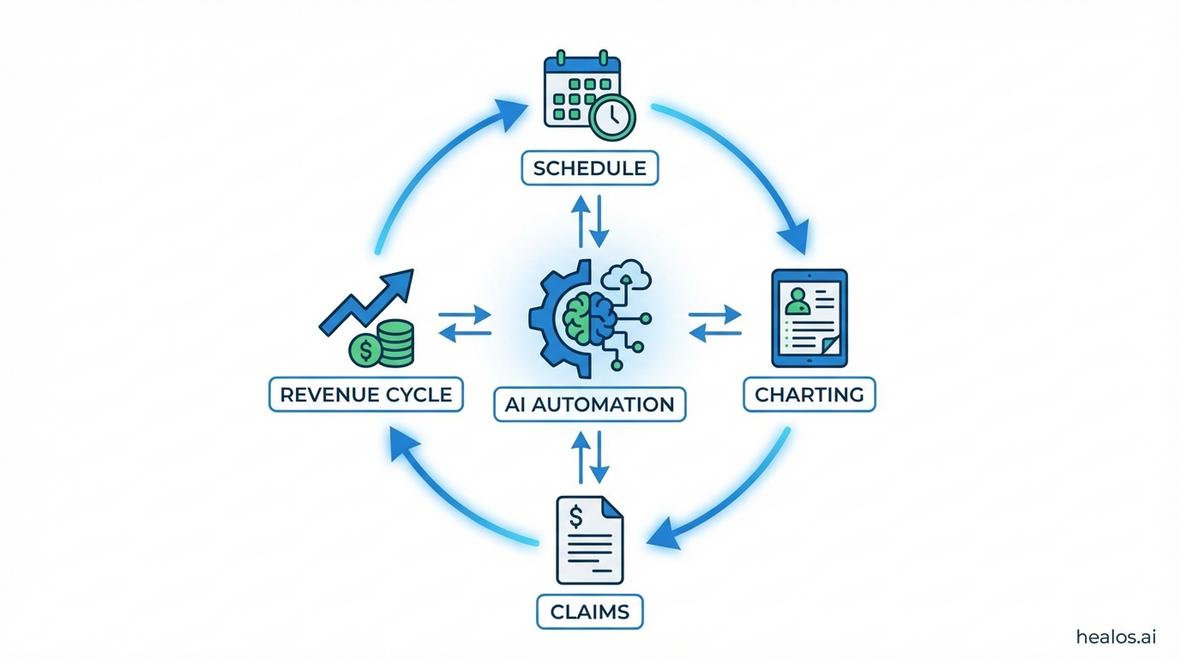
Effective medical administrative automation encompasses several interconnected domains:
- Front Office Automation: Patient intake, AI receptionist services, appointment scheduling, and insurance verification
- Clinical Documentation:AI scribe technology, ambient clinical documentation, and automated charting workflows
- Revenue Cycle Management: Claims processing, denial management, payment posting, and AR follow-up
- Back Office Operations: Referral management, prior authorization processing, and document automation
Research demonstrates that PDCA cycle reduced administrative processing time from 10.87 to 1.24 days in hospital settings, validating the transformative impact of systematic digital automation on healthcare administration.
Primary Pain Points Solved by Medical Administrative Automation
For overwhelmed practice managers, medical administrative automation directly addresses the three critical pain points threatening practice viability in 2026: staffing shortages, provider burnout, and revenue leakage.
Addressing Critical Staffing Shortages
The healthcare workforce crisis intensified dramatically post-pandemic. Medical assistants, front desk staff, and billing specialists remain exceptionally difficult to recruit and retain. Medical administrative automation provides immediate relief by:
- Eliminating the need to backfill administrative positions during turnover periods
- Allowing existing staff to focus on high-value patient interactions rather than data entry
- Scaling practice capacity without proportional increases in administrative headcount
- Reducing training burden as AI agents require configuration rather than extensive onboarding
Practices implementing comprehensive automation report 40-60% reductions in administrative time requirements, equivalent to eliminating 2-3 full-time positions in a 5-provider practice.
Reducing Provider Burnout Through Documentation Automation
Provider burnout stems primarily from excessive administrative burden, particularly clinical documentation. The average physician spends 2-3 hours on charting for every hour of direct patient care. Medical administrative automation transforms this ratio through:
- Ambient documentation: AI scribes capture clinical conversations and generate structured notes automatically
- Intelligent charting:Custom note templates adapt to provider preferences and specialty requirements
- Automated coding: AI agents suggest appropriate CPT and ICD-10 codes based on documentation
- EHR integration: Direct data flow eliminates manual data entry across systems
According to AI tools streamline administrative tasks and optimize workflows, with medium-quality evidence supporting improved diagnostic accuracy and reduced documentation errors.
Improving Financial Health and Reducing Claim Denials
Revenue leakage from claim denials costs the average practice 5-10% of potential revenue annually. Medical administrative automation addresses this through:
- Pre-submission scrubbing: AI agents validate claims against payer rules before submission
- Automated eligibility verification: Real-time insurance verification prevents coverage issues
- Denial pattern analysis: Machine learning identifies recurring denial reasons and implements preventive workflows
- Accelerated follow-up: Automated AR management reduces days in receivables by 30-40%
Practices using comprehensive revenue cycle management automation report first-pass claim acceptance rates exceeding 95%, compared to industry averages of 75-80%.
Key Areas for Medical Administrative Automation Implementation
Strategic implementation requires prioritizing automation in areas delivering maximum ROI and operational impact. For overwhelmed practice managers, these domains warrant immediate attention.
Front Office Automation: The Patient-Facing Foundation
Front office operations represent the first touchpoint for patients and the initial data collection point for revenue cycle workflows. Automation here delivers compounding benefits:
Patient Intake and Registration: Digital intake forms with intelligent field validation reduce errors by 70% compared to manual entry. AI-powered intake systems pre-populate fields from insurance cards, verify data against payer databases, and flag potential coverage issues before appointments.
Appointment Scheduling and Reminders: AI receptionists handle appointment booking via phone, text, and web portals. Automated reminder systems reduce no-show rates from industry averages of 18-20% to below 8%, directly improving revenue capture and schedule efficiency.
Insurance Verification: Real-time eligibility checks conducted automatically 48-72 hours before appointments eliminate surprise denials. Automated verification covers benefits, copays, deductibles, and authorization requirements without staff intervention.
Clinical Documentation Automation: Reclaiming Provider Time
Clinical documentation consumes more provider time than any other administrative task. Modern medical administrative automation transforms this burden:
Ambient Clinical Intelligence: Advanced AI scribes listen to patient-provider conversations, identify clinical concepts, and generate structured SOAP notes automatically. Providers review and sign notes in 60-90 seconds rather than spending 10-15 minutes per patient on manual documentation.
Specialty-Specific Templates: Unlike generic transcription, intelligent automation adapts to specialty workflows. A cardiology practice receives cardiovascular-specific templates while a psychiatry practice gets mental health-focused documentation structures.
Coding Assistance: AI agents analyze completed documentation and recommend appropriate billing codes, reducing coding errors and ensuring documentation supports selected codes for audit defense.
Revenue Cycle Automation: Accelerating Cash Flow
Revenue cycle inefficiencies directly impact practice financial health. Medical administrative automation delivers measurable improvements across the billing lifecycle:
Automated Claims Processing: AI agents generate claims from clinical documentation, validate against payer requirements, and submit electronically without manual review. Claims reach payers within 24 hours of service delivery rather than the 5-7 day industry average.
Denial Management: When denials occur, intelligent denial management systems categorize reasons, generate appeals with supporting documentation, and resubmit automatically. This reduces denial resolution time from 30-45 days to 7-10 days.
Payment Posting and Reconciliation: Automated payment posting matches EOBs to claims, posts payments, and identifies underpayments requiring follow-up. This eliminates 80-90% of manual posting work and accelerates reconciliation.
Back Office Automation: Supporting Seamless Operations
Back office functions create bottlenecks when handled manually. Automation here eliminates delays and reduces administrative burden:
Prior Authorization Processing: AI agents extract clinical information from charts, complete payer authorization forms, and submit requests automatically. Prior authorization automation reduces turnaround time from 7-14 days to 2-3 days.
Referral Management: Automated referral workflows track outgoing referrals, verify specialist receipt, and follow up on completed consultations. This ensures care coordination without manual tracking spreadsheets.
Document Processing:Fax automation and EOB extraction eliminate manual document handling, automatically routing information to appropriate workflows and extracting structured data from unstructured documents.
Strategic Implementation: A Roadmap for Practice Managers
Successful medical administrative automation requires strategic planning, phased implementation, and change management. This roadmap guides overwhelmed practice managers through the deployment process.
Phase 1: Workflow Assessment and Prioritization
Begin by documenting current administrative workflows and identifying high-impact automation opportunities:
- Time tracking: Have staff log time spent on administrative tasks for 2 weeks to establish baseline metrics
- Bottleneck identification: Map patient and data flows to identify manual handoffs and delays
- Cost analysis: Calculate fully-loaded staff costs for administrative functions to quantify automation ROI
- Priority ranking: Rank opportunities by ROI potential, implementation complexity, and staff pain points
Phase 2: Vendor Selection and Integration Planning
Choose automation platforms based on integration capabilities, specialty fit, and unified functionality. Key evaluation criteria include:
- EHR integration depth: Direct API connections eliminate data re-entry and ensure real-time synchronization
- Unified platform approach: Single-vendor solutions reduce integration complexity and vendor management overhead
- Specialty-specific capabilities: Ensure the platform supports your specialty workflows and documentation requirements
- Implementation support: Evaluate vendor training, configuration assistance, and ongoing support offerings
Platforms like HealOS offer unified agent architectures that integrate front office, clinical, and revenue cycle automation through a single implementation.
Phase 3: Pilot Deployment and Optimization
Start with a limited pilot to validate ROI and refine workflows before practice-wide rollout:
- Select pilot scope: Choose 1-2 providers or a single administrative function for initial deployment
- Configure workflows: Customize templates, approval processes, and integration points to match practice operations
- Train users: Provide hands-on training for affected staff and establish feedback mechanisms
- Measure results: Track time savings, error rates, and user satisfaction weekly during the pilot
- Refine and scale: Address issues identified during pilot before expanding to full practice
Phase 4: Full Practice Deployment and Continuous Improvement
Expand automation across the practice while establishing ongoing optimization processes:
- Phased rollout: Deploy to additional providers and functions in 2-week intervals to manage change
- Performance monitoring: Establish dashboards tracking key metrics like claim acceptance rates, documentation time, and patient satisfaction
- Staff redeployment: Redirect staff freed from administrative tasks to patient engagement and care coordination roles
- Iterative refinement: Review automation performance monthly and adjust workflows based on results
Measuring ROI: Quantifying Medical Administrative Automation Benefits
Practice managers must justify automation investments through clear ROI metrics. Medical administrative automation delivers returns across multiple dimensions.
Direct Cost Savings
Calculate hard dollar savings from reduced administrative staffing requirements:
- Eliminated positions: Average practice saves $120,000-180,000 annually per avoided FTE hire
- Overtime reduction: Automation eliminates 80-90% of overtime hours during peak periods
- Reduced turnover costs: Lower administrative burden improves retention, saving $30,000-50,000 per avoided turnover
Revenue Improvements
Quantify revenue gains from improved billing efficiency and reduced denials:
- Accelerated collections: 30-40% reduction in days in AR improves cash flow by $50,000-100,000 for mid-sized practices
- Denial reduction: 5-10% decrease in denial rates captures an additional $75,000-150,000 annually
- Increased patient volume: Providers seeing 2-3 additional patients daily generate $200,000-300,000 in additional annual revenue
Productivity Gains
Calculate value of reclaimed provider and staff time:
- Provider time savings: 1-2 hours daily per provider valued at $150,000-300,000 annually for improved work-life balance or additional revenue
- Staff productivity: 40-60% reduction in administrative time allows 2-3 FTEs to handle work previously requiring 5-6 staff members
Why HealOS: The Unified Agent Approach to Medical Administrative Automation
Traditional healthcare automation requires piecing together multiple point solutions, each with separate contracts, integrations, and support relationships. This fragmented approach creates new administrative burdens while attempting to solve existing ones. HealOS delivers a fundamentally different architecture through its unified agent platform.
Seamless EHR Integration
HealOS maintains direct API integrations with major EHR platforms, enabling bidirectional data flow without manual intervention. Clinical documentation flows automatically into charts, eligibility verification updates patient records in real-time, and claims data synchronizes instantly. This eliminates the data re-entry that plagues many automation implementations.
Unified Agent Platform
Rather than separate products for front office, clinical documentation, and revenue cycle management, HealOS deploys specialized AI agents that communicate and collaborate within a unified platform. The AI receptionist shares data with the billing agent, which coordinates with the denial management agent, creating seamless workflows that mirror practice operations.
Specialty-Specific Optimization
Whether you operate a group practice, pediatric clinic, or virtual care operation, HealOS adapts to your specialty workflows and documentation requirements without extensive customization. Pre-configured templates and workflows accelerate implementation while maintaining flexibility for practice-specific needs.
Frequently Asked Questions About Medical Administrative Automation
How long does medical administrative automation implementation take?
Implementation timelines vary by scope, but most practices achieve initial automation within 2-4 weeks. A phased approach starting with high-impact areas like clinical documentation or front office automation delivers quick wins while building toward comprehensive automation over 2-3 months.
What ROI can practices expect from administrative automation?
Typical ROI ranges from 300-500% in the first year, driven by reduced staffing costs, improved collections, and increased provider productivity. Mid-sized practices commonly save $150,000-300,000 annually while improving patient satisfaction and provider work-life balance.
Does automation replace existing staff?
Medical administrative automation eliminates repetitive tasks rather than positions. Most practices redeploy staff to higher-value activities like patient engagement, care coordination, and complex problem resolution. Natural attrition addresses staffing reductions when necessary, avoiding layoffs.
How does automation handle exceptions and complex cases?
Modern AI agents escalate exceptions to staff for review rather than attempting to force-fit every scenario into automated workflows. This hybrid approach delivers 80-90% straight-through processing while ensuring appropriate human oversight for complex situations.
What about data security and HIPAA compliance?
Reputable medical administrative automation platforms maintain full HIPAA compliance, including business associate agreements, encrypted data transmission, and secure cloud infrastructure. Ensure your vendor provides SOC 2 Type II certification and clear compliance documentation.
Conclusion
Medical administrative automation represents the most effective strategy for overwhelmed practice managers facing staffing shortages, provider burnout, and revenue pressures in 2026. By systematically automating front office operations, clinical documentation, and revenue cycle management, practices scale efficiently without proportional increases in administrative headcount. The evidence is clear: practices implementing comprehensive automation reduce administrative time by 40-60%, improve claim acceptance rates to 95%+, and reclaim 1-2 hours daily per provider for patient care. For practice managers committed to operational efficiency and financial health, medical administrative automation isn't optional it's essential for sustainable growth in modern healthcare delivery.