
Medical AI Receptionist: The Complete 2026 Guide To Automating Front Desk Workflows And Scaling Without Hiring

Introduction
The administrative burden on healthcare practices has reached a breaking point. Physicians spend twice as much time on documentation and administrative tasks as they do with patients, leading to widespread burnout and operational inefficiency. For practice managers facing staffing shortages, rising labor costs, and increasing patient demand, the traditional front desk model is no longer sustainable. This is where a medical AI receptionist becomes not just a helpful tool, but a strategic necessity.
A medical AI receptionist is an intelligent automation solution designed to handle core front-office functions appointment scheduling, patient intake, insurance verification, call management, and EHR synchronization without human intervention. By deploying this technology, overwhelmed practice managers can automate repetitive workflows, reduce operational costs, and scale patient access without increasing headcount. The result is improved financial health through reduced claim denials, enhanced operational efficiency, and liberation of staff to focus on high-value patient care activities.
This comprehensive guide explores how medical AI receptionists work, their strategic benefits for practice managers, key implementation considerations, and how to select the right solution with a particular focus on unified agent platforms like HealOS that integrate seamlessly with existing EHR systems.
What Is a Medical AI Receptionist?
A medical AI receptionist is an artificial intelligence-powered system that performs front-office administrative tasks traditionally handled by human receptionists. Unlike basic chatbots or simple scheduling tools, modern medical AI receptionists leverage natural language processing, machine learning, and deep EHR integration to manage complex workflows autonomously.
Core Capabilities of Medical AI Receptionists
- 24/7 Appointment Scheduling: Patients can book, reschedule, or cancel appointments at any time through voice, text, or web interfaces without staff intervention.
- Intelligent Call Management: The AI handles inbound calls, triages patient needs, answers frequently asked questions, and routes urgent matters appropriately.
- Automated Patient Intake: Digital forms are sent, completed, and automatically uploaded to the EHR, eliminating manual data entry.
- Insurance Verification: Real-time eligibility checks ensure coverage information is accurate before appointments, reducing claim denials.
- Seamless EHR Synchronization: All patient interactions, appointments, and documentation sync bidirectionally with your practice management system.
- Follow-Up Automation: Automated reminders, post-visit instructions, and recall notifications improve patient compliance and reduce no-shows.
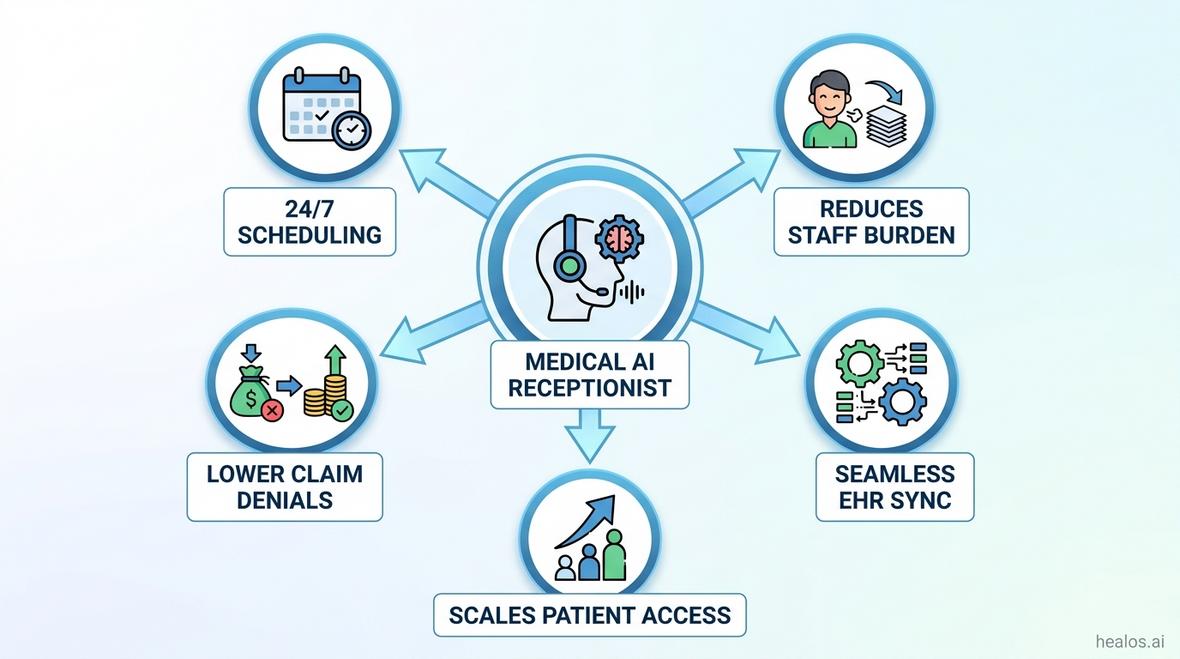
The image above illustrates how a medical AI receptionist delivers measurable value: 24/7 scheduling, reduced staff burden, seamless EHR sync, scalable patient access, and lower claim denials all critical for overwhelmed practice managers seeking operational efficiency.
Why Practice Managers Need Medical AI Receptionists Now
Practice managers face a perfect storm of challenges: staffing shortages, provider burnout, financial pressure from claim denials, and patient demand for convenient access. According to a CDC National Health Statistics Report, physicians spend 2 hours on EHR and administrative tasks for every 1 hour of patient care a ratio that contributes directly to burnout and operational inefficiency.
Addressing Staffing Shortages and Rising Labor Costs
Hiring and retaining qualified front desk staff has become increasingly difficult and expensive. Turnover rates in medical reception roles often exceed 30% annually, creating constant recruitment and training costs. A medical AI receptionist eliminates this cycle by providing consistent, reliable performance without vacations, sick days, or turnover. For practices operating on tight margins, the cost savings are substantial AI receptionists typically cost a fraction of a full-time employee's salary and benefits.
Reducing Provider Burnout Through Administrative Relief
When front desk staff are overwhelmed, administrative burdens overflow to clinical teams. Providers spend valuable time answering scheduling questions, clarifying insurance issues, and managing patient communications. By automating these workflows with a medical AI receptionist, practices free clinical staff to focus on patient care, improving job satisfaction and reducing burnout.
Improving Financial Health by Reducing Claim Denials
Insurance verification errors are a leading cause of claim denials, which directly impact practice revenue. A medical AI receptionist performs real-time eligibility checks before every appointment, ensuring accurate coverage information is captured. This proactive verification reduces denials, accelerates reimbursement cycles, and improves cash flow critical metrics for practice managers responsible for financial performance.
Scaling Patient Access Without Increasing Headcount
Growth-oriented practices face a dilemma: how to serve more patients without proportionally increasing staff. A medical AI receptionist solves this by handling unlimited concurrent interactions. Whether managing 10 or 100 calls simultaneously, the AI maintains consistent service quality, enabling practices to scale patient volume profitably. Solutions like HealOS AI Receptionist provide this scalability through unified agent architecture.
Key Features to Look for in a Medical AI Receptionist
Not all medical AI receptionists are created equal. Practice managers should evaluate solutions based on specific features that directly address operational pain points and strategic goals.
Seamless EHR Integration
The most critical feature is deep, bidirectional EHR integration. Your medical AI receptionist should synchronize appointments, patient demographics, insurance information, and clinical notes automatically without manual data entry. Platforms like HealOS Integrations support major EHR systems, ensuring smooth workflows regardless of your existing technology stack.
Natural Language Processing and Voice AI
Patients expect natural, conversational interactions not robotic scripts. Advanced Voice AI technology enables the medical AI receptionist to understand intent, context, and even accents, providing a human-like experience. This capability is essential for patient satisfaction and adoption rates.
Intelligent Call Routing and Triage
A sophisticated medical AI receptionist doesn't just answer calls it triages them intelligently. Routine inquiries are handled autonomously, while urgent medical concerns are escalated to clinical staff immediately. This ensures critical issues receive prompt attention while routine tasks are automated. Explore Medical Answering services for more on intelligent call management.
Automated Patient Intake and Forms Management
Manual data entry from paper forms is time-consuming and error-prone. A modern medical AI receptionist sends digital intake forms automatically, collects responses, and populates the EHR before the patient arrives. This streamlines check-in processes and improves data accuracy. Learn more about AI-powered patient intake solutions.
Real-Time Insurance Verification
Preventing claim denials starts at scheduling. Your medical AI receptionist should verify insurance eligibility in real-time during appointment booking, flagging coverage issues before they become billing problems. Automated eligibility verification is a core component of revenue cycle optimization.
Automated Appointment Reminders and Follow-Up
No-shows cost practices thousands of dollars monthly. A medical AI receptionist sends personalized reminders via text, email, or voice, and can even initiate follow-up calls for post-visit care instructions or recall appointments, improving compliance and patient outcomes.
Implementation Considerations for Practice Managers
Successfully deploying a medical AI receptionist requires strategic planning and change management. Practice managers should approach implementation methodically to maximize adoption and ROI.
Assessing Practice Readiness
Before implementation, evaluate your current workflows to identify the highest-impact automation opportunities. Which front desk tasks consume the most staff time? Where do errors most frequently occur? Prioritize automating these areas first. Practices with high call volumes, frequent scheduling changes, or complex insurance requirements typically see the fastest ROI.
Staff Training and Change Management
Introducing a medical AI receptionist changes job roles, which can create anxiety among staff. Communicate early and often about how the technology will reduce burden, not eliminate jobs. Position the AI as a tool that handles repetitive tasks so staff can focus on complex problem-solving and patient relationship building. Involve front desk staff in configuration and testing to build ownership and expertise.
Patient Communication and Adoption
Patients need clear communication about new interaction channels. Announce the medical AI receptionist through multiple touchpoints website updates, email newsletters, in-office signage, and during check-out. Emphasize benefits like 24/7 scheduling convenience and faster service. Offer traditional phone support as a backup during the transition period to maintain confidence.
Measuring Success and ROI
Define success metrics before launch: call handling time, appointment booking rates, no-show percentages, staff overtime hours, and claim denial rates. Track these metrics monthly to quantify ROI and identify optimization opportunities. Most practices see measurable improvements within 60-90 days. Platforms like HealOS RCM provide integrated analytics to track financial performance.
HealOS: The Unified Agent Approach to Medical AI Receptionists
While point solutions address individual front desk functions, unified agent platforms offer a more strategic approach. HealOS exemplifies this philosophy by integrating medical AI receptionist capabilities with clinical documentation, revenue cycle management, and administrative automation in a single platform.
Why Unified Agents Matter
Disconnected point solutions create data silos, integration headaches, and fragmented workflows. A unified agent approach means your medical AI receptionist shares context with your AI scribe, billing automation, and referral management systems. When a patient schedules an appointment, the system automatically verifies insurance, sends intake forms, prepares clinical documentation templates, and updates billing workflows all without manual handoffs.
Seamless EHR Integration
HealOS supports bidirectional integration with major EHR platforms, ensuring appointment data, patient demographics, clinical notes, and billing information flow seamlessly across systems. This eliminates duplicate data entry, reduces errors, and maintains a single source of truth. For practice managers, this integration is the difference between a disruptive implementation and a smooth transition.
Specialty-Specific Configurations
Different specialties have unique scheduling, intake, and communication requirements. HealOS offers configurations tailored to pediatrics, psychiatry, cardiology, and other specialties, ensuring the medical AI receptionist understands specialty-specific workflows, terminology, and patient needs.
Comparing Medical AI Receptionist Solutions
The market offers numerous medical AI receptionist platforms, each with distinct strengths and limitations. Practice managers should evaluate options based on integration depth, feature breadth, pricing transparency, and specialty fit.
Standalone Scheduling Tools vs. Unified Platforms
Simple scheduling tools offer basic appointment booking but lack intelligence, EHR integration, and broader workflow automation. Unified platforms like HealOS provide end-to-end automation from initial patient contact through billing and follow-up. For practices seeking comprehensive transformation rather than incremental improvement, unified platforms deliver superior ROI.
Voice AI Capabilities
Not all AI receptionists handle phone calls effectively. Solutions with advanced voice AI can manage natural conversations, understand context, and handle complex requests autonomously. This capability is critical for practices where phone remains the primary patient communication channel. Evaluate HealOS comparison pages to see how different solutions stack up.
Pricing Models and Total Cost of Ownership
Medical AI receptionist pricing varies widely from per-appointment fees to flat monthly subscriptions. Consider total cost of ownership including implementation, training, and ongoing support. Solutions with transparent pricing and flexible scaling options provide better budget predictability. HealOS offers straightforward pricing aligned with practice size and usage.
Real-World Impact: How Medical AI Receptionists Transform Practices
Beyond theoretical benefits, medical AI receptionists deliver measurable operational and financial improvements across diverse practice settings.
Reducing Staff Overtime and Burnout
Practices report 40-60% reductions in front desk overtime after implementing medical AI receptionists. By automating after-hours call management, weekend appointment requests, and routine inquiries, the AI relieves pressure on human staff. This reduces burnout, improves retention, and enhances workplace culture critical for practice managers struggling with turnover.
Improving Patient Satisfaction Scores
Patients value convenience and responsiveness. Medical AI receptionists provide instant answers, 24/7 scheduling access, and consistent service quality all of which boost patient satisfaction scores. Practices using AI receptionists report higher patient retention rates and increased positive online reviews, which drive new patient acquisition.
Accelerating Revenue Cycles
By verifying insurance at scheduling and ensuring accurate intake data, medical AI receptionists reduce claim denials and accelerate reimbursement cycles. Practices report 15-30% improvements in first-pass claim acceptance rates, translating directly to improved cash flow and financial stability. Combine this with insurance automation tools for maximum revenue cycle optimization.
The Future of Medical AI Receptionists in Healthcare
The capabilities of medical AI receptionists continue to expand rapidly. Emerging trends include predictive scheduling based on patient history, proactive outreach for preventive care, multilingual support, and deeper integration with telehealth platforms. As AI technology advances, medical AI receptionists will transition from reactive task automation to proactive patient engagement and population health management.
For practice managers, the strategic question is not whether to adopt AI receptionists, but when and which platform to choose. Early adopters gain competitive advantages through operational efficiency, superior patient experience, and financial performance. As patient expectations evolve and labor markets tighten, practices without intelligent automation will struggle to compete.
Frequently Asked Questions
How much does a medical AI receptionist cost compared to hiring staff?
Medical AI receptionists typically cost between $200-$800 monthly depending on features and practice size, compared to $35,000-$50,000 annually for a full-time receptionist including benefits. The cost savings are substantial, especially for multi-location practices needing extended hours coverage.
Will patients accept interacting with an AI instead of a human?
Studies show that when AI interactions are natural and efficient, patient acceptance rates exceed 85%. Patients value convenience and speed over human interaction for routine tasks like scheduling. Offering both AI and human options during transition periods builds confidence and adoption.
How long does implementation take?
Basic medical AI receptionist implementation typically requires 2-6 weeks including EHR integration, workflow configuration, staff training, and patient communication. Practices with standard workflows and supported EHR systems can often go live faster. Complex multi-specialty or multi-location practices may require longer implementation timelines.
Can a medical AI receptionist handle complex medical questions?
Medical AI receptionists are designed to handle administrative tasks, not provide medical advice. They can answer common questions about office hours, insurance, forms, and general procedures. Clinical questions are escalated to appropriate clinical staff immediately through intelligent triage protocols.
What happens if the AI system goes down?
Reputable medical AI receptionist platforms maintain 99.9% uptime with redundant systems and failover protocols. Most solutions include automatic fallback to human answering services or voicemail during outages, ensuring patients can always reach your practice. Evaluate vendor SLAs and disaster recovery plans during selection.
How does a medical AI receptionist integrate with my existing EHR?
Integration approaches vary by platform and EHR system. Leading solutions like HealOS offer native integrations with major EHR platforms through APIs, enabling bidirectional data synchronization. Some systems require middleware or custom integration work. Verify integration capabilities with your specific EHR during vendor evaluation.
Conclusion
For overwhelmed practice managers facing staffing shortages, provider burnout, and operational inefficiency, a medical AI receptionist is not a luxury it's a strategic imperative. By automating front desk workflows, these intelligent systems reduce administrative burden, improve financial health through lower claim denials, and enable practices to scale patient access without increasing headcount. The key is selecting a solution with seamless EHR integration and unified agent architecture, like HealOS, that transforms isolated point solutions into comprehensive workflow automation. As healthcare continues its digital transformation, practices that embrace intelligent automation today will lead their markets tomorrow. The question is not whether to adopt a medical AI receptionist, but how quickly you can implement one to gain competitive advantage.