
Medical Coding AI Tools: The Complete 2026 Guide To Automating Coding, Reducing Denials & Scaling Your Practice

Introduction
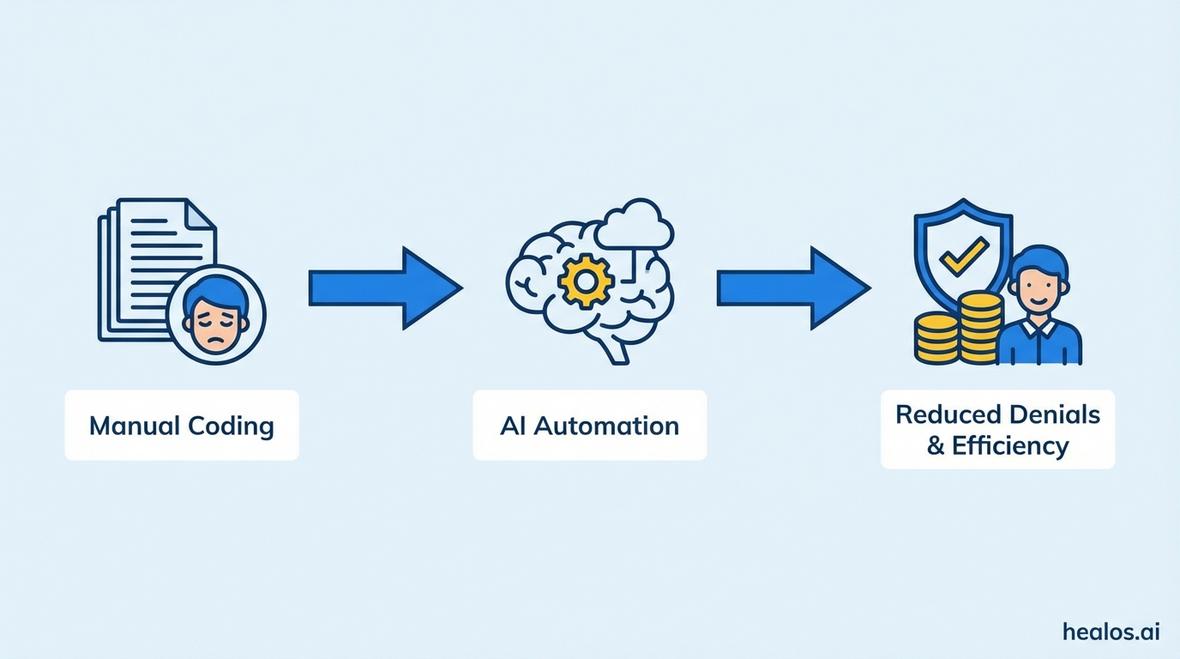
For overwhelmed practice managers, the daily grind of medical coding can feel like an uphill battle. Staffing shortages, mounting claim denials, and provider burnout from excessive charting are more than operational headaches they threaten the financial health and scalability of your practice. Enter medical coding ai tools, a transformative solution that automates complex coding workflows, reduces errors, and frees your team to focus on patient care instead of administrative drudgery.
According to industry research, the U.S. AI coding market at $982M in 2025, with the U.S. dominating at USD 982.06 million in 2025, up from USD 866.55 million in 2024. This explosive growth underscores how hospitals and clinics are betting on AI to achieve operational scalability. As the medical coding market valued at $20.8B in 2026, reaching $30.44B by 2030, projected at a 10% CAGR, the message is clear: automated solutions are no longer optional they are strategic imperatives.
This guide dives deep into how medical coding ai tools work, their tangible benefits for practice managers, and how platforms like HealOS deliver seamless EHR integration and unified AI agents to streamline your revenue cycle. Whether you are battling claim denials or looking to scale without adding headcount, this article equips you with the insights to make informed decisions in 2026.
What Are Medical Coding AI Tools?
Medical coding AI tools leverage advanced machine learning and natural language processing (NLP) to automatically extract clinical details from provider notes, assign appropriate ICD-10, CPT, and HCPCS codes, and flag inconsistencies before claims submission. Unlike traditional manual coding, which relies heavily on human coders to interpret clinical documentation, AI-driven platforms analyze unstructured data in real time, ensuring faster turnaround and higher accuracy.
At their core, these tools use AI NLP extracts codes from notes, flags inconsistencies, reducing errors and enhancing compliance. By automating repetitive tasks such as code lookup, cross-referencing payer rules, and identifying missing documentation, medical coding ai tools enable your team to process claims more efficiently and with fewer denials.
Key capabilities include:
- Automated Code Extraction: AI reads clinician notes and suggests the most accurate codes based on documentation.
- Real-Time Validation: Tools cross-check codes against payer guidelines and flag potential denials before submission.
- Compliance Monitoring: Built-in rules engines ensure adherence to CMS regulations and evolving coding standards.
- Seamless EHR Integration: Platforms like HealOS RCM connect directly to your existing EHR, eliminating data silos and manual re-entry.
Why Practice Managers Need Medical Coding AI Tools in 2026
The operational pain points faced by practice managers today are systemic: understaffed coding departments, rising claim denial rates, and providers spending more time on documentation than patient interaction. According to multiple pilot studies, AI pilots show gains in coding speed and accuracy, with 2024-2025 pilots proving AI boosts coding speed and accuracy for trained coders, supporting RCM market growth through 2026.
Addressing Staffing Shortages and Provider Burnout
One of the most pressing challenges for practice managers is the inability to hire and retain qualified medical coders. With a national shortage of certified professionals, even well-funded practices struggle to maintain adequate staffing levels. Medical coding ai tools serve as force multipliers, enabling smaller teams to handle larger claim volumes without sacrificing quality or compliance.
Moreover, by automating routine coding tasks, AI frees up existing staff to focus on complex cases, appeals, and patient inquiries activities that require human judgment and empathy. This shift not only improves job satisfaction but also reduces burnout among providers who no longer need to spend hours after clinic verifying codes and modifiers.
Reducing Claim Denials and Improving Cash Flow
Claim denials are a silent killer of practice profitability. Even a small percentage increase in denials can translate to significant revenue loss when multiplied across thousands of encounters. AI-powered coding platforms dramatically reduce denial rates by:
- Flagging incomplete or inconsistent documentation before claim submission.
- Ensuring code specificity to meet payer requirements (e.g., laterality, manifestation codes).
- Validating medical necessity and matching procedure codes to diagnosis codes.
Research shows that AI streamlines coding for revenue cycle efficiency, transforming revenue cycle operations by automating complex coding tasks and improving speed and accuracy across hospitals and clinics. For a practice manager focused on financial health, this translates directly to faster reimbursements, improved cash flow, and fewer resources spent on rework and appeals.
Top Benefits of Medical Coding AI Tools for Practice Managers
Deploying medical coding ai tools offers a suite of operational and financial advantages that align perfectly with the priorities of overwhelmed practice managers. Below, we break down the key benefits that make AI adoption a strategic imperative in 2026.
Operational Efficiency and Scalability
AI tools process claims at speeds unattainable by human coders. What once took hours reviewing documentation, cross-referencing coding manuals, and validating payer rules now happens in seconds. This efficiency allows practices to scale their operations without proportionally increasing administrative headcount. For instance, platforms like HealOS Revenue Cycle Management provide unified AI agents that handle coding, claims scrubbing, and denial management in a single workflow, eliminating handoffs and reducing cycle times.
Enhanced Accuracy and Compliance
Manual coding is inherently error-prone, with studies showing error rates as high as 10-15% in some specialties. AI-driven NLP models, trained on millions of clinical encounters, achieve accuracy rates exceeding 95% in pilot deployments. By continuously learning from payer feedback and regulatory updates, these tools adapt to changing coding guidelines (such as annual ICD-10 updates) without requiring manual retraining.
Compliance is another critical advantage. With built-in auditing capabilities, medical coding ai tools provide detailed logs of code assignments, making it easier to respond to audits and demonstrate adherence to CMS and commercial payer requirements. This transparency reduces legal risk and protects your practice from costly penalties.
Cost Savings and ROI
The financial case for AI is compelling. While traditional coding departments require salaries, benefits, training, and ongoing education, AI platforms operate on predictable subscription models with minimal overhead. Early adopters report ROI within 6-12 months, driven by reduced denials, faster collections, and labor savings. For practices operating on thin margins, these savings can be redirected toward patient care initiatives or strategic growth investments.
Seamless EHR Integration
One of the standout features of leading medical coding ai tools is their ability to integrate directly with existing EHR systems. HealOS Integrations support major platforms like Epic, Cerner, and Athenahealth, ensuring that coded data flows seamlessly into billing modules without manual intervention. This eliminates data silos, reduces duplicate entry, and accelerates the entire revenue cycle from encounter to payment.
How Medical Coding AI Tools Work: The Technical Foundation
Understanding the technical underpinnings of medical coding ai tools helps practice managers appreciate their capabilities and limitations. At a high level, these platforms rely on three core technologies: natural language processing (NLP), machine learning (ML), and rules-based engines.
Natural Language Processing for Code Extraction
NLP algorithms parse unstructured clinical notes progress notes, H&Ps, operative reports and extract key clinical concepts such as diagnoses, procedures, medications, and anatomical sites. Advanced models can even interpret context, distinguishing between 'history of diabetes' and 'active diabetes management' to assign the correct codes.
Machine Learning for Code Validation
Once codes are extracted, ML models validate them against historical claim data, payer policies, and coding guidelines. These models continuously improve as they process more claims, learning which code combinations are accepted or denied by specific payers. Over time, this results in higher first-pass acceptance rates and fewer rejections.
Rules-Based Engines for Compliance
In addition to ML, most platforms incorporate rules-based engines that enforce hard-coded compliance checks such as ensuring a procedure code is paired with a valid diagnosis, or flagging unbundled services that should be billed together. This layered approach combines the flexibility of AI with the reliability of deterministic logic, delivering both innovation and safety.
Choosing the Right Medical Coding AI Tool: Key Considerations
Not all medical coding ai tools are created equal. When evaluating platforms, practice managers should prioritize the following factors to ensure alignment with their operational needs and strategic goals.
EHR Compatibility and Integration Depth
Confirm that the AI tool integrates natively with your EHR. Surface-level integrations (e.g., file exports) add friction and manual steps, negating many efficiency gains. Look for vendors offering bi-directional APIs that enable real-time data exchange and automated workflows. HealOS AI Scribe, for example, supports deep integrations that allow coding suggestions to populate directly within the EHR encounter screen.
Specialty-Specific Training and Customization
AI models trained on general medical data may underperform in specialized practices. Ensure the vendor has experience and training data in your specialty whether it is cardiology, orthopedics, psychiatry, or oncology. Specialty-specific coding nuances, such as modifier usage and bundled procedures, require tailored training to achieve high accuracy.
Transparency and Explainability
AI is often criticized as a 'black box.' Choose platforms that provide clear explanations for code assignments, including references to the supporting clinical documentation. This transparency is essential for audits, appeals, and building trust with your coding team.
Scalability and Vendor Support
As your practice grows, your AI tool should scale effortlessly. Evaluate vendor support models, including onboarding, training, and ongoing optimization. Vendors offering dedicated account management and proactive performance monitoring are more likely to deliver sustained value over time.
HealOS and the Unified AI Agent Approach
For practice managers seeking a holistic solution, HealOS stands out with its 'unified agent' architecture. Rather than deploying siloed AI tools for coding, scribing, and billing, HealOS integrates these functions into a single platform, enabling seamless handoffs and end-to-end automation across the revenue cycle.
Key differentiators include:
- AI-Powered Medical Scribe: Automatically generates clinical notes during patient encounters, feeding structured data directly into coding workflows.
- Claims Scrubbing: Pre-submission validation that flags errors and optimizes code selection for maximum reimbursement.
- Denial Management: Automated tracking and appeals generation for rejected claims, reducing AR days and improving collections.
- Customizable Workflows: Tailor AI agents to match your practice's unique documentation and billing requirements.
By centralizing these capabilities, HealOS eliminates the integration complexity and workflow friction that plague multi-vendor environments. For overwhelmed practice managers, this means fewer vendors to manage, faster time-to-value, and a single source of truth for performance analytics.
Real-World Impact: Case Studies and Pilot Results
The promise of medical coding ai tools is backed by real-world evidence from early adopters. Pilot programs across hospitals and clinics have demonstrated measurable improvements in coding speed, accuracy, and financial outcomes.
One multi-specialty group practice reported a 40% reduction in coding time per encounter after deploying AI, enabling their coding team to process 60% more claims with the same headcount. Another orthopedic clinic saw denial rates drop from 12% to 4% within six months, directly attributable to improved code specificity and pre-submission validation.
These results are not isolated. As noted earlier, AI pilots show gains in coding speed and accuracy, with trained coders leveraging AI to achieve higher throughput and fewer errors. For practice managers, these case studies provide a roadmap for successful implementation and set realistic expectations for ROI timelines.
Overcoming Implementation Challenges
While the benefits are clear, deploying medical coding ai tools is not without challenges. Practice managers must navigate change management, data quality issues, and staff training to ensure a smooth rollout.
Change Management and Staff Buy-In
Introducing AI into established workflows can trigger resistance, especially among experienced coders who fear job displacement. Address these concerns head-on by positioning AI as a tool that augments not replaces human expertise. Involve coding staff in pilot testing, solicit their feedback, and celebrate early wins to build momentum.
Data Quality and Documentation Improvement
AI is only as good as the data it processes. Incomplete or inconsistent clinical documentation will result in suboptimal coding suggestions. Use AI deployment as an opportunity to improve provider documentation habits, leveraging tools like HealOS Custom Notes to standardize note templates and capture necessary details.
Training and Continuous Optimization
Initial AI accuracy may be lower than expected, requiring iterative tuning based on your practice's claim history and payer mix. Partner with vendors who offer robust training and ongoing optimization services, and allocate internal resources to monitor performance and provide feedback loops.
Frequently Asked Questions About Medical Coding AI Tools
How accurate are medical coding AI tools?
Leading platforms achieve accuracy rates of 95% or higher in pilot deployments, particularly when trained on specialty-specific data. However, accuracy depends on documentation quality and proper integration with EHR workflows.
Will AI replace human coders?
No. AI is designed to augment human coders by automating routine tasks, allowing them to focus on complex cases, audits, and appeals. Human oversight remains essential for quality assurance and handling edge cases.
What is the cost of implementing medical coding AI tools?
Pricing varies by vendor and practice size, typically ranging from subscription fees per provider or per claim processed. Most practices achieve ROI within 6-12 months through reduced denials and labor savings.
Can AI tools integrate with any EHR?
Most leading platforms support major EHR systems, but integration depth varies. Confirm native API support and bi-directional data flow during vendor evaluations.
Are AI coding tools compliant with HIPAA and other regulations?
Reputable vendors design their platforms with HIPAA compliance, including encryption, access controls, and audit logging. Always verify compliance certifications before deployment.
Conclusion
For overwhelmed practice managers in 2026, medical coding ai tools represent a strategic lever to automate workflows, reduce claim denials, and scale operations without expanding headcount. With the U.S. AI coding market surpassing $982 million and projected to grow rapidly, the question is not whether to adopt AI, but when and how. Platforms like HealOS deliver seamless EHR integration, unified AI agents, and proven ROI, making them ideal partners for practices committed to financial health and operational efficiency. By addressing staffing shortages, enhancing coding accuracy, and improving cash flow, these tools empower practice managers to reclaim time, reduce provider burnout, and focus on what matters most: delivering exceptional patient care.