
Medical Scribe AI: The Complete Guide To Automating Clinical Documentation And Reducing Provider Burnout

Healthcare providers today face an unprecedented administrative crisis. Physicians spend an average of 16 minutes on documentation for every patient encounter, translating to nearly half their workday buried in electronic health records instead of focusing on patient care. This administrative overload is a primary driver of provider burnout, with over 60% of clinicians reporting emotional exhaustion directly linked to charting demands.
Enter medical scribe AI—an innovative technology transforming how healthcare practices handle clinical documentation. By leveraging artificial intelligence and ambient voice recognition, medical scribe AI automates note-taking, generates structured clinical documentation, and seamlessly integrates with EHR systems, allowing providers to reclaim their time and focus on what truly matters: delivering exceptional patient care.
For overwhelmed practice managers grappling with staffing shortages, provider burnout, and operational inefficiencies, medical scribe AI offers a powerful solution. This comprehensive guide explores how AI-powered scribes work, their measurable benefits, implementation strategies, and how they compare to traditional human scribes equipping you with the knowledge to make an informed decision for your practice.
What Is Medical Scribe AI?
Medical scribe AI is an advanced software solution that uses artificial intelligence, natural language processing (NLP), and ambient listening technology to automatically capture, transcribe, and structure clinical conversations into comprehensive medical notes. Unlike traditional medical scribes who physically accompany providers during patient encounters, AI scribes operate passively in the background, capturing dialogue in real-time and transforming it into EHR-ready documentation.
The technology leverages ambient voice recognition to listen to the natural conversation between provider and patient, identifying key clinical information such as symptoms, diagnoses, treatment plans, and follow-up instructions. The AI then structures this information into standardized formats such as SOAP notes, progress notes, or specialty-specific templates within seconds, drastically reducing the manual charting burden.
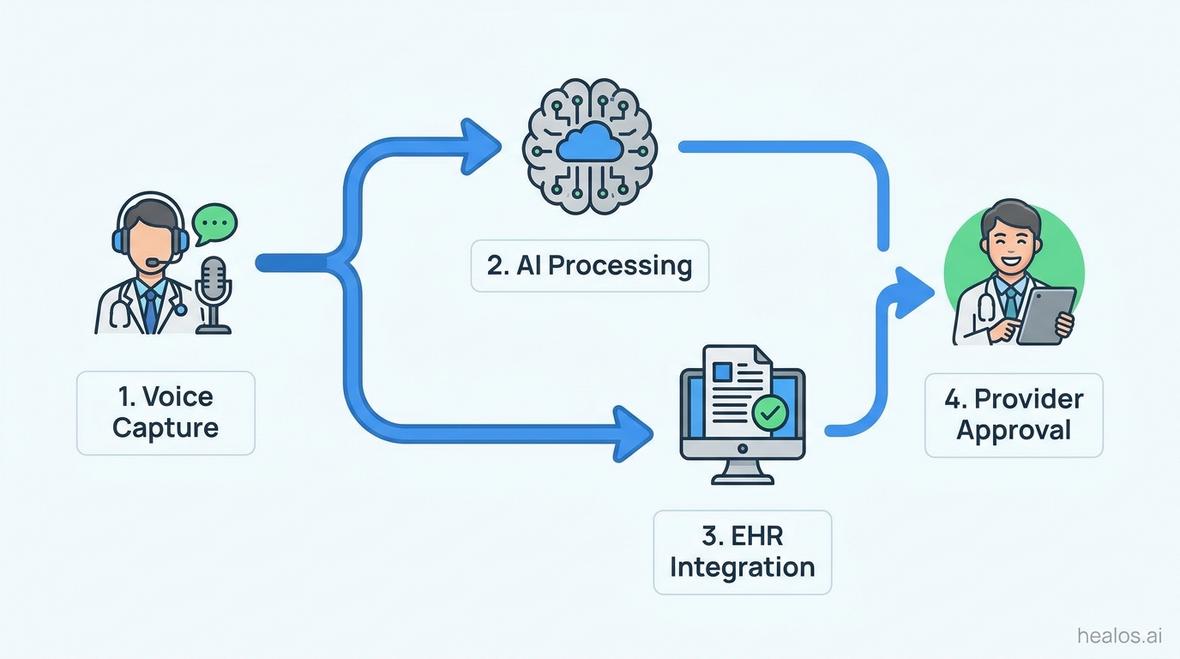
How Does Medical Scribe AI Work?
The workflow for medical scribe AI typically follows four critical steps:
- Voice Capture: During the patient encounter, the provider activates the AI scribe via a mobile app, desktop application, or integrated EHR tool. The system listens to the conversation in real-time, capturing all relevant clinical dialogue.
- AI Processing: Advanced algorithms powered by NLP and machine learning analyze the audio, extracting clinical entities, identifying diagnoses, medications, procedures, and other structured data elements.
- EHR Integration: The processed information is automatically formatted into the required documentation structure and pushed directly into the practice's EHR system, eliminating the need for manual data entry.
- Provider Approval: The clinician reviews the auto-generated note for accuracy, makes any necessary edits, and approves the final document all within minutes instead of the typical 15-20 minutes spent on manual charting.
This streamlined process not only saves time but also enhances documentation accuracy, reduces the risk of errors, and improves compliance with coding and billing requirements.
Why Overwhelmed Practice Managers Are Turning to Medical Scribe AI
For practice managers facing the dual pressures of staffing shortages and escalating administrative costs, medical scribe AI represents a transformative solution. According to NEJM Catalyst analysis: AI scribes cut pajama time and improve work satisfaction, physicians who adopted AI scribes experienced statistically significant reductions in time spent per appointment, documentation done outside core work hours (including pajama time), and overall administrative burden, with 84% of physicians reporting better patient interactions and 82% reporting improved work satisfaction.
Addressing Staffing Shortages
Hiring and retaining qualified medical scribes has become increasingly difficult. Human scribes require extensive training, incur ongoing salaries and benefits, and contribute to turnover-related disruptions. Medical scribe AI eliminates these challenges by providing a scalable, always-available solution that requires no onboarding time and operates consistently across all providers.
Reducing Provider Burnout
Provider burnout is a critical issue, with excessive charting being a leading cause. Research from PubMed Central outlines how ambient AI scribe technology was piloted in an integrated health system, quantifying reductions in clinician documentation time, changes in time spent in the EHR on notes and orders, and effects on after-hours workload. The results indicated that AI scribes can streamline clinical documentation and reduce administrative burden compared to traditional manual workflows, directly mitigating burnout.
Improving Operational Efficiency and Financial Health
For practice managers, the financial implications of medical scribe AI are substantial. By reducing the time providers spend on documentation, practices can increase patient throughput, reduce claim denials through improved accuracy, and lower labor costs associated with hiring and training human scribes. Additionally, the seamless EHR integration offered by platforms like HealOS ensures that documentation workflows are optimized for revenue cycle management, leading to faster reimbursements and healthier cash flow.
Key Benefits of Medical Scribe AI
The advantages of implementing medical scribe AI extend across clinical, operational, and financial dimensions. Here are the most impactful benefits:
Time Savings and Increased Productivity
Medical scribe AI dramatically reduces the time providers spend on documentation. High-frequency users can save up to 2.5 times more time per note than low-frequency users, enabling clinicians to see more patients, spend more time on complex cases, or simply leave work on time. This time savings translates directly into increased practice capacity and revenue potential.
Enhanced Documentation Accuracy
AI-powered scribes leverage sophisticated NLP algorithms to ensure clinical notes are comprehensive, accurate, and compliant with coding standards. This reduces the likelihood of errors, improves the quality of patient records, and minimizes the risk of audit findings or claim denials. According to a JMIR Medical Informatics editorial, emerging evidence on ambient AI scribe technologies describes their potential to transform documentation by auto-generating notes from clinical conversations, summarizing early accuracy and efficiency metrics.
Improved Patient Interactions
When providers are freed from the burden of typing or clicking through EHR screens during patient visits, they can maintain better eye contact, engage more meaningfully with patients, and foster stronger therapeutic relationships. Studies show that 84% of physicians using AI scribes report better patient interactions, leading to higher patient satisfaction scores and improved clinical outcomes.
Seamless EHR Integration
Leading medical scribe AI solutions, such as HealOS AI Scribe, offer deep integrations with major EHR platforms, ensuring that documentation flows directly into existing workflows without disrupting practice operations. This seamless connectivity eliminates double data entry, reduces administrative friction, and supports a unified approach to practice automation.
Cost-Effectiveness
Compared to the ongoing expenses of hiring, training, and retaining human scribes typically costing practices $30,000 to $50,000 per scribe annually medical scribe AI offers a highly cost-effective alternative. Subscription-based pricing models provide predictable costs, and the scalability of AI allows practices to extend scribe services to all providers without proportional increases in expense.
Medical Scribe AI vs. Human Scribes: A Detailed Comparison
While human scribes have long been the standard for reducing documentation burden, medical scribe AI offers distinct advantages that make it an increasingly preferred option for modern practices.
| Feature | Medical Scribe AI | Human Scribe |
|---|---|---|
| Availability | 24/7, always on-demand | Limited by work hours and scheduling |
| Cost | Subscription-based, scalable pricing | $30,000–$50,000+ per scribe annually |
| Training Time | Minimal; instant deployment | Weeks to months of onboarding |
| Consistency | Uniform quality across all encounters | Variable, dependent on individual skill |
| Privacy & Security | HIPAA-compliant, encrypted data | Requires strict oversight and training |
| Scalability | Unlimited, no additional hiring needed | Requires proportional hiring for growth |
| Documentation Speed | Real-time to near-instant completion | Depends on scribe efficiency |
The comparison clearly demonstrates that medical scribe AI offers superior scalability, cost-efficiency, and consistency, making it an ideal solution for practices aiming to automate administrative workflows without increasing headcount.
How to Choose the Right Medical Scribe AI Solution
Selecting the best medical scribe AI platform requires careful evaluation of several key factors:
EHR Integration Capabilities
Ensure the AI scribe solution integrates seamlessly with your existing EHR system. Platforms like HealOS Integrations support a wide range of EHRs, enabling smooth data flow and minimizing workflow disruptions.
Specialty-Specific Customization
Different specialties have unique documentation requirements. Whether you operate in therapy, cardiology, pediatrics, or psychiatry, choose a solution that offers customizable templates and specialty-specific workflows.
Compliance and Security
HIPAA compliance is non-negotiable. Verify that the AI scribe solution employs robust encryption, secure data storage, and complies with all relevant healthcare regulations to protect patient privacy and practice integrity.
Ease of Use and Training
The best medical scribe AI solutions require minimal training and feature intuitive interfaces. Look for platforms that offer comprehensive onboarding support, video tutorials, and responsive customer service to ensure rapid adoption across your practice.
Pricing and ROI
Evaluate the total cost of ownership, including subscription fees, implementation costs, and potential savings from reduced staffing and increased productivity. A transparent pricing model and demonstrated ROI are essential for justifying the investment to stakeholders.
Implementing Medical Scribe AI: Best Practices
Successful implementation of medical scribe AI requires a strategic approach and careful change management. Here are best practices to ensure a smooth rollout:
Start with a Pilot Program
Begin with a small group of providers to test the solution, gather feedback, and refine workflows before scaling across the entire practice. This phased approach minimizes disruption and allows for iterative improvements.
Provide Comprehensive Training
Even though medical scribe AI is user-friendly, providers and staff benefit from hands-on training sessions, video tutorials, and ongoing support. Platforms like HealOS Academy offer educational resources to accelerate adoption.
Customize Templates and Workflows
Tailor the AI scribe's templates and documentation formats to match your practice's specific needs and preferences. Customization ensures that the generated notes align with your clinical standards and billing requirements.
Monitor Performance and Gather Feedback
Continuously track key metrics such as documentation time, provider satisfaction, and accuracy rates. Solicit feedback from providers and staff to identify areas for improvement and optimize the system over time.
Integrate with Broader Practice Automation
Medical scribe AI is most effective when integrated into a comprehensive automation strategy. Consider combining it with AI receptionist services, insurance automation, and document automation to create a unified, efficient practice operation.
Real-World Impact: Case Studies and Statistics
The measurable benefits of medical scribe AI are backed by compelling data and real-world success stories:
- Time Reduction: Practices report up to 75% reduction in documentation time per encounter, freeing providers to see additional patients or reduce after-hours charting.
- Improved Work Satisfaction: 82% of physicians using AI scribes report improved work satisfaction, directly addressing burnout and turnover concerns.
- Enhanced Patient Experience: 84% of providers note better patient interactions, leading to higher patient satisfaction scores and improved clinical outcomes.
- Financial Gains: By increasing patient throughput and reducing claim denials through accurate documentation, practices experience measurable improvements in revenue cycle performance.
These outcomes underscore the transformative potential of medical scribe AI for practices seeking to scale operations, improve provider well-being, and enhance financial health.
Addressing Common Concerns About Medical Scribe AI
Accuracy and Reliability
Modern medical scribe AI solutions achieve accuracy rates exceeding 95%, with continuous machine learning improving performance over time. Providers retain full control, reviewing and approving all documentation before finalizing, ensuring clinical accuracy and compliance.
Patient Privacy and Data Security
Reputable AI scribe platforms are HIPAA-compliant, employing end-to-end encryption, secure cloud storage, and rigorous access controls. Patient data is protected at every stage, meeting or exceeding regulatory standards.
Provider Adoption and Change Management
Initial resistance to new technology is natural, but with proper training, clear communication of benefits, and visible leadership support, providers quickly recognize the value of medical scribe AI. Pilot programs and phased rollouts help ease the transition.
Integration Complexity
Leading solutions like HealOS are designed for seamless integration with major EHR systems, minimizing technical complexity and ensuring that implementation does not disrupt existing workflows. Dedicated support teams assist with setup and troubleshooting.
Future Trends in Medical Scribe AI
The field of medical scribe AI is rapidly evolving, with several emerging trends poised to further enhance its capabilities:
- Advanced Clinical Analytics: AI scribes will increasingly offer real-time clinical decision support, flagging potential diagnoses, suggesting evidence-based treatments, and identifying coding opportunities.
- Multi-Language Support: Expanding language capabilities will enable AI scribes to serve diverse patient populations, improving accessibility and care quality.
- Deeper EHR Ecosystem Integration: Future solutions will integrate not only with EHRs but also with billing systems, practice management software, and population health platforms, creating a truly unified healthcare automation ecosystem.
- Enhanced Personalization: Machine learning will enable AI scribes to adapt to individual provider preferences, documentation styles, and specialty-specific requirements, delivering highly personalized support.
Frequently Asked Questions
What is medical scribe AI?
Medical scribe AI is an artificial intelligence-powered solution that automatically captures, transcribes, and structures clinical conversations into comprehensive, EHR-ready documentation, significantly reducing the time providers spend on manual charting.
How does medical scribe AI differ from human scribes?
Medical scribe AI offers 24/7 availability, instant deployment, consistent quality, and scalability at a fraction of the cost of human scribes, making it a more efficient and cost-effective solution for modern practices.
Is medical scribe AI HIPAA-compliant?
Yes, reputable medical scribe AI platforms are fully HIPAA-compliant, employing robust encryption, secure data storage, and strict access controls to protect patient privacy and meet regulatory standards.
Can medical scribe AI integrate with my existing EHR?
Leading medical scribe AI solutions, such as HealOS, support seamless integration with a wide range of EHR systems, ensuring smooth data flow and minimal disruption to existing workflows.
What are the cost savings of medical scribe AI?
Practices can save tens of thousands of dollars annually by replacing human scribes with AI-powered solutions, while also benefiting from increased patient throughput, reduced claim denials, and improved provider productivity.
How long does it take to implement medical scribe AI?
Implementation timelines vary, but many practices can deploy medical scribe AI within days to weeks, especially with platforms offering quick onboarding, training resources, and dedicated support teams.
Conclusion
Medical scribe AI represents a paradigm shift in healthcare documentation, offering overwhelmed practice managers a powerful tool to automate administrative workflows, reduce provider burnout, and improve financial health without increasing headcount. By leveraging advanced AI, ambient voice recognition, and seamless EHR integration, solutions like HealOS AI Scribe empower practices to reclaim valuable time, enhance patient interactions, and scale operations efficiently. As staffing shortages persist and documentation burdens intensify, adopting medical scribe AI is not just a competitive advantage it's a strategic imperative for modern healthcare practices committed to delivering exceptional care while maintaining operational excellence.