
Suki Agencies: Complete Guide To Suki AI Partnerships, Implementation & Better Alternatives In 2026

Understanding Suki Agencies and AI-Powered Healthcare Automation
As healthcare practices search for ways to reduce administrative burden and combat provider burnout, many turn to suki agencies and similar AI-driven documentation solutions. Suki AI has gained traction as an ambient clinical intelligence platform, but understanding how suki agencies operate, their costs, and whether better alternatives exist is critical for overwhelmed practice managers seeking scalable automation without expanding headcount.
Suki agencies typically refer to implementation partners, resellers, or consulting firms that help healthcare organizations deploy Suki AI's voice-enabled documentation technology. These agencies provide onboarding, training, and integration services to connect Suki with existing EHR systems. However, the fragmented nature of these partnerships can create confusion around pricing, support quality, and long-term ROI especially for small to mid-sized practices operating on tight margins.
According to research from the American Medical Association, physicians spend nearly two hours on administrative tasks for every hour of direct patient care. This imbalance drives burnout rates exceeding 50% across multiple specialties. Suki agencies promise to alleviate this burden through AI scribes, but practice managers must evaluate whether the investment truly delivers operational efficiency and financial health improvements.
How Suki Agencies Work: Implementation Models and Service Delivery
Suki agencies function as intermediaries between healthcare practices and Suki AI's core technology platform. These partners typically offer tiered service packages that include initial system configuration, EHR integration mapping, provider training sessions, and ongoing technical support. The implementation timeline generally spans 4-8 weeks, depending on practice size and existing infrastructure complexity.
Most suki agencies follow a phased rollout strategy. Phase one involves pilot testing with a small group of providers to identify workflow friction points. Phase two scales the deployment across the entire practice while monitoring adoption metrics like daily active users, notes completed per provider, and time-to-chart ratios. Phase three focuses on optimization through custom templates and specialty-specific configurations.
However, this multi-layered approach introduces several challenges for practice managers. First, coordination between the agency, Suki's technical team, and the practice's IT staff can create communication bottlenecks. Second, agencies often bundle mandatory consulting hours into contracts, inflating total costs beyond the base software subscription. Third, practices may face vendor lock-in if proprietary customizations make future platform migrations difficult.
EHR Integration Complexities with Suki Agencies
One of the most critical factors practice managers evaluate when working with suki agencies is EHR integration quality. Suki AI claims compatibility with major EHR platforms like Epic, Cerner, and Athenahealth, but real-world implementation often reveals gaps. Data mapping errors, authentication failures, and syncing delays can disrupt clinical workflows rather than streamline them.
For practices using less common EHR systems, suki agencies may propose custom API development an expensive proposition that extends timelines and requires ongoing maintenance. This contrasts sharply with platforms like HealOS, which offers pre-built integrations and a unified agent architecture that eliminates the need for complex middleware solutions.
Suki Agencies Pricing: Hidden Costs and Total Cost of Ownership
Understanding the true cost of working with suki agencies requires looking beyond the advertised per-provider monthly fees. Suki AI's base pricing typically starts around $249-$399 per provider per month, but agency markup, implementation fees, and mandatory training packages can push first-year costs significantly higher.
A typical pricing breakdown when working with suki agencies includes:
- Software licensing: $249-$399 per provider/month
- Implementation fee: $3,000-$8,000 one-time charge
- Training and onboarding: $150-$300 per provider
- Custom template development: $500-$2,000 per specialty
- Agency service fee: 10-25% markup on base subscription
- Ongoing support retainer: $500-$1,500 monthly
For a five-provider practice, the first-year total cost of ownership can exceed $25,000 a substantial investment that must be justified through measurable reductions in documentation time and claim denial rates. Practice managers focused on financial health need clear ROI metrics before committing to these expenditures.
Comparing Suki Agencies Costs to Direct-to-Practice Alternatives
Many practice managers discover that bypassing suki agencies and exploring direct platform alternatives delivers better value. For example, HealOS offers comprehensive AI automation starting at significantly lower monthly fees while including implementation support, unlimited training, and seamless EHR integrations without agency middlemen.
The cost differential becomes even more pronounced when considering the unified agent approach. Instead of paying separately for AI scribes, AI receptionists, insurance verification automation, and revenue cycle management tools, HealOS consolidates these functions into a single platform with transparent pricing and no hidden agency fees.
Key Limitations and Challenges of Suki Agencies
While suki agencies provide valuable implementation expertise, several structural limitations affect their ability to deliver long-term value for overwhelmed practice managers. Understanding these constraints helps decision-makers set realistic expectations and prepare contingency plans.
Staffing Turnover and Support Continuity Issues
Many suki agencies operate with small teams that service dozens of healthcare clients simultaneously. When key account managers or technical specialists leave, practices often experience knowledge gaps that disrupt ongoing optimization efforts. This turnover creates frustrating situations where new agency contacts must re-learn practice-specific workflows and customizations.
In contrast, platforms with direct customer success models maintain institutional knowledge within the vendor organization, ensuring continuity regardless of individual employee changes. This structural advantage becomes particularly important during critical periods like EHR upgrades or provider onboarding cycles.
Limited Scope of Automation Capabilities
Suki agencies primarily focus on ambient clinical documentation converting provider-patient conversations into structured notes. While valuable, this represents only one component of the administrative burden overwhelming practice managers. Other critical workflows like prior authorization processing, eligibility verification, and denial management require separate solutions.
This fragmented approach forces practices to manage multiple vendor relationships, each with distinct contracts, support channels, and integration requirements. The administrative overhead of coordinating these disparate systems often negates the time savings achieved through AI documentation alone.
Better Alternatives to Suki Agencies: Unified Healthcare Automation Platforms
For practice managers seeking to automate administrative workflows without increasing headcount, unified platforms offer compelling advantages over traditional suki agencies implementations. These comprehensive solutions address multiple pain points through integrated agent architectures rather than point solutions.
HealOS: The Unified Agent Approach to Practice Automation
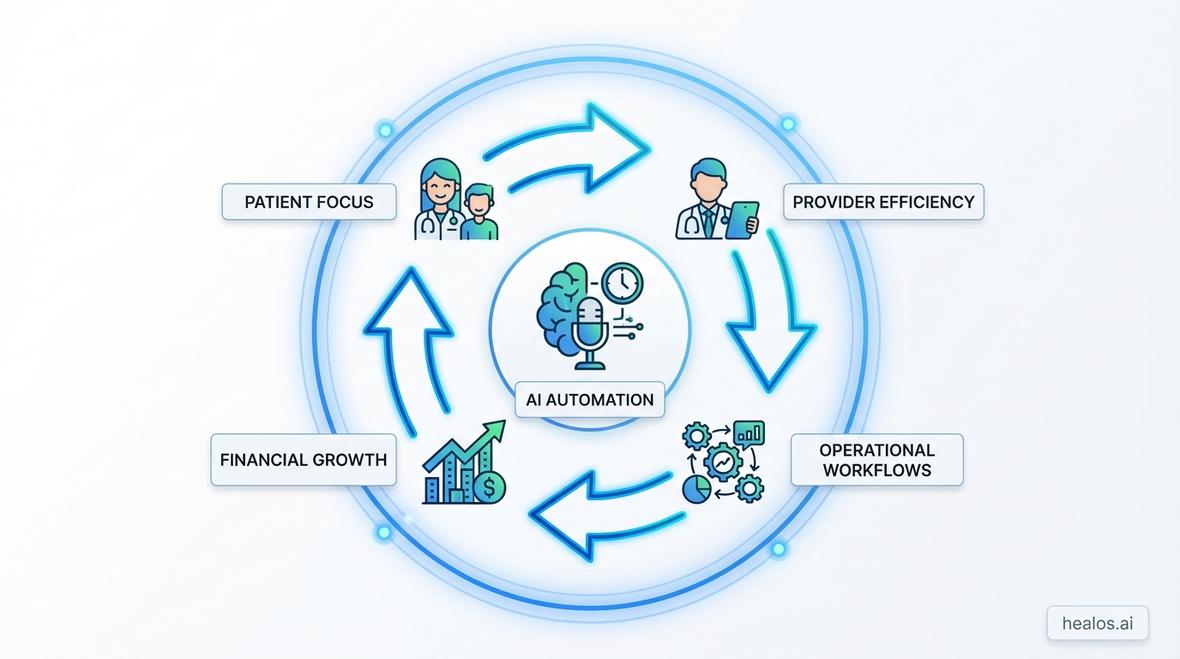
HealOS represents a fundamentally different approach to healthcare automation. Instead of requiring practices to work through agencies and coordinate multiple specialized tools, HealOS deploys AI agents that handle end-to-end workflows across documentation, patient communication, insurance operations, and revenue cycle management.
This unified architecture delivers several key benefits for overwhelmed practice managers:
- Single vendor relationship: One contract, one support team, one billing statement
- Seamless data flow: AI agents share context across workflows, eliminating duplicate data entry
- Predictable pricing: Transparent subscription model without agency markups or hidden fees
- Rapid implementation: Pre-built integrations enable deployment in days rather than months
- Comprehensive coverage: Addresses documentation, front desk, billing, and insurance automation through coordinated agents
AI Scribe Capabilities: Suki Agencies vs. Direct Platforms
When comparing pure AI scribe functionality, HealOS matches or exceeds suki agencies implementations across key dimensions. Both solutions offer ambient listening, specialty-specific templates, and EHR integration but HealOS adds critical capabilities like real-time medical translation, session analytics, and custom note generation without requiring expensive agency consulting packages.
Perhaps most importantly for practice managers dealing with staffing shortages, HealOS's AI scribe works in concert with its AI medical answering service and patient reminder systems to create true workflow automation rather than isolated productivity improvements.
Implementation Strategy for Practice Managers Evaluating Suki Agencies
If your practice is considering suki agencies or alternative automation platforms, a structured evaluation process helps ensure the selected solution addresses your specific pain points while delivering measurable ROI. The following framework guides overwhelmed practice managers through this critical decision.
Step One: Document Baseline Metrics
Before evaluating any vendor or agency, establish clear baseline measurements across these key performance indicators:
- Average documentation time per patient encounter
- Provider time spent on after-hours charting ('pajama time')
- Claims denial rate and top denial reasons
- Days in accounts receivable
- Phone abandonment rate and missed appointment percentage
- Administrative staff hours spent on insurance verification
These metrics enable apples-to-apples comparison of different automation approaches and provide the foundation for calculating ROI post-implementation.
Step Two: Define Pilot Test Requirements
Whether working with suki agencies or direct platform vendors, insist on a time-bound pilot with specific success criteria. A well-structured pilot should include:
- 2-4 week duration with 3-5 participating providers
- Daily measurement of adoption metrics and user feedback
- Technical integration testing with your specific EHR build
- Side-by-side comparison with existing workflows
- Clear decision criteria for proceeding to full deployment
Vendors hesitant to offer pilot programs may lack confidence in their solution's real-world performance a significant red flag for practice managers.
Step Three: Total Cost of Ownership Analysis
Create a comprehensive three-year financial model that captures all direct and indirect costs. For suki agencies implementations, this must include not just subscription fees but also:
- Implementation and training expenses
- Ongoing support and consulting retainers
- Custom development for specialty templates
- Opportunity cost of extended deployment timelines
- Risk premium for vendor lock-in scenarios
Compare this against the expected financial benefits from reduced staffing needs, improved collections, and lower denial rates. Industry data suggests that comprehensive automation platforms deliver 300-400% ROI within 18 months when properly implemented but only if total costs are accurately projected upfront.
The Future of Healthcare Automation: Beyond AI Scribes
While suki agencies and similar providers focus primarily on clinical documentation, forward-thinking practice managers recognize that sustainable scaling requires automation across the entire administrative workflow. The next generation of healthcare AI moves beyond single-point solutions toward orchestrated agent systems that handle complex, multi-step processes.
According to research from the Healthcare Information and Management Systems Society, practices implementing comprehensive automation platforms report 40-60% reductions in administrative overhead compared to 15-25% improvements from documentation-only solutions. This performance gap reflects the compounding benefits of integrated automation versus fragmented tools.
Emerging Capabilities in Unified Automation Platforms
Leading platforms now offer capabilities that extend far beyond what traditional suki agencies implementations provide:
- Intelligent referral management: Automated tracking, status updates, and specialist coordination
- Document processing automation: EOB extraction, fax routing, and records organization
- Underpayment detection: AI analysis of remittances to identify contracted rate discrepancies
- Digital patient intake: Pre-visit data collection that populates directly into the EHR
- Predictive analytics: Forecasting no-show risk, claim denial probability, and revenue trends
These advanced capabilities represent the logical evolution of healthcare automation moving from reactive documentation tools to proactive systems that anticipate needs and resolve issues before they impact practice operations.
Case Study: From Suki Agencies to Comprehensive Automation
A seven-provider family medicine practice in the Midwest initially engaged a suki agency in early 2025, seeking relief from documentation burden that had physicians spending 2-3 hours nightly on charting. After six months, they achieved moderate improvements documentation time dropped by approximately 35%—but discovered that other administrative bottlenecks had become more visible and problematic.
Insurance verification delays, prior authorization processing, and claims follow-up still consumed significant staff time. The practice employed three full-time administrative staff members but struggled to keep pace with patient volume growth. Hiring additional staff was financially unviable, creating a scaling ceiling that limited practice expansion.
After evaluating comprehensive alternatives, the practice transitioned to a unified automation platform that addressed documentation, front desk operations, and revenue cycle management through coordinated AI agents. The results over the subsequent nine months included:
- 72% reduction in total administrative time per patient encounter
- Elimination of provider 'pajama time' through real-time documentation
- 43% improvement in clean claim rate through automated eligibility verification
- $147,000 annualized savings from avoided administrative headcount additions
- 26% increase in patient capacity without extending office hours
This case illustrates why practice managers increasingly view suki agencies implementations as starting points rather than complete solutions and why unified platforms deliver superior ROI for practices committed to scaling without proportional headcount growth.
Making the Decision: Suki Agencies or Comprehensive Alternatives?
For overwhelmed practice managers evaluating suki agencies versus direct automation platforms, the decision framework should prioritize long-term operational efficiency over short-term implementation convenience. While agencies provide valuable hand-holding during deployment, this support comes at significant cost and may inadvertently create dependencies that limit future flexibility.
The most successful practices approach healthcare automation as a strategic investment in operational infrastructure rather than a tactical purchase. This mindset shift leads to several key principles:
- Prioritize platforms over point solutions: Unified architectures eliminate integration complexity and vendor coordination overhead
- Demand transparent pricing: All-inclusive subscription models prevent budget surprises and enable accurate ROI forecasting
- Insist on rapid deployment: Implementation timelines exceeding 30 days suggest architectural complexity that will create ongoing maintenance burdens
- Evaluate vendor longevity: Healthcare automation requires multi-year commitments choose vendors with sustainable business models and clear product roadmaps
- Validate real-world performance: Pilot testing with your specific workflows provides more reliable insights than generic vendor demonstrations
When viewed through this lens, suki agencies may serve specific niche requirements but rarely represent the optimal path for practices seeking comprehensive administrative workflow automation.
Frequently Asked Questions About Suki Agencies and Healthcare Automation
Do I need to work with suki agencies to use Suki AI?
No, Suki AI offers direct-to-practice sales and implementation services. However, many smaller practices lack internal IT resources and find agency partnerships helpful during initial deployment. The key question is whether the agency's value justifies their additional costs versus platforms with more intuitive setup processes.
Which EHR systems work best with suki agencies implementations?
Suki AI maintains strong integration partnerships with Epic, Cerner, and Athenahealth. Practices using these platforms typically experience smoother implementations. However, organizations on less common EHR systems may face integration challenges that require expensive custom development a scenario where platforms with broader pre-built integrations offer advantages.
How long does it take to see ROI from suki agencies implementations?
Most practices report measurable documentation time savings within 4-6 weeks of go-live. However, financial ROI depends on whether time savings translate into increased patient capacity or reduced staffing needs. Practices that leverage automation to scale revenue rather than simply reduce expenses typically achieve positive ROI within 6-9 months.
What level of staff training is required for suki agencies solutions?
Initial training typically requires 2-4 hours per provider for basic functionality, with additional sessions for specialty-specific templates and advanced features. Administrative staff need separate training on workflow changes related to automated documentation. Total training time commitment can reach 20-30 hours for a five-provider practice a significant operational disruption during deployment.
Are suki agencies implementations HIPAA compliant and secure?
Suki AI maintains HIPAA compliance certifications and uses encryption for data transmission and storage. However, practices remain ultimately responsible for ensuring their specific implementation meets regulatory requirements. This includes proper business associate agreements with both Suki and any agencies involved in implementation or support.
Conclusion
Suki agencies provide valuable implementation support for practices deploying AI-powered clinical documentation, but overwhelmed practice managers must carefully evaluate whether this approach delivers the comprehensive automation needed to scale without increasing headcount. Hidden costs, limited scope, and coordination complexity often diminish the expected ROI from agency-mediated implementations.
Forward-thinking practices increasingly adopt unified automation platforms like HealOS that address documentation, patient communication, insurance operations, and revenue cycle management through integrated AI agents. This architectural approach eliminates vendor coordination overhead, reduces total cost of ownership, and delivers measurable improvements across all administrative workflows not just clinical charting. By focusing on comprehensive solutions rather than point products, practice managers can achieve the operational efficiency and financial health needed to thrive in an increasingly challenging healthcare landscape.