
Top Artificial Intelligence Healthcare Companies Transforming Practice Operations In 2026

Introduction
The healthcare industry is undergoing a seismic transformation powered by artificial intelligence healthcare companies that are redefining how medical practices operate. From reducing administrative burdens to automating revenue cycle management, AI-driven solutions are no longer optional they're essential for survival in an era of staffing shortages, rising operational costs, and escalating provider burnout. According to a study by the Office of the National Coordinator for Health Information Technology, AI applications in healthcare are expected to save the industry over $150 billion annually by 2026 through workflow automation and predictive analytics.
For overwhelmed practice managers grappling with staffing shortages and claim denials, understanding which artificial intelligence healthcare companies deliver measurable ROI is critical. This comprehensive guide examines the leading AI vendors revolutionizing healthcare operations, with a focus on solutions that automate administrative workflows, integrate seamlessly with existing EHR systems, and demonstrate clear financial impact.
Why Practice Managers Are Turning to Artificial Intelligence Healthcare Companies
The challenges facing modern healthcare practices are well-documented. Research from the American Medical Association reveals that physicians spend nearly 50% of their workday on administrative tasks, with documentation alone consuming 16 minutes of every clinical hour. This administrative burden translates directly into provider burnout, with 63% of physicians reporting symptoms of exhaustion related to non-clinical tasks.
Artificial intelligence healthcare companies address these pain points through targeted automation. By deploying AI agents that handle routine workflows from insurance verification to prior authorization processing practices can scale operations without proportional increases in headcount. This approach directly aligns with the core goals of practice managers seeking operational efficiency and improved financial health.
The Financial Case for AI Adoption
The return on investment for AI implementation in healthcare practices is compelling. Practices utilizing comprehensive AI platforms report average cost savings of $42,000 per provider annually when replacing human scribes with AI medical scribe solutions. Additionally, automated insurance eligibility verification reduces claim denial rates by up to 35%, directly improving revenue cycle performance.
For practices managing multiple providers, these savings compound rapidly. A five-provider family medicine practice implementing AI-driven workflows can expect first-year savings exceeding $200,000 when factoring in reduced administrative staffing needs, improved claim acceptance rates, and decreased provider overtime from after-hours charting.
Leading Artificial Intelligence Healthcare Companies by Capability
Not all artificial intelligence healthcare companies deliver the same value proposition. The market segments into specialized point solutions versus comprehensive platforms. Understanding these distinctions helps practice managers select vendors aligned with their operational priorities.
Comprehensive AI Healthcare Platforms
The most impactful artificial intelligence healthcare companies offer unified platforms that address multiple workflow pain points simultaneously. Rather than implementing disparate vendors for scribing, patient intake, and billing automation, integrated platforms reduce implementation complexity and improve data continuity across functions.
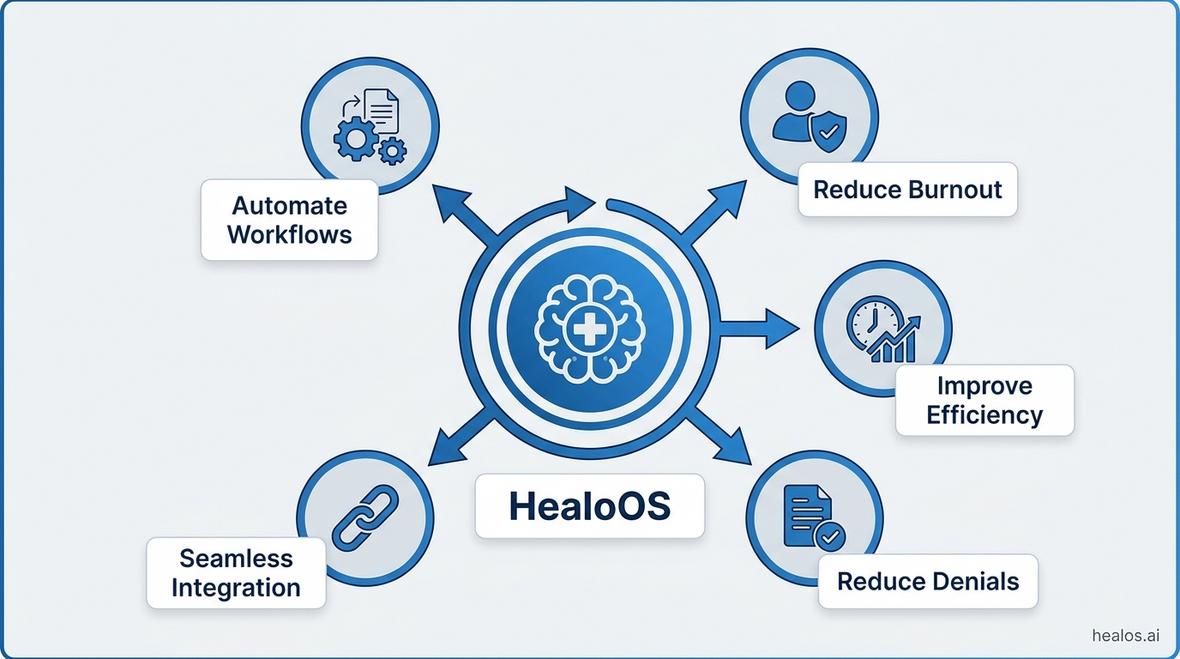
HealOS exemplifies the unified agent approach, combining ambient clinical documentation, AI receptionist capabilities, automated revenue cycle management, and intelligent referral processing into a single coherent system. This architecture eliminates the integration headaches associated with cobbling together multiple point solutions while providing consistent data flows across the patient journey. The platform's seamless EHR integration means implementation timelines measured in days rather than months a critical consideration for resource-constrained practices.
Specialized AI Vendors for Specific Workflows
While comprehensive platforms offer breadth, certain artificial intelligence healthcare companies focus intensively on specific domains. Ambient clinical documentation specialists like DeepScribe and Freed.ai concentrate exclusively on reducing charting burden, offering highly refined transcription and note-generation capabilities. These solutions typically integrate with existing practice management systems as standalone modules.
Similarly, AI-driven billing automation vendors focus specifically on revenue cycle optimization. Companies in this segment deploy machine learning to identify coding errors, predict denial likelihood, and automate claim follow-up workflows. For practices with existing documentation solutions but persistent billing challenges, specialized RCM AI can complement current systems.
Prior Authorization and Insurance Automation Specialists
Prior authorization represents one of healthcare's most time-consuming administrative burdens. According to the American Medical Association's 2025 physician survey, practices complete an average of 41 prior authorizations weekly, consuming 14 hours of staff time. Artificial intelligence healthcare companies addressing this workflow use intelligent document processing and payer-specific rulesets to automate authorization requests.
Leading solutions in this category monitor authorization status in real-time, automatically submit required documentation, and escalate cases requiring human review. The resulting efficiency gains free clinical staff from administrative drudgery while accelerating treatment initiation for patients. HealOS includes prior authorization automation as part of its unified platform, eliminating the need for separate vendor relationships.
What to Evaluate When Choosing Among Artificial Intelligence Healthcare Companies
Selecting the right AI vendor requires systematic evaluation across multiple dimensions. Practice managers should assess candidates using a consistent framework that considers both immediate implementation requirements and long-term strategic fit.
EHR Integration and Technical Architecture
The single most important selection criterion is seamless integration with existing EHR systems. Solutions requiring manual data entry or complex interfaces negate the efficiency gains AI promises to deliver. Best-in-class artificial intelligence healthcare companies offer native integrations with major EHR platforms including Epic, Cerner, Athenahealth, and NextGen.
HealOS distinguishes itself through its flexible integration architecture, supporting both API-based connections for real-time data exchange and sophisticated screen-scraping technology for EHRs lacking modern integration capabilities. This dual approach ensures compatibility regardless of practice infrastructure a critical advantage for community practices using legacy systems.
Scope of Workflow Automation
Comprehensive workflow coverage determines ultimate ROI. Artificial intelligence healthcare companies offering single-function automation require practices to manage multiple vendor relationships, each with separate contracts, support channels, and training requirements. This fragmentation creates hidden administrative costs that erode efficiency gains.
Evaluate vendors based on their ability to automate your highest-impact workflows. For most practices, this includes clinical documentation, patient intake and scheduling, insurance verification, claim submission and follow-up, and denial management. Platforms addressing all five domains from a unified architecture deliver superior total cost of ownership compared to assembled point solutions.
Accuracy, Compliance, and Quality Assurance
AI-generated clinical documentation must meet stringent accuracy and compliance standards. Leading artificial intelligence healthcare companies achieve 98%+ accuracy rates through hybrid approaches combining large language models with medical-specific training and human-in-the-loop quality assurance for high-stakes scenarios.
Request detailed accuracy metrics during vendor evaluation, specifically asking about performance across different specialties and encounter types. Solutions trained predominantly on primary care may underperform in specialized settings like oncology or behavioral health. Additionally, verify HIPAA compliance certifications, data encryption standards, and audit trail capabilities required for regulatory adherence.
Customization and Specialty-Specific Capabilities
Generic AI solutions often require extensive post-implementation customization to match specialty-specific workflows. The best artificial intelligence healthcare companies offer pre-configured templates for major specialties while supporting custom template creation for unique practice needs.
HealOS provides specialty-optimized solutions for cardiology, pediatrics, psychiatry, oncology, and numerous other specialties. This approach reduces implementation time while ensuring generated documentation meets specialty-specific requirements from day one.
Implementation Best Practices for AI Healthcare Solutions
Successful AI deployment extends beyond vendor selection. Practice managers must orchestrate change management, staff training, and performance monitoring to realize projected benefits.
Phased Rollout Strategy
Begin AI implementation with a single high-impact workflow rather than attempting simultaneous deployment across all functions. Most practices achieve optimal results starting with clinical documentation automation, where benefits manifest immediately through reduced after-hours charting. Once providers adapt to AI-assisted documentation, expand to front-office automation including patient reminders and intake automation.
This phased approach allows iterative refinement based on real-world performance data. Monitor key metrics including documentation time per encounter, claim acceptance rates, and staff satisfaction scores throughout rollout. Use these insights to optimize configurations before expanding to additional workflows.
Training and Change Management
Provider resistance represents the primary obstacle to AI adoption. Physicians accustomed to established documentation workflows may initially distrust AI-generated notes or perceive additional technology as burdensome rather than liberating. Address these concerns through comprehensive training emphasizing how AI augments rather than replaces clinical judgment.
Successful implementations include hands-on training sessions where providers experience AI-assisted workflows in controlled scenarios before live patient encounters. Identify early adopters within the practice who can serve as champions, demonstrating tangible time savings to skeptical colleagues. Most practices report provider enthusiasm within two weeks once time savings become apparent.
Continuous Performance Monitoring
Establish baseline metrics before AI implementation to quantify impact accurately. Critical KPIs include average documentation time per encounter, percentage of charts completed within 24 hours, claim denial rates, and provider satisfaction scores. Artificial intelligence healthcare companies should provide analytics dashboards enabling real-time performance monitoring across these dimensions.
Schedule monthly reviews during the first quarter post-implementation to identify optimization opportunities. Small configuration adjustments like refining specialty templates or adjusting ambient listening sensitivity can significantly improve performance. Best-in-class vendors provide dedicated implementation support ensuring practices maximize their AI investment.
Calculating Your Practice's AI ROI
Quantifying expected return on investment helps justify AI expenditure to stakeholders while establishing performance benchmarks. Calculate ROI across four primary dimensions: direct labor cost reduction, improved revenue capture, provider time recapture, and scalability without proportional staffing increases.
Direct Labor Cost Reduction
AI automation reduces staffing requirements for routine administrative functions. A practice employing two full-time medical scribes at $40,000 annually can eliminate these positions when implementing comprehensive AI documentation, yielding $80,000 in annual savings. Similarly, front-office automation through AI receptionists handling appointment scheduling and patient inquiries can reduce receptionist requirements by one FTE in typical five-provider practices, saving approximately $35,000 annually.
Revenue Capture Improvement
Enhanced documentation accuracy and automated charge capture increase revenue per encounter. Practices implementing AI documentation report average revenue increases of 8-12% through improved coding specificity and reduced undercoding. For a practice generating $2 million in annual collections, this represents $160,000-$240,000 in additional revenue with no increase in patient volume.
Additionally, reduced claim denials directly impact cash flow. Automated insurance verification and eligibility checking reduces denial rates by 30-40%, accelerating collections and reducing accounts receivable aging. The combination of increased capture and reduced denials typically improves practice profitability by 15-20% within the first year.
Provider Time Recapture
The most significant yet often overlooked ROI component is provider time recapture. Physicians spending two hours daily on after-hours documentation regain 500+ hours annually through AI automation. This recovered time enables additional patient appointments, reduces burnout-related turnover, or simply improves work-life balance all delivering substantial value even when not directly monetized.
Future Directions for Artificial Intelligence Healthcare Companies
The artificial intelligence healthcare companies leading today's market continue innovating beyond current capabilities. Understanding emerging trends helps practice managers make future-proof technology investments.
Predictive Analytics and Proactive Care Management
Next-generation AI platforms incorporate predictive analytics identifying patients at elevated risk for adverse events or care gaps. By analyzing historical clinical data, artificial intelligence healthcare companies can flag patients requiring preventive interventions, automate outreach for overdue screenings, and optimize care coordination for complex chronic conditions.
Autonomous AI Agents
Current AI implementations primarily augment human workflows. Emerging autonomous agents will independently execute complete processes including claim processing, denial management, and patient enrollment with minimal human oversight. These agents will collaborate with each other, escalating only exceptional cases requiring human judgment. This evolution will further compress administrative costs while enabling unprecedented operational scale.
Enhanced Interoperability
As healthcare data exchange standards mature, artificial intelligence healthcare companies will leverage comprehensive patient data from multiple sources including wearables, remote monitoring devices, and health information exchanges. This holistic data access will enable more sophisticated clinical decision support and population health management capabilities integrated directly into AI-assisted workflows.
Frequently Asked Questions
What is the typical cost for artificial intelligence healthcare companies' solutions?
Pricing varies significantly based on scope and practice size. Standalone AI scribing solutions typically range from $99-$399 per provider monthly. Comprehensive platforms including documentation, front-office automation, and RCM capabilities range from $500-$1,200 per provider monthly. Most vendors offer tiered pricing based on feature sets and support levels. HealOS provides transparent pricing with no hidden implementation fees, ensuring predictable total cost of ownership.
How long does AI implementation typically require?
Implementation timelines depend on solution complexity and practice readiness. Basic AI scribing can deploy in 2-5 days for practices with compatible EHR systems. Comprehensive platform implementations including multiple workflow automations typically require 2-4 weeks for full deployment. Solutions requiring custom integrations or extensive configuration may extend to 6-8 weeks. Select vendors offering rapid deployment pathways to minimize disruption to practice operations.
Are AI-generated clinical notes sufficiently accurate for regulatory compliance?
Leading artificial intelligence healthcare companies achieve 98%+ accuracy in clinical documentation through advanced natural language processing and medical-specific training. However, providers maintain ultimate responsibility for note accuracy and should review AI-generated content before signing. Most practices report that review requires 30-60 seconds per note compared to 10-15 minutes for manual documentation a substantial time savings while maintaining quality standards.
Do artificial intelligence healthcare companies support specialty-specific workflows?
The best platforms offer pre-configured templates optimized for major specialties including primary care, behavioral health, cardiology, orthopedics, and others. Verify that prospective vendors have demonstrated experience in your specialty and can provide reference customers with similar practice profiles. HealOS supports a comprehensive range of specialty-specific solutions with templates refined through thousands of clinical encounters.
How do artificial intelligence healthcare companies ensure HIPAA compliance and data security?
Reputable vendors implement comprehensive security frameworks including end-to-end encryption, role-based access controls, and regular security audits. All artificial intelligence healthcare companies serving U.S. practices must sign Business Associate Agreements accepting liability for protected health information. Request detailed security documentation including SOC 2 certifications, penetration testing results, and incident response procedures during vendor evaluation.
Conclusion
Artificial intelligence healthcare companies are delivering transformative operational improvements for practices willing to embrace automation. For overwhelmed practice managers facing staffing shortages and administrative burden, AI represents a strategic imperative rather than an optional enhancement. The most successful implementations leverage comprehensive platforms like HealOS that address multiple workflows through unified architecture, ensuring seamless integration and maximizing return on investment. By systematically evaluating vendors against clear criteria integration capabilities, workflow scope, accuracy standards, and specialty fit practice managers can confidently select AI partners positioned to drive sustainable operational efficiency and financial performance improvements well into the future.