
Voice AI For Healthcare: Complete Guide To Reducing Administrative Burden And Scaling Your Practice

Understanding Voice AI for Healthcare
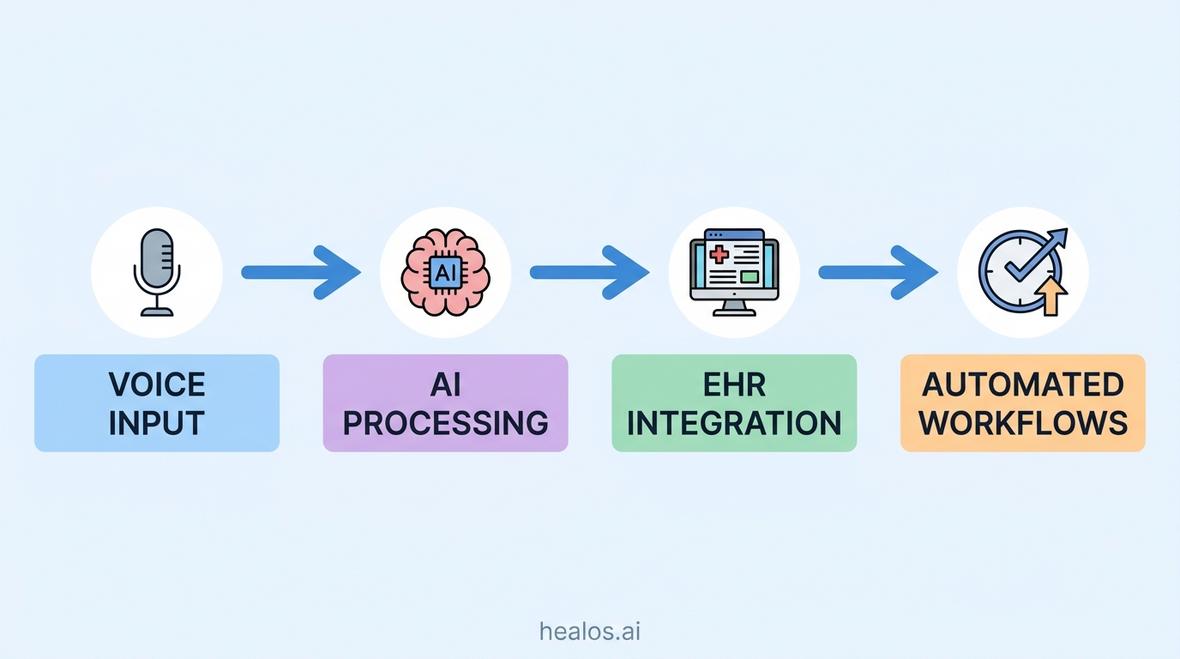
Voice AI for healthcare represents a transformative shift in how medical practices handle documentation, patient interactions, and administrative workflows. As staffing shortages intensify and provider burnout reaches crisis levels, practice managers are turning to voice-enabled artificial intelligence solutions to automate routine tasks without adding headcount. These intelligent systems use natural language processing and machine learning to understand clinical conversations, transcribe patient encounters, and integrate seamlessly with existing electronic health records (EHRs).
The promise of voice AI for healthcare extends beyond simple transcription. Modern platforms function as unified agents capable of handling documentation, patient outreach, appointment reminders, and even clinical decision support. For the overwhelmed practice manager juggling staffing shortages and mounting administrative costs, voice AI offers a path to operational efficiency and financial stability. According to an NEJM AI review: generative AI voice agents expected to automate 70–80% of routine clinical conversations and documentation, these technologies are poised to dramatically reduce clinician time spent on non-clinical tasks.
Understanding how voice AI works and more importantly, how it fits into your practice's existing workflows is essential for practice managers seeking to scale operations while maintaining quality care. The technology has matured rapidly, with solutions now offering HIPAA-compliant security, multi-specialty customization, and proven ROI that directly addresses the core pain points of modern healthcare administration.
Key Benefits of Voice AI for Overwhelmed Practice Managers
Practice managers face unprecedented challenges in today's healthcare environment. Staffing shortages, rising operational costs, and increasing documentation requirements create a perfect storm that threatens practice viability. Voice AI for healthcare directly addresses these pain points through several concrete mechanisms.
Reducing Documentation Burden and Provider Burnout
The single largest source of physician dissatisfaction stems from excessive documentation requirements. A systematic review links EHR documentation burden to physician burnout and turnover risk, quantifying how automation of charting via tools such as voice AI can be a lever for staff retention and operational stability. When providers spend 2-3 hours on documentation for every hour of patient care, burnout becomes inevitable.
Voice AI solutions like HealOS AI Scribe capture clinical conversations in real-time, automatically generating structured SOAP notes, progress notes, and specialty-specific documentation. A study of medical scribes shows up to 30% reduction in physician EHR time, illustrating upside for voice AI documentation. This time savings translates directly into improved provider satisfaction, reduced turnover costs, and the ability to see more patients without increasing workload stress.
Automating Patient Outreach and Engagement
Patient engagement activities appointment reminders, follow-up calls, care gap closures, and chronic disease monitoring consume significant staff time. Voice AI for healthcare automates these workflows at scale. An American Heart Association: AI voice agent improved BP monitoring, reaching 85% of patients and closing 1,939 care gaps, improving quality measure performance from 1 to 4 stars. This operational excellence directly impacts both patient outcomes and practice revenue through improved quality incentive payments.
For practices struggling with callback volume and patient adherence, automated follow-up calls provide consistent, scalable outreach that human staff simply cannot match. The system can handle hundreds of calls simultaneously, document responses automatically, and escalate critical issues to clinical staff all while maintaining a conversational, empathetic tone that patients find engaging.
Scaling Operations Without Adding Headcount
The BLS healthcare employment data shows persistent staffing shortages and rising demand for healthcare support roles, reinforcing the macro trend that practices cannot simply hire their way out of administrative burden. Voice AI offers an alternative scaling strategy that improves margins rather than eroding them.
By deploying AI receptionist capabilities for phone triage, appointment scheduling, and insurance verification, practices can handle 30-50% more call volume without additional front-desk staff. The technology works 24/7, never calls in sick, and maintains consistent quality across thousands of interactions. For the practice manager focused on financial health, this represents a fundamental shift in the economics of practice growth.
Implementation Strategies for Practice Managers
Successfully deploying voice AI for healthcare requires more than selecting a vendor. Practice managers must consider workflow integration, staff training, change management, and ongoing optimization to realize the full value of these technologies.
Seamless EHR Integration Requirements
The most successful voice AI implementations feature deep EHR integration rather than standalone solutions that create additional workflow steps. HealOS integrations connect directly with major EHR systems including Epic, Cerner, athenahealth, and dozens of specialty-specific platforms. This integration ensures that AI-generated documentation flows directly into patient charts without manual copy-paste operations that waste time and introduce errors.
When evaluating voice AI solutions, practice managers should prioritize vendors offering bi-directional API connections, real-time data synchronization, and the ability to pull patient context from the EHR to inform AI-generated documentation. The 'unified agent' approach consolidates multiple automation capabilities documentation, patient communication, billing support within a single platform that shares data across functions.
Staff Training and Change Management
Technology adoption fails when frontline staff resist new workflows. Successful voice AI implementation begins with clear communication about how the technology supports rather than replaces clinical and administrative staff. Providers need hands-on training with the voice AI system in low-stakes environments before using it with actual patients.
Practice managers should designate 'super users' among clinical and administrative staff who become internal champions and troubleshooters. These individuals receive advanced training and provide peer support during the transition period. Regular feedback sessions identify workflow friction points and allow for customization of templates and prompts to match practice-specific documentation styles.
The goal is not to force staff to adapt to rigid technology, but rather to configure the voice AI for healthcare system to support existing workflows while gradually introducing efficiency improvements. Most practices achieve full adoption within 4-6 weeks when following structured change management principles.
Measuring ROI and Success Metrics
Practice managers must establish baseline metrics before implementation to quantify voice AI impact. Key performance indicators include:
- Provider documentation time: Measure average minutes per encounter spent on EHR documentation before and after implementation
- Patient throughput: Track encounters per day and revenue per provider to identify capacity improvements
- Staff overtime hours: Monitor administrative 'pajama time' and after-hours charting that diminishes work-life balance
- Patient satisfaction scores: Assess whether reduced screen time during visits improves patient experience ratings
- Claim denial rates: Evaluate whether improved documentation completeness reduces billing rejections
Research from IBM research: economic model shows voice-based AI agents can deliver cost-effective routine monitoring and patient outreach, improving scalability and patient engagement. For most practices, the ROI calculation is straightforward: the cost of voice AI subscriptions (typically $99-299 per provider per month) compares favorably against the $40,000-60,000 annual cost of hiring additional administrative staff or medical scribes.
Voice AI Use Cases Across Medical Specialties
The versatility of voice AI for healthcare means it adapts to specialty-specific documentation requirements and workflows. Practice managers in different specialties can leverage the technology in unique ways.
Primary Care and Family Medicine
Primary care practices face the highest documentation burden due to the breadth of conditions treated and the complexity of chronic disease management. Voice AI for individual providers captures comprehensive history of present illness, review of systems, and assessment and plan sections while automatically generating CPT and ICD-10 codes for billing.
For preventive care visits, voice AI prompts providers to address age-appropriate screenings and quality measures, ensuring complete documentation that supports optimal reimbursement. The technology also facilitates care coordination by automatically generating referral letters and patient education materials based on the encounter conversation.
Behavioral Health and Psychiatry
Mental health providers face unique documentation challenges related to session content, risk assessment, and treatment planning. Voice AI for psychiatry captures nuanced therapeutic conversations while maintaining appropriate clinical boundaries and confidentiality standards.
The technology generates progress notes in multiple formats (SOAP, DAP, BIRP) depending on practice preference and payer requirements. For practices managing medication-assisted treatment or intensive outpatient programs, voice AI scales documentation capacity without the prohibitive cost of dedicated psychiatric scribes.
Cardiology and Specialty Practices
Cardiology-specific voice AI understands complex terminology related to echocardiograms, stress tests, catheterization procedures, and electrophysiology studies. The system automatically structures technical findings, correlates with previous studies, and generates specialty-appropriate assessment and plan sections.
For specialty practices performing procedures, voice AI captures pre-procedure assessments, intra-procedure notes, and post-procedure instructions with appropriate billing documentation. This ensures complete medical-legal records while reducing the documentation time that takes specialists away from direct patient care.
Advanced Capabilities Beyond Basic Documentation
While clinical documentation represents the most visible application of voice AI for healthcare, the technology enables several additional workflow automations that directly impact practice efficiency and financial performance.
Revenue Cycle Management Support
Voice AI integration with revenue cycle management workflows automates insurance eligibility verification, prior authorization generation, and denial management. The system reviews clinical documentation and automatically identifies missing information that could trigger claim denials, prompting providers to complete required elements before submitting charges.
For practices struggling with claim rejection rates, this proactive approach prevents revenue leakage. The AI can also generate appeal letters for denied claims by pulling relevant clinical documentation and payer-specific justification language. This automation reduces the administrative burden on billing staff while improving first-pass claim acceptance rates.
Patient Intake and Scheduling Automation
Automated patient intake using voice AI collects demographic information, insurance details, medical history, and reason for visit before the appointment. Patients can complete this process via phone or smart speaker, with the AI asking clarifying questions and documenting responses directly in the practice management system.
This pre-visit data collection reduces check-in time, improves data accuracy, and allows clinical staff to review patient information before the encounter. Combined with voice AI scheduling capabilities, practices can automate the entire appointment lifecycle from initial contact through post-visit follow-up.
Quality Measures and Value-Based Care Reporting
Value-based care contracts require extensive documentation of quality measures and care gaps. Voice AI systems can prompt providers during encounters to address outstanding quality measures for example, reminding a provider that a diabetic patient is due for HbA1c testing or diabetic retinopathy screening.
The AI documents quality measure completion in structured formats that facilitate reporting to payers and quality registries. This automation transforms quality improvement from a burdensome administrative task into a seamless component of routine clinical care. The AHA hypertension study mentioned earlier demonstrated how voice AI-driven monitoring can dramatically improve quality measure performance while reducing staff workload.
Security, Compliance, and Ethical Considerations
Practice managers must ensure that voice AI implementations meet stringent healthcare privacy and security requirements. The technology handles protected health information (PHI) and clinical conversations that demand robust safeguards.
HIPAA Compliance Requirements
Legitimate voice AI for healthcare vendors provide Business Associate Agreements (BAAs) and maintain HIPAA-compliant infrastructure including encryption at rest and in transit, audit logging, and access controls. Practice managers should verify that vendors undergo regular security audits and maintain SOC 2 Type II certification or equivalent third-party validation.
The AI system should never store voice recordings longer than necessary for processing, and all PHI should be de-identified or destroyed according to data retention policies. Staff training must address proper use of voice AI in clinical environments, including when to pause recording for particularly sensitive discussions.
Clinical Accuracy and Oversight
While voice AI dramatically reduces documentation time, it does not eliminate the need for provider review and editing. The technology assists rather than replaces clinical judgment. Providers remain responsible for verifying that AI-generated documentation accurately reflects the encounter and clinical decision-making.
Best practices include configuring the AI to flag uncertainties or areas requiring provider verification, and establishing workflows where providers perform a quick review of AI-generated notes before signing. Most platforms show 95-98% accuracy on routine documentation, but specialty-specific terminology and complex clinical scenarios may require human refinement.
Patient Consent and Transparency
Practices should inform patients when voice AI is being used to document encounters. This transparency builds trust and allows patients to ask questions or opt out if they have concerns. Most patients readily accept the technology when they understand it allows providers to maintain better eye contact and engagement during visits rather than staring at a computer screen.
Clear signage in exam rooms and brief verbal notification ('I'm using an AI assistant to help with documentation today') suffice for most practices. The focus should be on the benefits to patient experience rather than dwelling on technical details that may cause unnecessary concern.
Future Trends in Voice AI for Healthcare
The voice AI for healthcare market is evolving rapidly, with several emerging capabilities that will further transform practice operations over the next 2-3 years.
Predictive Analytics and Clinical Decision Support
Next-generation voice AI systems will move beyond documentation into active clinical decision support. By analyzing patterns across thousands of encounters, the AI can identify diagnostic possibilities that providers might overlook, suggest evidence-based treatment protocols, and flag potential drug interactions or contraindications in real-time during patient conversations.
This predictive capability represents a significant shift from passive documentation to active clinical partnership. While providers retain ultimate decision authority, the AI functions as a safety net and knowledge repository that reduces cognitive burden and improves care quality.
Multilingual Capabilities and Real-Time Translation
Language barriers represent a significant challenge in diverse patient populations. Emerging voice AI systems offer real-time translation capabilities that allow providers to conduct encounters in one language while the AI generates documentation and patient instructions in another language. This technology democratizes access to care for non-English speaking populations without the scheduling constraints and cost of human interpreters.
The system can also provide culturally appropriate communication styles and health literacy-adjusted patient education materials based on demographic data and previous interactions. This personalization improves patient comprehension and adherence while reducing staff time spent on customization.
Ambient Intelligence and Smart Clinic Environments
The future of voice AI extends beyond individual encounters to create 'smart clinic' environments where the technology monitors workflow efficiency, predicts patient volume surges, and proactively suggests operational adjustments. For example, the AI might detect that appointment slots are consistently running behind schedule and recommend adjustments to scheduling templates or identify providers who might benefit from additional support.
This ambient intelligence transforms practice management from reactive problem-solving to proactive optimization. The practice manager gains unprecedented visibility into operational metrics and receives actionable recommendations for continuous improvement.
Selecting the Right Voice AI Solution for Your Practice
Practice managers evaluating voice AI vendors should apply a structured decision framework that goes beyond feature checklists to assess cultural fit, implementation support, and long-term viability.
Key Evaluation Criteria
Critical factors to consider include:
- EHR integration depth: Does the solution require manual data entry or achieve true bi-directional synchronization?
- Specialty-specific customization: Can templates and terminology be adapted to your practice's documentation style?
- Pricing transparency: Are costs based on per-provider subscription or usage-based billing that might escalate unexpectedly?
- Implementation support: Does the vendor provide dedicated onboarding assistance and ongoing optimization?
- User experience: Do providers find the interface intuitive or does it add workflow complexity?
- Multi-location support: Can the solution scale across multiple practice sites with centralized administration?
Request demonstrations that use your actual documentation templates and clinical scenarios rather than generic examples. The best vendors will offer pilot programs that allow you to test the technology with a small group of providers before committing to practice-wide deployment.
Total Cost of Ownership Analysis
Beyond subscription fees, consider implementation costs, training time, ongoing support requirements, and potential integration expenses with existing systems. Compare this total cost against the alternative of hiring additional administrative staff, outsourcing transcription services, or continuing with current inefficient workflows.
For most practices, the financial equation strongly favors voice AI adoption. A practice with 5-10 providers typically achieves positive ROI within 3-6 months through a combination of increased patient throughput, reduced overtime costs, and improved claim acceptance rates. The long-term benefits provider retention, staff satisfaction, and competitive positioning provide additional value that transcends pure financial calculations.
Getting Started with Voice AI Implementation
For practice managers ready to move forward, a phased implementation approach minimizes disruption while building organizational confidence in the technology.
Phase One: Pilot with Champions
Begin with 2-3 enthusiastic providers who are willing to troubleshoot issues and provide detailed feedback. Focus on perfecting workflows and template customization with this small group before expanding. Document time savings, satisfaction improvements, and any unexpected challenges that emerge during real-world use.
This pilot phase typically runs 4-6 weeks and provides the case study data needed to convince skeptical staff members of the technology's value. The champion providers become internal evangelists who can address concerns from their peers more effectively than any vendor pitch.
Phase Two: Gradual Expansion
Roll out voice AI to additional providers in waves, grouping by specialty or documentation style similarity. This allows you to apply lessons learned from the pilot phase while maintaining manageable support requirements. Continue to gather metrics on adoption, satisfaction, and outcomes to refine your implementation strategy.
During expansion, pay particular attention to staff members who struggle with the technology. These individuals may need additional training, workflow adjustments, or reassurance about job security. The goal is universal adoption across the practice, which requires addressing individual concerns rather than mandating compliance.
Phase Three: Ongoing Optimization
Once voice AI is deployed practice-wide, shift focus to continuous improvement. Review AI-generated documentation regularly to identify opportunities for template refinement. Solicit ongoing feedback from providers and staff about pain points or desired enhancements. Work with your vendor to implement customizations that further streamline workflows.
Optimization is never complete as clinical guidelines evolve, payer requirements change, and new staff join the practice, your voice AI configuration should adapt accordingly. The most successful practices treat voice AI as a living system that grows with the organization rather than a static technology deployment.
Conclusion
Voice AI for healthcare represents a fundamental shift in how medical practices approach documentation, patient engagement, and administrative workflows. For the overwhelmed practice manager facing staffing shortages, provider burnout, and mounting operational pressures, these technologies offer a viable path forward. By automating routine clinical conversations, generating structured documentation, and handling patient outreach at scale, voice AI enables practices to grow capacity without proportional increases in headcount. The evidence is compelling: practices implementing comprehensive voice AI solutions see 30-75% reductions in documentation time, improved provider satisfaction, and stronger financial performance through reduced claim denials and increased patient throughput. Success requires careful vendor selection, thoughtful implementation, and ongoing optimization but the return on investment justifies the effort for practices committed to operational excellence and sustainable growth in an increasingly complex healthcare environment.